


A treadmill can keep running while a problem develops, so waiting for a complete breakdown is a poor maintenance plan. A belt that slips, a new scraping sound, or a change in speed deserves attention before it disrupts a workout. For homes and facilities, professional treadmill servicing works best when it responds to clear observations rather than guesswork.
Downtime can interrupt a home routine or leave facility equipment out of use. A few consistent visual checks and a simple service record make it easier to spot recurring symptoms. You can observe the machine without opening it or attempting repairs.
Use the manufacturer’s guidance for model-specific maintenance, and record what you notice, when it happens, and whether it returns. This guide covers warning signs, safe pre-service checks, and how to decide between routine care and professional equipment servicing.
Key Takeaways
- Recognize visible wear and changes in treadmill performance that call for professional attention.
- Keep routine checks observational and follow the equipment manual before carrying out maintenance.
- Compare owner checks, a one-off fault assessment, and planned servicing to choose a practical next step.
- Record symptoms and actions consistently, whether you manage one home treadmill or several facility machines.
- Use treadmill servicing Dubai as part of wider equipment planning when a fault persists or interrupts use.
Treadmill servicing: recognize wear before it interrupts training
A treadmill may still switch on even when its belt begins drifting or its movement turns uneven. Waiting for a complete failure can mean avoidable downtime. Start by observing the machine’s normal operation, not by dismantling it or guessing which component has failed.
A treadmill combines a moving belt, a running surface, and controls. The Treadmill overview offers general background on the machine and its use. For maintenance, focus on what you can safely observe: belt tracking, movement, sound, and the console’s response. These signs indicate a need for assessment, not a confirmed diagnosis. Follow the manufacturer’s instructions for maintenance tasks.
Which treadmill warning signs deserve attention?
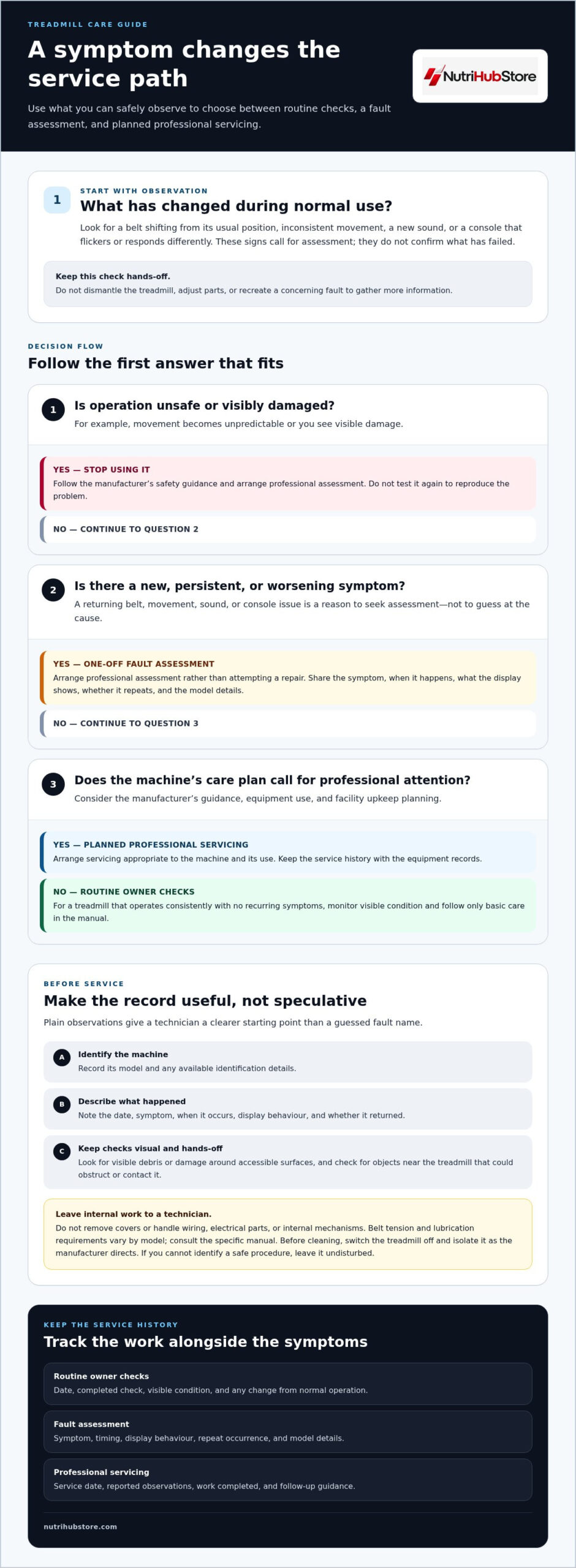
Watch for a belt that shifts from its usual position, moves inconsistently, or makes a new sound during normal use. A display that flickers or responds differently also merits attention. If a symptom returns, record it rather than assuming what caused it. Stop using the treadmill if its movement becomes unpredictable or you see visible damage.
Why early observations matter at home and in gyms
Note when the change occurs: during startup, at a particular speed, or after a specific use. Record the date, the symptom, and whether it returned. “Belt movement became uneven during use” gives a technician a clearer starting point than “the treadmill feels wrong.” Don’t recreate a concerning fault just to collect more information.
At home, a recurring issue can make you wary of using the treadmill. In a gym, it can leave a machine unavailable or affect how users share equipment. A clear record helps distinguish a one-off observation from a recurring pattern and supports equipment planning. For treadmill servicing Dubai, those notes also make a professional assessment more focused without treating a symptom as a diagnosis. If the issue persists, arrange professional equipment servicing instead of attempting an internal repair.
How to check a treadmill safely before arranging service
A pre-service check should give a technician useful information, not create another problem. Limit it to what you can see and observe. Don’t remove covers, reach inside the machine, or adjust parts. Consult the treadmill’s manual before carrying out maintenance.
Before cleaning, switch the treadmill off and isolate it as directed by its manufacturer. If you can’t identify a safe procedure, skip the cleaning and leave the machine undisturbed until it can be assessed.
A simple pre-service treadmill inspection
Record the treadmill’s model and any available identification details. Then note the symptom, when it occurs, what the display shows, and whether it repeats. Keep the check visual and hands-off:
- Look for visible debris or damage around the belt and accessible surfaces.
- Check the surrounding area for anything that could obstruct or contact the treadmill.
- Observe the console and controls without repeatedly testing a machine that behaves unpredictably.
- Write down the date and what you noticed, using plain descriptions instead of guessed fault names.
These observations help make a service discussion more precise, but they don’t establish what has failed.
What owners should leave to a technician
Don’t open the motor compartment or handle wiring, electrical parts, or internal mechanisms. Belt tension and lubrication requirements vary by model. Use the specific manual rather than applying a generic adjustment or lubricant. Persistent movement, motor, control, or electrical symptoms need professional assessment.
If the treadmill shows visible damage or behaves unpredictably, stop using it and follow the manufacturer’s safety guidance. Don’t try to recreate the fault for more detail. A clear record is safer and more useful than further testing.
For professional treadmill servicing, share the model details and symptom notes so the assessment can start with useful observations. If you’re also planning wider equipment needs, browse gym equipment options.
Routine treadmill care, repairs, or ongoing maintenance?
A treadmill that runs quietly today still needs an appropriate care plan. The right response depends on its condition, how often it is used, and the manufacturer’s recommendations. Routine checks help you notice changes; they don’t replace repairs or professional servicing.
| Approach | Trigger | Suitable action | What to record |
|---|---|---|---|
| Routine owner checks | Scheduled observation under the machine’s manual, or ordinary cleaning and care. | Follow only the manufacturer-approved basic care steps. Keep the check visual and don’t adjust internal parts. | Date, completed check, visible condition, and any change from normal operation. |
| One-off fault assessment | A new, persistent, worsening, or safety-related symptom. | Stop use if operation seems unsafe and arrange professional assessment rather than attempting a repair. | Symptom, when it occurs, display behaviour, whether it repeats, and model details. |
| Planned professional servicing | Manufacturer guidance, equipment usage, or facility upkeep planning indicates a need for professional attention. | Arrange equipment servicing appropriate to the machine and its use; keep the service history with its records. | Service date, reported observations, work completed, and any follow-up guidance. |
When are routine checks enough?
Routine checks suit a treadmill that operates consistently and has no recurring symptoms. Use them to monitor visible condition and complete only the basic care described in the manual. A single checklist or schedule won’t suit every model. Let the manufacturer’s recommendations and the machine’s actual use guide maintenance timing.
When should a treadmill receive professional assessment?
Move beyond routine observation if a symptom returns, becomes more pronounced, or affects safe operation. Don’t keep testing a machine with unpredictable movement or an apparent electrical issue. Record what happened and arrange professional assessment. Treat the observation as a symptom, not a diagnosis, and leave internal repairs to a technician.
Nutrihub Store provides equipment servicing for homes and facilities when a treadmill needs attention beyond owner checks. For facilities, recurring equipment needs can also inform broader gym setup and facility planning. For treadmill servicing Dubai, match the response to what you’ve observed: monitor stable operation, document changes, and escalate persistent or safety-related faults.
Build a treadmill servicing routine that fits your equipment
A maintenance log is useful only if people can understand and update it. Keep the process straightforward: consult the manual, observe the treadmill, record what you find, and review the notes for recurring patterns. Let the manufacturer’s instructions and actual use guide maintenance timing. A home treadmill and a shared facility machine may have different demands.
Create a useful treadmill maintenance log
Use a notebook or digital record, but keep the details consistent. For each treadmill, capture:
- Identification: model and any available serial or asset details.
- Usage context: home or facility use, plus relevant changes in how the machine is used.
- Observations: date, symptom, when it occurs, and whether it has returned.
- Actions: checks completed according to the manual, service visits, and any follow-up guidance.
In a facility, identify the specific treadmill instead of writing “treadmill” in a shared log. Record similar symptoms on separate machines individually. That makes it easier to tell whether an issue appears isolated or across several units. Keep the manual and service history accessible to whoever manages the equipment.
Prepare clear information for a service assessment
Describe what happened, not what you think caused it. For example, write “belt movement became uneven during use and the symptom returned” rather than naming a faulty component. Include when it starts, what the display shows, whether it repeats, the model details, and relevant maintenance or service notes.
This record gives professional equipment servicing a clearer starting point. Nutrihub Store provides equipment servicing for treadmill and wider gym equipment needs. If symptoms persist, worsen, or raise a safety concern, stop using the machine and arrange professional assessment rather than attempting internal repairs. Consistent records also make treadmill servicing Dubai easier to plan around the equipment’s condition and use.
Review each machine’s log against its manual and make the next action clear: continue approved routine care, monitor a stable observation, or arrange service. Good records support better decisions, but they don’t replace a technician’s assessment.
Keep treadmill servicing connected to broader gym equipment care
A recurring treadmill issue can inform equipment planning, even when it affects only one machine. Facility managers can compare service records across equipment to identify where attention may be needed. Similar symptoms don’t prove a shared cause, so treat each record as evidence to review, not a diagnosis.
What facility managers can learn from recurring treadmill issues
Review logs together when planning equipment upkeep. Note which treadmill is affected, how often the symptom has appeared, whether it has changed, and what action followed. Record a similar symptom on another machine separately. A technician’s assessment can establish whether the cases are connected.
This approach helps managers prioritize attention based on observed condition and equipment use, rather than relying on memory or waiting until a machine becomes unusable. It can also support decisions about equipment availability while an issue is assessed. Keep each treadmill’s record alongside broader gym equipment servicing notes so recurring needs remain visible between service visits.
Choose a clear next step for your treadmill
If the treadmill operates consistently, continue only the routine care described in its manufacturer’s manual and keep its record current. If a symptom returns, worsens, or raises a safety concern, stop using the machine when appropriate and arrange professional assessment. Nutrihub Store provides equipment servicing for maintenance needs at homes and facilities, helping turn recorded observations into a clear service discussion.
Before arranging service, gather the treadmill’s model details, symptom notes, and relevant maintenance history. Facility managers can add observations about other equipment, but shouldn’t assume the machines share a fault. This context helps connect one treadmill’s needs with wider maintenance planning.
If your equipment needs extend beyond servicing, explore the fitness and equipment shop for relevant gym products. Start with the record, then choose the next step that fits the machine’s condition.
Keep your treadmill ready for the next workout
A treadmill can remain in use while an early warning sign develops, so maintenance should start with observation, not guesswork. Watch for changes in belt tracking, movement, sound, or console response. Follow the manufacturer’s guidance and don’t attempt internal repairs.
A simple record turns symptoms into useful service information. Note the machine’s model, when an issue occurs, whether it returns, and any relevant maintenance history. Stable operation supports continued routine care. Persistent, worsening, or safety-related symptoms call for professional assessment. Nutrihub Store provides professional gym equipment servicing, along with gym setup and sports flooring support for wider facility needs.
For treadmill servicing Dubai, keep your notes accessible, act on recurring symptoms, and arrange professional servicing when a treadmill needs attention beyond routine checks. Consistent records help you make informed equipment-care decisions and keep training plans on track.
When routine checks aren’t enough, use your service record to arrange equipment servicing with Nutrihub Store.
Frequently Asked Questions
How often should a treadmill be serviced?
Follow the maintenance guidance in your treadmill’s manual and account for how heavily the machine is used. A shared facility treadmill may have different demands from one used at home, so a fixed interval won’t suit every model or setting. Record routine checks and service history, then review them against the manufacturer’s recommendations. Arrange professional assessment sooner if you notice recurring symptoms or a change in performance.
What are the signs that a treadmill needs servicing?
Changes in belt tracking, inconsistent movement, new noises, or unusual console behaviour are reasons to pay attention. A single observation may not return, but a symptom that repeats or worsens deserves assessment. Stop using the treadmill if its movement becomes unpredictable or you see visible damage. These signs describe a problem; they don’t confirm which part has failed. Record what happened and when instead of guessing at the cause.
Can I service a treadmill myself?
You can carry out visual checks and basic care only when the manufacturer’s manual describes them. Stick to observable areas, and switch off and isolate the treadmill as directed before cleaning. Don’t remove covers, work on electrical components, or adjust internal parts. Belt tension and lubrication requirements vary by model, so avoid generic instructions. Leave repairs and persistent faults to professional service technicians, and stop using the machine if it appears unsafe.
What should I check before arranging treadmill servicing?
Note the treadmill’s model and any available identification details, then describe the symptom in plain language. Record when it occurs, what the display shows, and whether it has happened again. Look only at accessible areas for visible debris or damage. Don’t remove covers or test a machine that behaves unpredictably. For treadmill servicing Dubai, these notes provide useful context without presenting a suspected cause as a diagnosis.
Why does a treadmill belt slip or move off-centre?
A slipping or off-centre belt can have several possible explanations, and observation alone can’t identify the cause. Note whether the belt shifts consistently or only during particular use, but don’t adjust its tension unless the manufacturer’s manual specifically guides that task. An incorrect adjustment may create further problems. If the movement continues, worsens, or feels unsafe, stop using the treadmill and arrange professional assessment.
Is regular treadmill maintenance necessary for a home gym?
Yes. A home treadmill still needs attention guided by its manual and actual use. Routine observation can help you notice changes before they interrupt a workout, while a simple log keeps symptoms and completed care from relying on memory. Follow only the maintenance steps approved for your model. If a fault returns or affects safe operation, routine care isn’t a substitute for professional equipment servicing.
What information should I give a treadmill service technician?
Share the treadmill’s model and any available identification details, along with a plain description of the symptom. Explain when it starts, what the display shows, and whether it repeats or has changed. Include relevant maintenance and previous service notes. Avoid naming a component as faulty unless a professional has assessed it. Clear observations help the technician understand what you’ve noticed and provide a focused starting point for the assessment.