


A maintenance contract can look complete on paper and still leave a facility unsure who handles a recurring treadmill fault or records a safety check. A gym maintenance contract UAE facilities can rely on should turn expectations into clear, trackable work, not just a schedule of visits.
Equipment faults interrupt workouts and daily operations. If terms such as “routine servicing” don’t specify which machines, tasks, repairs, or reports are covered, it’s hard to plan. A practical agreement should reflect the facility’s equipment and usage, then define the work and recordkeeping.
Start with the equipment, layout, and floor surfaces, then spell out the service tasks and records staff need to track completed work. NutrihubStore.com provides equipment servicing, gym setup, and fitness and sports flooring solutions, connecting equipment care with the wider needs of a facility. Identify the machines that matter most to member access, then define how their condition will be monitored.
Key Takeaways
- A gym maintenance contract UAE facility operators can manage should spell out the work, reporting, and responsibilities, not rely on broad promises.
- Build an asset list so service coverage reflects the equipment members use and the way the facility operates.
- Separate routine servicing from fault repairs and replacement decisions to avoid gaps in expectations.
- The illustrative scenario below shows how a reactive repair pattern can shift toward a planned maintenance process.
- Prepare operating priorities and existing service records before assessing whether a maintenance arrangement fits your gym.
What a Gym Maintenance Contract in the UAE Should Actually Solve
A fitness facility can stay open while a faulty treadmill, loose cable, or noisy cycle disrupts members’ routines. The doors are open, but some equipment isn’t ready to use. A gym maintenance contract UAE operators can manage should address that gap by setting out how equipment care is planned, recorded, and handled when faults arise.
A gym maintenance contract is an ongoing framework for inspecting and servicing equipment, documenting work, and clarifying how faults are managed. It gives the facility and its service team a shared reference point. It doesn’t guarantee uninterrupted access or mean every repair and replacement is included.
The right arrangement depends on what the facility owns, how often members use each machine, and which equipment matters most to daily operations. A commercial gym with heavily used cardio machines may prioritise those assets differently from a workplace fitness room with a smaller equipment mix. Floor surfaces and layout can also affect access for inspection and servicing.
How ongoing maintenance differs from one-off gym equipment repair
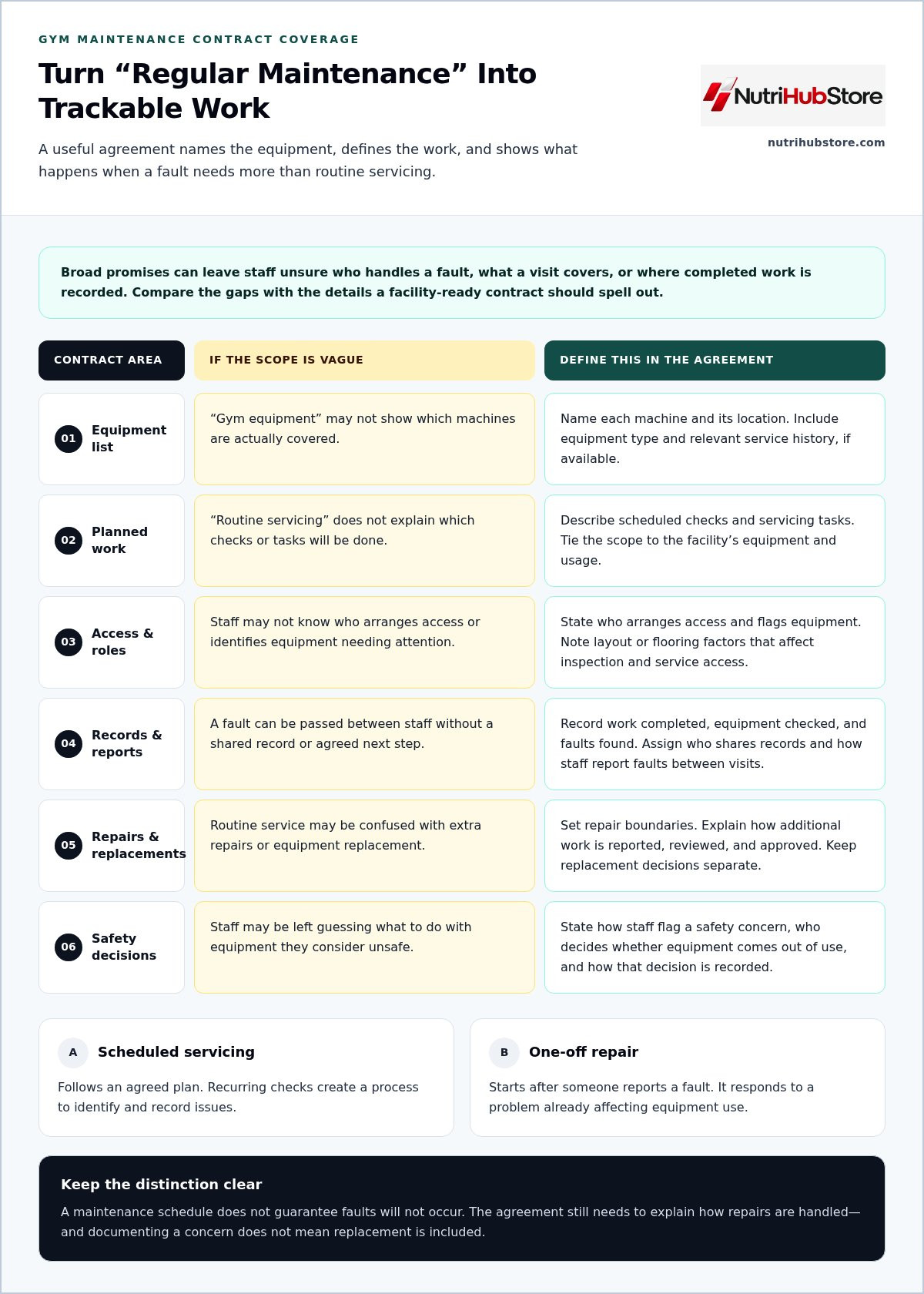
Scheduled inspection and servicing follow an agreed plan and may include checking equipment condition and carrying out defined maintenance tasks. One-off repair starts after someone reports a fault. The approaches serve different needs: scheduled work creates a recurring process, while repair responds to a problem already affecting use.
Recurring checks give staff a chance to identify and record issues, then decide what action is needed. That is the practical role of preventive maintenance. A schedule can’t guarantee that faults won’t occur, however, so the agreement still needs to explain how repairs are handled.
Which facility problems a contract can help manage
For commercial gyms, workplace facilities, and other fitness spaces, equipment faults are only part of the challenge. Staff may not know who owns the next step, whether a machine has already been inspected, or where its service history is recorded. A clear contract can assign responsibilities and define what information gets recorded after scheduled work or a reported fault.
Those records help facility teams see what work took place and what still needs attention. They also provide a basis for reviewing recurring issues and discussing repair or replacement decisions, rather than treating each service visit as an isolated event.
One-off repairs may suit a facility with limited equipment or occasional servicing needs. A recurring agreement may suit operators who want a defined maintenance process. Judge each option by how well its scope matches the equipment mix, usage patterns, and operating priorities, not by the promise of a contract alone.
What Gym Maintenance Contract Coverage Should Include
A contract can promise “regular maintenance” and still leave staff unsure whether a specific treadmill, fault report, or repair falls within scope. For a gym maintenance contract UAE facility teams can manage, the agreement should identify the equipment covered, define planned work, and explain how faults and follow-up decisions will be recorded.
Set a clear equipment inventory and service scope
Start with an asset list that names each machine and its location. Include the equipment type and relevant service history, if available. List each treadmill and other cardio machine individually rather than using a broad label such as “gym equipment.” Staff can then see which assets the agreement covers.
Next, describe the scheduled checks and servicing tasks without relying on vague phrases. State who arranges access and identifies equipment that needs attention. If the layout or flooring affects how technicians reach or work around equipment, include that context. A scope tied to the facility is easier to review than a generic list of visits.
For a broader look at planning care around gym equipment, see Gym Equipment Servicing in the UAE: A Practical Facility Guide. NutrihubStore.com also provides gym equipment servicing and setup solutions as part of its gym infrastructure offering.
Specify records, reporting, and repair boundaries
A maintenance log should show what work took place, which equipment was checked, and any faults identified. The agreement should say who records and shares this information, and how facility staff report a problem between scheduled visits. Clear reporting prevents a fault from being passed between staff without an agreed next step.
Draw a firm line between routine servicing and additional repair work. Explain how the service team reports a fault that needs attention beyond agreed tasks, who reviews the recommendation, and how approval works before extra work proceeds. Keep replacement decisions separate too: a contract can document a concern without implying that equipment replacement is included.
Keep safety responsibilities clear. State how staff should flag equipment they consider unsafe, who decides whether it should be taken out of use, and how that decision is recorded. Specific wording gives staff a usable process instead of leaving them to guess what a maintenance visit covers.
A Gym Maintenance Contract Case Study: From Reactive Repairs to a Planned Process
A planned process makes service history easier to follow, but it doesn’t prove that breakdowns have fallen or uptime has improved. The scenario below is illustrative, not a documented customer outcome.
An illustrative facility challenge
Imagine a workplace gym where staff report equipment faults as they appear. A treadmill concern gets passed between shifts, while other machines have no consistent service record. The facility remains open, but staff can’t readily tell which equipment has been checked, what work took place, or whether a reported issue still needs follow-up.
The problem isn’t a documented number of hours lost. It’s the lack of a shared process. Without an asset list and clear reporting responsibilities, staff may have to piece together equipment history from scattered notes or memory.
Turning reports into a planned process
The facility could start by listing each machine, its location, and any available service history. It could then define which equipment receives scheduled servicing, what those tasks cover, who logs completed work, and how staff report faults between visits. A fault that needs additional repair work would be recorded separately, with a clear approval step before that work proceeds.
This approach creates a traceable process, not a guaranteed result. A maintenance log shows what was inspected and which concerns remain open, but it can’t establish a measurable reduction in faults unless the facility records and compares evidence over time. Planned servicing also doesn’t mean every repair or replacement decision falls within the agreement.
For a focused equipment example, Treadmill Servicing: Maintenance Guide for UAE Facilities can help operators think through care for a common cardio machine. The same principle applies across the asset list: define the equipment, the agreed work, and the path from a reported fault to a decision.
A gym maintenance contract UAE facility teams can use should make that path clear. Set out who records service work, who reviews reported concerns, and how decisions about taking equipment out of use are documented. Clear responsibilities help staff follow the process without assuming every repair or replacement is included.
How to Evaluate a Gym Maintenance Contract Before Committing
A low headline price or a promise of “complete coverage” won’t tell you whether a contract fits your facility. Before committing, check whether its scope reflects the equipment you operate, how members use it, and how your team will handle service records and faults. That’s the practical test for a gym maintenance contract UAE facility managers can work with.
Match service planning to equipment use and facility needs
Start with an asset list. Record each machine’s type and location, then note available service history and how the equipment supports daily operations. A heavily used treadmill may need different attention from equipment used occasionally in a workplace fitness room. These details give both sides a sound basis for setting the servicing plan.
Next, describe operating priorities: which equipment matters most to member access, how staff report issues, and what access or layout considerations could affect servicing. Include the floor context too. Equipment placement, access around machines, and the surface beneath them can inform facility planning, but a maintenance agreement isn’t a flooring specification. For a deeper look at surfaces, refer to Fitness Flooring UAE: The Technical Guide to Gym Facility Surfaces in 2026.
There’s no universal inspection interval that suits every facility. Set the agreed frequency according to the contract’s scope and the equipment’s use, rather than applying an arbitrary schedule to every machine.
Review responsibilities, records, and contract boundaries
Compare the scope against your asset list. Are the covered machines identifiable? Does the agreement explain what scheduled servicing includes, who reports a fault, and who records completed work? If a technician identifies a problem outside routine servicing, the agreement should clarify the reporting and approval steps before extra work proceeds.
Check the contract’s boundaries as carefully as its promises. Routine servicing, repair work, and replacement decisions are different responsibilities. Unclear wording can leave staff uncertain about what happens next. Review exclusions and confirm that service records will help your team track open faults and past work.
Before signing, check that the contract identifies covered assets, planned tasks, reporting and record responsibilities, approval steps for extra repairs, and exclusions. If any details remain vague, request clearer wording before treating the agreement as an operating plan.
Plan Gym Equipment Maintenance with NutrihubStore.com
A servicing plan is useful only when it reflects the equipment your facility actually runs. Nutrihub Store provides gym equipment servicing, gym setup, and fitness and sports flooring solutions, helping operators consider equipment care within the wider facility context.
Prepare a practical brief for your facility’s equipment servicing
Before arranging ongoing servicing, prepare a brief that makes the facility’s needs clear. Include an asset list with each machine’s type and location, then add known faults and available service records. Note which equipment is central to daily operations and how members typically use it. Specific details help shape a service scope around the facility instead of relying on a generic description.
- Equipment: List cardio and strength machines individually, with locations.
- Known issues: Record reported faults and whether they remain unresolved.
- Operating priorities: Identify equipment whose condition directly affects member access.
- Existing records: Gather service logs, previous repair notes, and outstanding recommendations.
- Facility context: Note layout or floor surface details that may affect access around equipment.
This preparation gives facility operators a firmer starting point for discussing a gym maintenance contract UAE arrangement. It also helps separate planned servicing from additional repair work, so responsibilities and approval steps are clear rather than left to assumption.
Turn your priorities into a defined service scope
Use the brief to identify which equipment needs attention, what the facility considers a priority, and what information staff need after service visits. Existing records can show what has already been addressed and where questions remain. The scope can then reflect the equipment mix, usage patterns, layout, and floor surfaces without assuming every gym needs the same plan.
For broader planning that connects equipment with facility design, refer to Comprehensive Gym Setup Services in the UAE: Building Performance Facilities. Gym setup and flooring decisions can affect how equipment is arranged and accessed, while ongoing equipment servicing addresses care after the facility is in use.
Bring your inventory, operating priorities, and service history together before defining the work. A clear brief makes it easier to set out what your facility needs and where the service scope ends.
Turn Equipment Care into a Clear Plan
A useful gym maintenance contract UAE facility teams can manage starts with a clear picture of the equipment, operating priorities, and service history. Its value lies in defining what routine servicing covers, how faults are reported, and who handles repair or replacement decisions.
Keep the agreement grounded in your facility. An asset list connects planned care to the machines members use, while clear records make completed work and unresolved issues easier to track. Review the scope against your layout and floor surfaces too, especially where equipment access affects servicing.
NutrihubStore.com provides professional gym equipment servicing, along with gym setup and fitness and sports flooring solutions. Consider equipment care as part of the wider facility plan, rather than a series of disconnected fixes. Start with your inventory and priorities, then turn them into a practical servicing brief.
Bring your equipment inventory and servicing priorities to NutrihubStore.com to plan your gym equipment servicing, setup, or flooring needs.
Frequently Asked Questions
What should a gym maintenance contract include?
A useful contract should identify the equipment it covers, planned servicing activities, recordkeeping, reporting responsibilities, and how faults are handled. For example, it should distinguish scheduled work on a treadmill from additional repair work after a fault appears. It should also state exclusions and clarify approval steps for work outside the agreed scope. Tailor the details to the facility’s equipment mix and operating priorities rather than assuming every agreement covers the same tasks.
Is a gym maintenance contract worth it for a small facility?
It depends on the equipment, its usage, and the facility’s need for planned servicing and maintenance records. A smaller gym may have fewer machines, but a fault in equipment members rely on can still interrupt planned use. Identify the assets that matter most, then compare the contract’s scope and recordkeeping with your needs. Facility size alone won’t tell you whether an ongoing agreement is a practical fit.
How often should gym equipment be serviced under a contract?
There isn’t one servicing interval that suits every machine and facility. The schedule should reflect the equipment inventory, usage patterns, operating requirements, and agreed scope. Make sure the written contract states when planned servicing takes place instead of relying on verbal assumptions. For equipment-specific intervals, use relevant documented recommendations for those assets. Avoid applying a universal schedule when machines differ in type, use, and maintenance needs.
Can a gym maintenance contract cover repairs as well as servicing?
Yes, an agreement can describe both, but routine servicing and repair work aren’t automatically the same scope. Read the terms to see which tasks are included, how staff should report faults, and what happens when a problem needs work beyond planned servicing. The contract should also state who reviews recommendations and approves additional work. This clarity helps facility teams understand their responsibilities when a fault appears between scheduled visits.
What happens if gym equipment breaks between scheduled maintenance visits?
The contract should explain how staff report the fault, who receives or reviews the report, and how additional work is approved. Record the affected machine and the issue so the facility can track follow-up. Don’t assume an ongoing servicing agreement includes every repair or replacement. The written terms should define those boundaries. Response times and repair outcomes depend on the specific agreement, so don’t treat them as automatic features of a maintenance contract.
How do I compare gym maintenance contracts in the UAE?
Compare the covered equipment, planned servicing tasks, schedule, maintenance records, reporting responsibilities, and boundaries around repairs. Then assess whether the written scope reflects your facility’s actual use and priorities. A gym maintenance contract UAE operators can manage should make these details clear, not rely on broad promises or headline terms. Compare agreements against the same asset list so you can spot gaps in coverage and differences in responsibilities.