


The toughest-looking surface can still be the wrong floor for a sports venue. Choosing sports facility flooring UAE operators can rely on means looking beyond material names: a court, weight-training area, and multipurpose studio place different demands on traction, impact response, and upkeep. Which surface fits your activities, traffic, and maintenance capacity? Heat, humidity, ventilation, and subfloor preparation can also affect the choice, so assess the room and installation conditions before settling on a product.
Durability matters, but it won’t tell you whether a surface suits the movement, equipment, and cleaning routine in each zone. Use this comparison to shortlist options by activity, weigh impact and traction against maintenance, and identify installation questions to settle before requesting a proposal. Ask suppliers for product-specific information and care instructions instead of relying on broad claims. A zone plan and site notes will also help you discuss flooring options and gym setup support in the context of your facility.
Key Takeaways
- Start your sports facility flooring UAE shortlist by matching each surface category to the activity and demands of its zone.
- Compare rubber flooring, interlocking tiles, vinyl sports flooring, and artificial turf by intended use, impact needs, traction, and upkeep.
- Assess indoor conditions, including heat exposure, humidity, ventilation, and cleaning routines, before judging a surface’s suitability.
- Compare supplier proposals using written product data, installation scope, care guidance, and exclusions, not broad performance claims.
- Use your zone plan and site notes to discuss flooring options and gym setup support with a potential provider.
Sports facility flooring UAE: start with the activity, not the material
Choosing a floor by appearance or material name can leave a venue with a surface that doesn’t suit how people use the room. Sports facility flooring is the surface selected for the activities it must support. For sports facility flooring UAE projects, begin with a zone plan rather than a catalogue. Mark what happens in each space, what equipment is used, and how the area is cleaned.
A gym training area may need to handle equipment and repeated loading; a court has sport-specific movement and ball-response demands. A multipurpose room may host changing activities, while circulation areas face regular foot traffic rather than the same training loads. These differences matter. Don’t assume one surface will suit every sport, room, or format.
The broad idea of a performance surface includes factors such as traction and shock absorption. For a deeper look at fitness-flooring fundamentals, consult the technical guide to fitness flooring.
Which activities will the floor need to support?
List each zone’s primary activity, equipment, and expected user groups before comparing surfaces. Note whether people will lift weights, join group exercise, play court sports, or move equipment between sessions. Also record whether the room has a fixed layout or needs to change between activities. These details help suppliers assess actual use instead of recommending a surface based on a broad label such as “gym flooring.”
Weight training can involve concentrated loads and equipment contact. Group exercise involves repeated movement across a shared area, while court sports have their own traction and playing characteristics. Those demands differ, so ask suppliers to explain how a proposed surface fits each activity. Don’t accept “suitable for all sports” without product information that relates to your use case.
What does facility use reveal about flooring priorities?
A commercial gym may focus on how training zones handle equipment and routine cleaning. A school may need to account for varied activities and frequent room use. A hotel fitness room may have a different equipment layout and user pattern, while a multipurpose facility must weigh the needs of activities that share the same space.
Separate fixed-use rooms from flexible ones. A room dedicated to one sport can be assessed against that activity. A room used for classes, court games, or changing equipment layouts needs a proposal that addresses those transitions. Document expected use, including how often the room changes function, rather than relying on assumptions.
Choose flooring to match documented room use, not a material label. Record activities and equipment by zone, then ask suppliers to connect their recommendations to those requirements.
Compare sports facility flooring materials by performance trade-offs
A material name alone won’t tell you whether a floor can handle your room’s activity. For sports facility flooring UAE projects, compare each proposed surface against intended use, impact demands, traction, cleaning routines, and installation conditions. Treat performance statements as claims to verify against current manufacturer documentation for the exact product, rather than assuming products in the same category perform alike.
| Surface category | Intended use to assess | Impact and traction questions | Upkeep and supplier questions |
|---|---|---|---|
| Rubber flooring | Could it suit the planned gym or training zone? | Ask for product-specific information on impact response and grip for the intended activity. | What cleaning methods are recommended? How does the product handle the planned equipment and traffic? |
| Interlocking tiles | Could a tile format fit the room and its equipment layout? | Confirm how the surface finish and installation affect stability and traction. | How are edges, joins, and the subfloor handled? What care instructions apply? |
| Vinyl sports flooring | Consider it where the activity and room use call for a sports floor in sheet or tile form. | Request relevant data for the sport, including traction and any stated ball response or impact performance. | Ask about cleaning products, installation scope, and subfloor preparation. |
| Artificial turf | Assess it only for activities suited to a turf surface. | Ask how the product’s documented surface characteristics match movement and use in that zone. | Confirm routine care, installation requirements, and any limitations in the supplier’s documentation. |
How do rubber flooring and interlocking tiles differ?
Rubber describes a material category; interlocking tiles describe a format. A tile may use rubber, but the format alone doesn’t establish whether it suits a training area. Start with the activity and compare the exact products under consideration. Check product thickness, surface finish, tile design, and installation method instead of assuming all rubber floors or tile systems perform alike. See this guide to rubber flooring for gyms and the interlocking gym tile installation guide for focused discussions.
When should a facility assess other sports surfaces?
Consider vinyl or artificial turf when the planned sport or training format makes that category relevant. For court use, request sport-specific information on traction, ball response, and impact. For turf, ask which activities the product is designed to support and what routine care it requires. Performance varies by product, subfloor, and installation, so don’t transfer one product’s claims to another.
Nutrihub Store offers fitness and sports flooring alongside gym setup support. Once you’ve defined the zones and questions for suppliers, review fitness and sports flooring options and confirm which materials and installation options are currently available.
How to evaluate sports flooring for UAE facility conditions
A floor can meet a supplier’s general description and still be a poor fit for the room it will cover. Buyers considering sports facility flooring UAE should assess the actual site and compare it with the product’s documented limits, rather than relying on broad claims about performance in a hot climate.
Indoor conditions vary. A fully enclosed training area, a room with direct sunlight, and a space near entrances or changing areas may face different heat, humidity, and moisture exposure. Ventilation and cleaning routines also shape what the surface encounters day to day. Record those details before asking suppliers to recommend a product.
Which site conditions should buyers document?
Walk each proposed flooring zone and note how it operates. Record whether it’s indoors, receives direct sunlight, or sits near doors and other areas where conditions may change. Include the cleaning products used, how often staff clean, and whether users bring moisture in from adjacent spaces. Note any known problems with the existing surface or subfloor as well.
Before requesting proposals, document each zone’s sunlight and heat exposure, humidity, ventilation, cleaning products and frequency, and likely moisture contact. Give suppliers the same information so their recommendations can be compared on a consistent basis. Ask them to confirm in writing whether the specific product and installation are suitable for those conditions, and to identify any limits or assumptions.
How should buyers compare durability and maintenance claims?
Request care instructions for the exact product, not general advice for a material category. Clarify which cleaning methods the manufacturer permits, which products to avoid, and who will handle routine inspections after handover. A surface described as durable still needs an appropriate care plan.
Ask what happens if a section becomes damaged. Can it be repaired in place, or might replacement involve adjoining areas? The answer may depend on the product and installation, so request the method and any relevant limitations in writing. Don’t assume a modular-looking surface is easy to replace or that a continuous floor can be repaired invisibly.
Separate evidence from sales language. Product data and manufacturer care documents relate to the specified product; a general statement such as “built for UAE conditions” may not explain exposure limits, cleaning requirements, or installation assumptions. Ask the supplier to connect each claim to written documentation, and flag gaps before comparing proposals. This gives your team a practical basis for assessing suitability, upkeep, and responsibilities after installation.
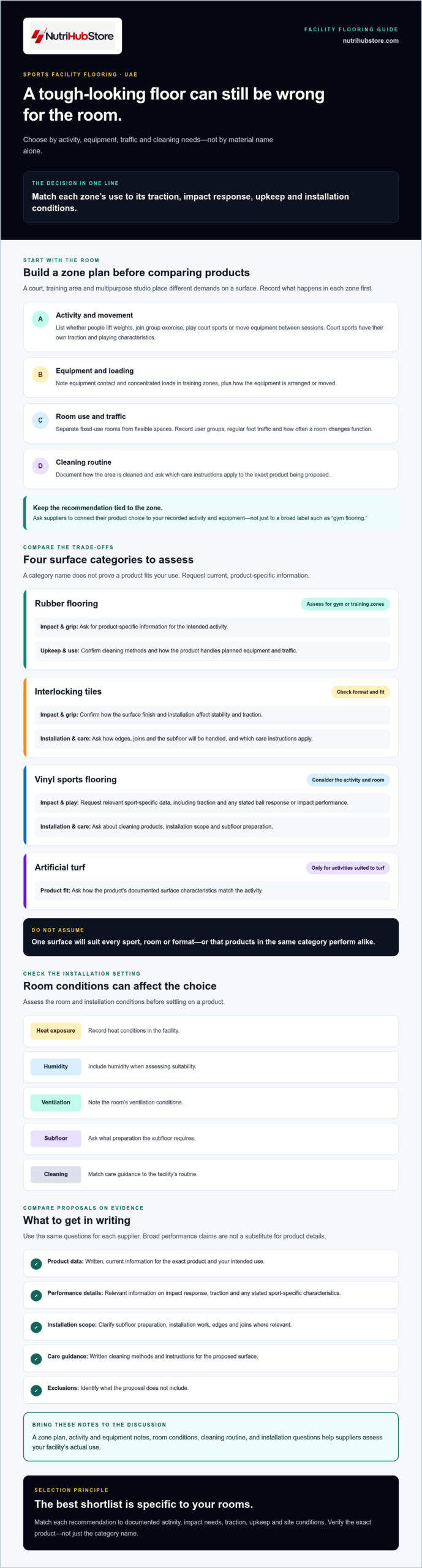
A practical checklist for comparing sports flooring proposals
A proposal can look complete and still leave important questions unanswered. For sports facility flooring UAE projects, compare the work in writing, not just the surface name or headline price. Give each supplier the same information and use the checklist below to spot differences in scope before choosing.
- Define the zones. List the rooms or areas to be covered and the activities planned for each.
- Document site conditions. Record the subfloor, access constraints, environmental conditions, and any existing surface issues you know about.
- Shortlist surfaces. Match options to each zone’s use, then check product documentation for relevant performance details.
- Compare proposals. Review product data, installation scope, subfloor assumptions, care guidance, exclusions, and project-specific pricing side by side.
- Confirm handover. Agree on what the supplier will provide at completion, including care instructions and any relevant product or installation documents.
What should a flooring quotation or proposal clarify?
Check that each proposal names the specified surface and the areas where it will be used. It should describe the installation scope, subfloor assumptions or preparation, maintenance guidance, and exclusions. Ask how the plan handles transitions between flooring types and edges adjoining other surfaces. If a proposal makes performance claims without supporting product documentation, request the relevant evidence before using those claims to compare options. Project-specific scope and pricing should come from a supplier proposal based on the facility’s requirements, not a generic estimate.
How can facilities plan installation with less disruption?
Identify which rooms need to remain accessible, any operating schedules the work must accommodate, and other facility tasks that need coordination. Ask the supplier to explain the preparation and installation sequence, what access is required, and what conditions must be met before the area can be handed back for use. Avoid relying on a fixed installation timeline before the supplier has assessed the site and confirmed the project scope.
Before accepting a proposal, check that it states what is included, what is excluded, and who is responsible for each handover requirement. Clear answers make supplier comparisons more useful and help you identify gaps before work begins.
Choose a sports flooring partner and define your next step
A useful flooring recommendation starts with evidence about your facility, not a broad request for “a durable floor.” Your shortlist should reflect the activities in each room, site conditions, maintenance priorities, and product documentation. For sports facility flooring UAE projects, those details help you ask focused questions and assess whether a proposed surface fits the job.
NutrihubStore.com offers fitness and sports flooring alongside gym setup support. Flooring can be considered as part of a wider gym setup, but confirm which materials and installation options are available, along with the proposed scope, before proceeding. Ask what options may suit your facility and what information the supplier needs to assess the request.
What should buyers share when asking for flooring guidance?
Prepare a short project brief before you enquire. Include the facility type, intended activities by room, room dimensions, and photographs that help show the existing space. Add what you know about the subfloor, access or operating constraints, and maintenance priorities. For example, note whether a room needs to stay in use during the project or whether cleaning routines restrict the products and methods your team can use.
Be clear about unknowns, too. A recommendation depends on the facility details and on which products and installation options are available. Ask the supplier to identify any assumptions that still need checking.
How does professional setup support fit into the decision?
If your project includes equipment as well as flooring, gym setup support may help you consider how the parts of the facility fit together. Share the planned room layout and equipment needs so the scope can be discussed in context. Keep service boundaries clear: equipment servicing is a separate offering, not an automatic part of flooring installation. Confirm responsibilities, installation details, and exclusions in the proposal.
Once you’ve gathered the room details and documented your priorities, use them to start a focused enquiry. Ask which fitness and sports flooring options are currently available and what further site information is needed before a recommendation can be made.
Turn your flooring shortlist into a clear project brief
A surface should earn its place in your facility. Start with the activities planned for each zone, then compare relevant options by impact, traction, upkeep, and the product information suppliers can provide.
For sports facility flooring UAE projects, site conditions matter as much as the material category. Document heat and moisture exposure, cleaning routines, and ventilation, then ask suppliers to confirm suitability and installation assumptions in writing. Clear proposals make it easier to compare scope, care requirements, exclusions, and handover details before you commit.
NutrihubStore.com offers fitness and sports flooring and gym setup services. Share your facility type, intended use, room dimensions, and known site constraints when asking about available options. A specific brief makes the next discussion more focused.
A well-prepared shortlist puts you in a stronger position to choose a surface that fits the work your venue needs to do.
Frequently Asked Questions
Which flooring is best for a sports facility in the UAE?
The best option depends on the activity, room conditions, and product documentation, not a single material label. A training zone with gym equipment has different requirements from a court or multipurpose room. For sports facility flooring UAE projects, record indoor heat exposure, humidity, sunlight, ventilation, and cleaning routines. Then ask suppliers to confirm in writing that the specific product and installation suit those conditions.
Is rubber flooring suitable for every gym or sports facility?
No. Rubber flooring may be worth assessing for some gym training areas, but that doesn’t establish that it suits court sports, group exercise, or every equipment layout. Check the product’s documented intended use, surface finish, impact information, and care instructions against the activities planned for the zone. Ask the supplier to explain any limitations, especially if the proposal makes broad claims about grip, durability, or suitability.
Are interlocking gym tiles a good choice for sports facilities?
They can be a candidate for some training spaces, but the interlocking format alone doesn’t guarantee a good fit. Tile design, thickness, surface finish, subfloor, and installation method can affect the finished floor. Ask for product-specific information and clarify how joins, edges, and transitions will be handled. Compare the proposed setup with the room’s activities and equipment rather than assuming every tile system is alike.
How do I choose sports facility flooring for different activities?
Start by listing each room’s activities, equipment, and typical users. Then identify the performance needs of each zone, such as impact response for training, traction for movement, or ball response for court use. Compare potential surfaces against those requirements and request supporting product information. Also consider cleaning routines and installation conditions. This zone-by-zone approach helps you avoid choosing one surface based only on the facility’s general label.
Can one flooring material work across an entire sports facility?
It may work in spaces with similar activities and operating conditions, but using one material everywhere can create compromises. A circulation area, weight-training zone, and court don’t necessarily need the same surface characteristics or care routine. Compare the benefits of a consistent floor with the needs of each room. If you choose one option across multiple zones, ask the supplier to confirm its suitability for each intended use.
What should I ask a sports flooring supplier before choosing?
Ask which activities the specific product is intended to support and request its relevant product data and care instructions. Confirm subfloor assumptions, preparation and installation scope, transition details, and exclusions. Ask how the supplier’s performance claims relate to your site conditions, including heat, humidity, sunlight, and cleaning practices. If the information is unclear or unsupported, request written clarification before treating the proposal as suitable.
How can I compare sports flooring proposals fairly?
Give each supplier the same zone plan, site information, and activity requirements. Compare proposals for the specified product, intended areas, product documentation, subfloor preparation, installation details, care guidance, exclusions, and handover requirements. Check whether each price covers the same scope, and ask suppliers to identify assumptions that could change it. A like-for-like comparison is more useful than ranking proposals by headline price alone.