


Pre-sleep casein can support overnight muscle protein synthesis, but it cannot make up for too little protein across the day. That distinction matters when considering micellar casein protein timing for overnight muscle repair: a serving before bed may keep amino acids available during sleep, but it does not guarantee greater muscle growth.
Conflicting advice about casein, whey, and bedtime snacks can make a simple nutrition choice feel complicated. The practical question is whether a pre-sleep serving fills a gap in your routine or adds a supplement you do not need. If your meals already cover your protein needs, the clock may matter less than your overall eating pattern.
What can pre-sleep casein realistically do, and how does it compare with whey or foods such as Greek yogurt and cottage cheese? It can be a useful option, especially around evening resistance training, but it is not a shortcut to recovery. The key is understanding what timing may change, where its limits lie, and which protein source fits your day.
Key Takeaways
- Treat micellar casein protein timing for overnight muscle repair as a routine choice, not a promise of greater muscle gain.
- Compare casein, whey, and dairy foods by convenience, digestion, and how well they fit your evening routine.
- Let your daily protein intake and meal schedule guide whether a pre-sleep serving adds value.
- Choose a serving size based on your needs and comfort rather than assuming one dose suits everyone.
- Weigh practical trade-offs such as taste, cost, and digestive comfort before adding a supplement.
Does Micellar Casein Before Bed Support Overnight Muscle Repair?
Bedtime protein may support muscle protein synthesis, but it cannot compensate for too little protein or energy across the day. That is the key distinction behind micellar casein protein timing for overnight muscle repair: a pre-sleep serving can help you include protein in your routine, but it does not guarantee faster recovery or bigger muscles.
Micellar casein is a form of casein, the main protein group in milk. It is generally digested more slowly than whey, although the pace varies with the food or drink and the person consuming it. Casein protein is part of milk’s protein structure and is used in food and nutrition products.
Muscle repair does not begin at bedtime or stop when you wake up. It is part of the body’s ongoing response to training, supported by sleep and adequate food intake. A pre-sleep protein choice only makes sense in that wider context.
What does overnight muscle repair actually mean?
Your muscles continually break down and rebuild protein. Resistance training increases the need for repair, while dietary protein supplies amino acids the body can use to build muscle proteins. Researchers often measure muscle protein synthesis, or the building side of this process. That measure is not the same as less soreness, greater strength, or visible muscle growth.
A plausible mechanism is not a guaranteed training outcome: amino acids available during sleep may support muscle protein synthesis, but they cannot promise faster recovery or more muscle.
Soreness can reflect several responses to exercise, and strength gains develop through repeated training and recovery. One change in meal timing will not determine either. Sleep quality, a suitable training plan, and enough food and protein over time all matter.
Why do people take casein before sleep?
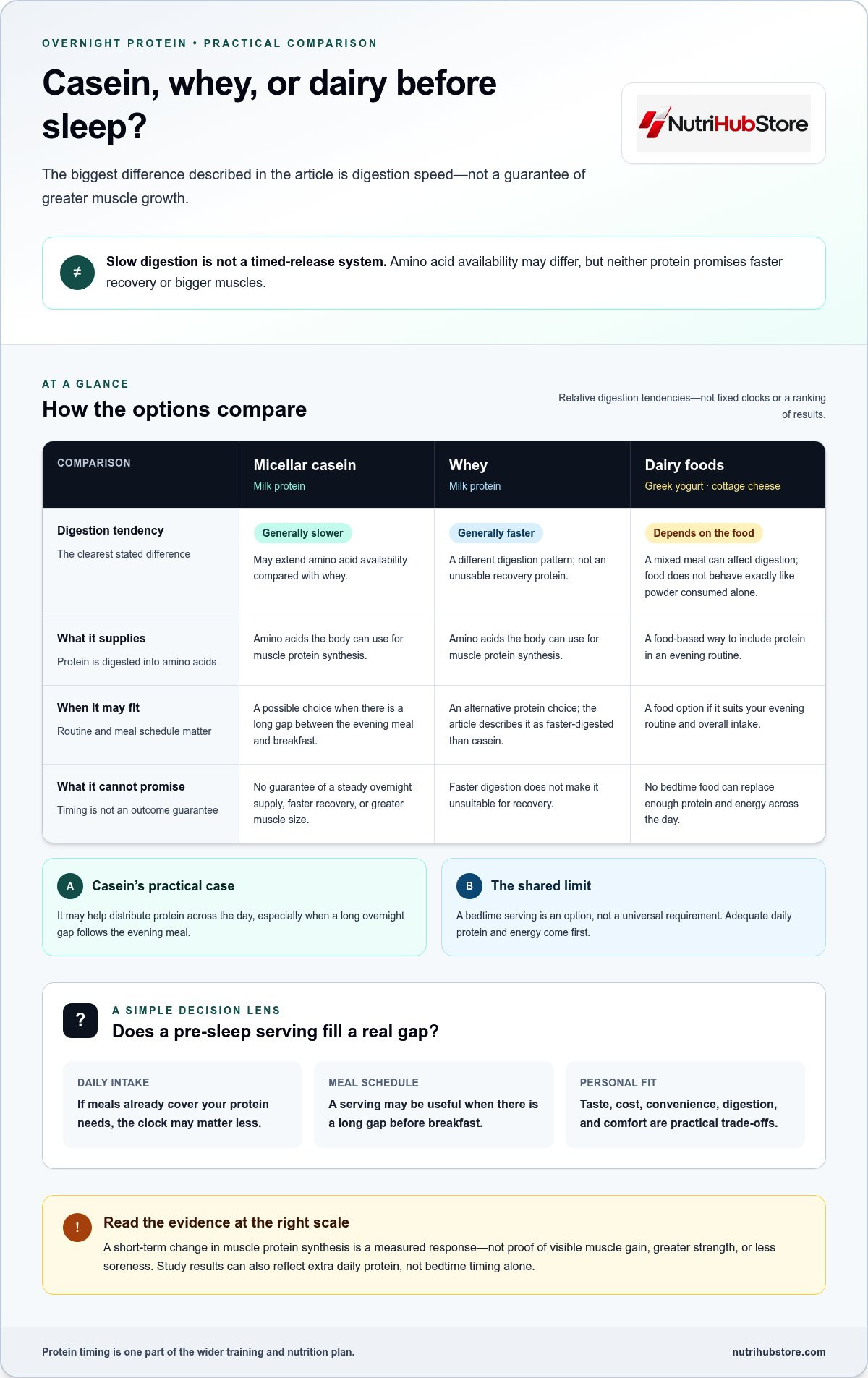
The rationale is straightforward: because casein is digested relatively slowly, eating it before bed may provide amino acids over a longer period than choosing a faster-digested protein. A pre-sleep serving can therefore help distribute protein across the day, particularly when there is a long gap between the evening meal and breakfast.
That mechanism does not settle the practical question for everyone. Research findings depend on factors such as the comparison group, participants’ age and training, and their total protein intake. If a study compares a protein drink with a non-protein placebo, any difference may reflect extra daily protein as well as bedtime timing.
So the useful question is not simply whether you can take casein before bed. Ask whether it fills a gap in your eating pattern. If your evening meal already provides protein and your overall intake is adequate, a late serving may offer little practical advantage. Bedtime intake is an option, not a universal requirement.
How Micellar Casein Digestion Relates to Overnight Protein Availability
Slow digestion describes a tendency, not a timed-release system. Micellar casein is often called slow-digesting because it tends to move through digestion differently from whey. It does not release amino acids at an identical rate in every person or guarantee a steady supply throughout the night. The rest of the meal, digestion, and individual differences all shape what happens after you eat.
As protein is digested, it breaks down into amino acids that enter the bloodstream. Muscles can use those amino acids for protein synthesis, the process of building muscle proteins. This makes overnight availability a plausible part of the case for casein, but it does not prove that casein before sleep produces greater muscle size or strength over time.
Casein’s slower digestion may extend amino acid availability, but it does not guarantee a specific overnight effect or lasting training result.
How casein differs from whey after consumption
Casein and whey are both milk proteins, but they tend to produce different digestion patterns: whey is generally digested faster, while casein is generally slower. These are relative descriptions, not fixed clocks. A mixed meal can affect digestion, so a protein powder consumed alone may not behave exactly like protein eaten with other foods.
Neither pattern makes one protein unusable for recovery. Both supply amino acids; the difference is how their availability tends to unfold after consumption.
What pre-sleep protein studies can tell us
Human studies can measure changes in muscle protein synthesis over a defined period after participants consume protein before sleep. Those results help explain a possible mechanism. On their own, they do not show that people will build more muscle or become stronger over months of training.
Study design matters. Researchers may compare a bedtime protein serving with a non-protein placebo, or compare different proteins. If one group consumes more protein overall, the result cannot automatically be credited to bedtime timing alone. Participants’ age, training schedule, and usual protein intake also affect how closely a finding applies to someone else.
A short-term increase in muscle protein synthesis is a measured response, not a direct prediction of visible gains. Longer-term studies can examine strength or muscle size, but outcomes reflect the full training and nutrition plan, not just one bedtime serving. For micellar casein protein timing for overnight muscle repair, the evidence supports a measured view: digestion can influence when amino acids become available, while the effect of timing on lasting results is less certain.
Compare the stated protein source and serving details across sports-nutrition products to judge how each option fits your overall intake and preferences.
Micellar Casein vs Whey or Food Before Sleep: Which Fits Better?
The best bedtime protein is one that fits your nutrition needs and feels comfortable to use. Casein’s slower digestion may appeal if you prefer a protein source that digests more gradually, but that does not make whey or ordinary food a poor choice. Convenience, taste, texture, and digestive comfort may matter more than the category name on the pack.
| Option | Convenience | Digestion considerations | Routine fit |
|---|---|---|---|
| Micellar casein | A powder can be quick to prepare. | Generally digests more gradually than whey, but not at a fixed rate. | May suit someone who wants a simple pre-sleep serving and likes its texture. |
| Whey | Can be convenient when already part of your routine. | Generally digests faster than casein; individual responses and meal context vary. | May fit if you enjoy its taste or prefer how you prepare it. |
| Protein-containing food | Requires choosing and preparing a food. | The whole meal affects digestion; dairy foods can provide casein. | May suit someone who prefers eating rather than mixing a powder. |
When casein may suit a bedtime routine
Casein can be practical if a shake fits easily into your evening and you like its slower-digestion rationale. But a powder you dislike is unlikely to become a consistent habit. Taste, thickness, fullness, and digestive comfort all affect whether it works for you. Casein does not uniquely trigger overnight repair; it is one way to add protein.
When whey or a food-based option may make more sense
Whey may be more comfortable if you prefer its flavour, texture, or preparation. Food may feel more satisfying: Greek yogurt and cottage cheese are examples of dairy foods that provide casein. These are options, not prescribed bedtime meals. If you are comparing powders, use a sports-nutrition product range as a starting point, then read each label rather than assuming every product in a category is alike.
Labels clarify what a serving provides and what else is in the product. Check the protein amount per serving, serving size, ingredients, and any components you know you do not tolerate. A “casein” label alone cannot tell you whether the flavour, texture, or preparation will suit you. The same applies to whey powders.
For micellar casein protein timing for overnight muscle repair, routine fit is a better guide than a blanket rule. If casein feels comfortable and helps you include protein, it can work. If whey or food fits your evening better, there is no need to switch just because bedtime is approaching.
How to Decide on Casein Timing, Serving Size, and Routine
A precise bedtime schedule will not fix a protein intake that is too low across the day. First decide whether casein adds anything useful, then consider the exact timing. This keeps micellar casein protein timing for overnight muscle repair in perspective: it is a routine choice, not a shortcut.
Start with total daily protein and meal pattern
Review your usual meals and snacks across a typical day. If dinner already includes a protein-rich food and you have eaten protein regularly, another serving before bed may not fill a meaningful gap. Also consider how protein fits into your wider sports nutrition and training routine.
- Assess your daily intake. Note your usual protein sources and portions before adding a supplement. The ISSN’s general range for exercising individuals is 1.4-2.0 g of protein per kilogram of body weight per day; this is a broad guideline, not an individual prescription.
- Check meal timing. Consider when you eat dinner and whether there is a long gap before breakfast. A bedtime serving may be convenient if your evening meal is early or light. It may be unnecessary if you have already had a substantial protein-containing meal.
- Choose an option you will use comfortably. Consider taste, texture, fullness, and how your stomach responds. A theoretically suitable powder is a poor fit if it disrupts sleep or feels unpleasant.
- Set serving size and timing from evidence and the label. Research protocols have often tested 30-40 g of casein about 30-60 minutes before sleep. Those are study conditions, not a universal dose or deadline. Check the product label for its serving directions and protein amount; grams of powder and grams of protein are not necessarily the same.
Fit timing and serving decisions to your routine
Think of pre-sleep intake as a convenient window, not a strict cutoff. If your schedule means you take protein earlier in the evening, do not assume the routine has failed. Consistent intake across the day matters more than arranging every serving around bedtime.
Pay attention to what happens in practice. If a serving leaves you too full, causes digestive discomfort, or is hard to tolerate, try a smaller amount within the product’s directions, take it earlier, or choose another protein source. Protecting sleep matters more than forcing a bedtime shake.
Decide in this order: assess daily protein, review meal timing, choose a comfortable source, then set a label-led serving and schedule. If you are still comparing options, base the decision on your nutrition pattern rather than expecting a specific result from the clock.
Choosing a Protein Strategy for Overnight Recovery
A bedtime shake is not the measure of a good nutrition routine. Start with the protein you get across the day, then add casein only if it fills a practical gap and suits your evening. No single powder guarantees recovery; training, sleep, and consistent eating still shape progress.
Consider the trade-offs plainly. A powder can be convenient, but its taste or texture may not suit you. Casein’s gradual digestion may appeal, while whey or protein-containing food may better match your preferences. Cost matters too: compare the serving information and overall value with foods you already enjoy, without assuming a supplement is necessary.
What to check on a protein product label
Read the label rather than relying on the category name. Compare the stated protein source, serving size, and protein amount per serving. Then review the ingredient and allergen information against your own needs and preferences. These details help you judge what you are choosing and whether it fits your routine, including any ingredients you prefer to avoid.
Use a protein-powder buying guide alongside the label if you need broader evaluation criteria. Focus on what the product provides and whether you will use it consistently, not claims that suggest a particular powder guarantees an outcome.
A practical takeaway for training and rest days
Your protein routine does not need to change dramatically on a rest day. If your usual meals support your daily intake, keep that pattern steady. Bedtime casein is not mandatory for muscle maintenance or progress, and skipping a shake does not erase the value of consistent training and nutrition.
If a bedtime serving is convenient and comfortable, it can be one way to include protein. If it adds unwanted fullness, digestive discomfort, or expense without solving a real gap, choose a food option or leave it out. The right strategy supports your overall intake without making your routine harder to maintain.
For micellar casein protein timing for overnight muscle repair, the practical decision comes down to fit, not a guaranteed effect. Readers comparing protein and other sports-nutrition choices can explore sports nutrition options.
Before adding another supplement, write down what you typically eat in a day and check whether a bedtime serving would fill a genuine gap.
Build a Routine That Works Beyond Bedtime
Make your next step practical: review your usual meals, note where protein already fits, and decide whether a pre-sleep option would solve a real gap. The goal is not to perfect the clock. It is to build a routine you can sustain without sacrificing comfort or sleep. That is the useful way to think about micellar casein protein timing for overnight muscle repair.
For an alternative protein option, Nutrihub Store retails Kevin Levrone Gold Whey. Apply the same standard to every choice: consider what fits your overall intake, preferences, and routine instead of expecting one supplement to replace consistent nutrition and training.
Start with meals you already enjoy, then add a supplement only if it makes your plan easier to follow. Choose an option that supports a steady approach to training and recovery.
Frequently Asked Questions
Can I take micellar casein on rest days?
Yes, you can take it on a rest day if it fits your usual eating pattern. For example, if dinner is early and you would normally have a protein-containing snack later, casein may be one option. If you are already eating enough for your needs and do not want another serving, there is no need to add one just because you trained the day before. Follow the product label.
Is micellar casein suitable for people with lactose intolerance?
It depends on the specific product and your tolerance, so do not assume every casein powder has the same lactose content. Check its ingredient and allergen statements for information relevant to you; if the label does not clarify a detail you need, do not guess. Milk allergy is different from lactose intolerance. For a diagnosed allergy, significant symptoms, or uncertainty about your situation, seek advice from a qualified healthcare professional.
Can micellar casein cause digestive discomfort before bed?
Yes, it may cause discomfort for some people, and a large-feeling serving close to bedtime can be unpleasant even if the ingredients are otherwise suitable. Notice whether fullness, bloating, or other symptoms affect your sleep. You do not need to force a shake into your routine. Check the label and directions; if discomfort persists or concerns you, stop using it and seek appropriate professional advice.
Can I mix micellar casein with hot liquid?
Check the specific product’s preparation directions before mixing it with a hot drink. Powders can differ: heat may change the texture or cause clumping, depending on the formulation. If the label does not mention hot liquids, use the stated preparation method rather than assuming it will mix smoothly. A small test using the directed method can help you assess the texture before changing your routine.
Can I combine micellar casein with whey protein?
Yes, you can combine them if doing so suits your overall nutrition plan, but using two powders is not automatically better than choosing one or eating protein-containing food. Check both serving directions and ingredient lists, and account for the protein from each in your day. If the combination feels too heavy or causes digestive discomfort, use one source at a time or choose another option that feels comfortable.
Should I take micellar casein immediately before going to sleep?
No, you do not need to target an exact bedtime minute. Study protocols use specific schedules to test a question, but that does not make the same timing compulsory for everyday routines. Choose a time that works with your evening meal and does not interfere with comfort or sleep, and follow the product directions. For micellar casein protein timing for overnight muscle repair, consistency in your broader eating pattern matters more than clock precision.