


A sleep supplement can be melatonin-free and still miss the reason you’re awake. A late training session, lingering caffeine or a shifting bedtime may each call for a different response, so natural sleep aid supplements without melatonin for lifters aren’t a one-size-fits-all fix.
If you’re avoiding melatonin, you may be looking for support that helps you wind down without adding another uncertain variable to your routine. That’s a reasonable goal, but supplement marketing often blurs relaxation, sleep quality and workout recovery into one promise. Those outcomes aren’t interchangeable.
Start with the ingredient and the problem you want to address. Magnesium, L-theanine, ashwagandha, valerian, chamomile and tart cherry are common options, but research strength and limitations vary. Compare what the ingredients may and may not do, read the label carefully, and consider your health context. Consistent sleep habits still matter, especially when training runs late. The aim is a practical choice, not a supplement that promises to erase the effects of a demanding schedule.
Key Takeaways
- Identify what’s disrupting sleep, such as post-training restlessness or an inconsistent bedtime, before considering a supplement.
- Natural sleep aid supplements without melatonin for lifters vary in purpose and evidence. A proposed calming mechanism doesn’t prove better sleep.
- Compare ingredients such as magnesium, glycine, L-theanine, tart cherry and ashwagandha by the strength and limits of human research.
- Read the full label for ingredient amounts, serving directions, warnings and any blend that obscures individual amounts.
- Protect time for sleep and review your routine, training and caffeine timing before treating a supplement as the main fix.
Why lifters look for natural sleep aid supplements without melatonin
A consistent training plan doesn’t guarantee an easy night’s sleep. You can finish a demanding session, follow your programme and still lie awake feeling switched on. That mismatch leads some athletes to consider natural sleep aid supplements without melatonin for lifters, particularly if they prefer not to use melatonin or want to understand other options.
A non-melatonin sleep aid is a supplement marketed to support sleep without containing melatonin. That description tells you what the product leaves out, not whether it works. It also doesn’t say whether the product may help you relax, fall asleep sooner, sleep longer or feel more recovered after training. These are separate outcomes. A calming effect isn’t proof of improved sleep, and a recovery claim isn’t proof of either.
Sleep-support supplements are products marketed to support sleep; they aren’t medical treatment or a substitute for adequate time in bed. Sleep involves more than winding down, as the overview of Sleep explains. A supplement can’t extend a short sleep opportunity or address every reason sleep is disrupted.
How training schedules can complicate sleep
Context matters. A late workout may leave some people feeling alert, while caffeine taken later in the day can affect sleep for some users. Other lifters may sleep normally after the same session. Training time, intensity and individual responses differ, so one difficult night doesn’t prove that you need a particular ingredient.
If sleep disruption continues, keeps returning or affects daily functioning, don’t assume a supplement will solve it. Consider discussing the pattern with a healthcare professional. A supplement can’t erase the effects of too little sleep, and it shouldn’t mask a schedule that leaves too little time for rest.
What “natural” and “without melatonin” actually tell you
“Natural” isn’t evidence of effectiveness, purity, safety or suitability for you. Plant-derived ingredients can still have risks, and product quality depends on more than marketing language. Check the full ingredient list and warnings, particularly if you take medication or have a health condition.
Choosing a melatonin-free product narrows the ingredient choice, but it doesn’t identify the best alternative. Match the sleep concern to the ingredient’s intended role, then consider whether human evidence supports the claimed outcome. For lifters, that distinction matters: a product promoted for relaxation or muscle recovery may not demonstrate a meaningful improvement in sleep.
How non-melatonin sleep supplements are intended to work
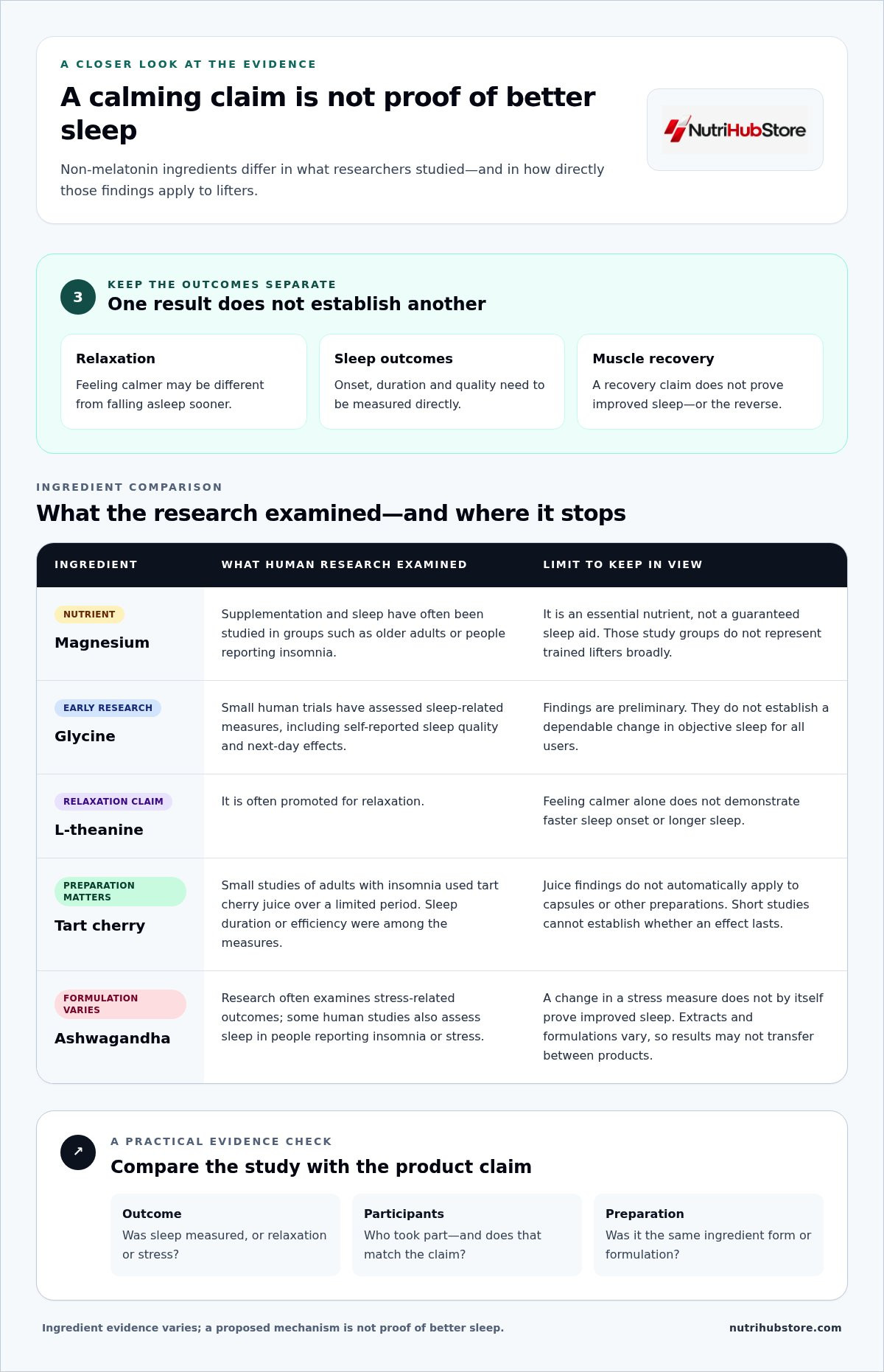
A proposed mechanism is not proof of better sleep. An ingredient may be described as calming, involved in a biological pathway or linked to recovery, but those claims don’t show that people fall asleep faster, sleep longer or wake feeling better. Human studies need to measure those outcomes directly. Results from small or narrowly defined groups may not apply to every lifter.
Keep the outcomes separate. Relaxation describes a possible change in how alert or tense someone feels. Sleep onset, duration and quality are sleep outcomes that need their own measurement. Muscle recovery is another claim entirely; evidence for one outcome doesn’t establish the others. Johns Hopkins Medicine’s overview of Natural Sleep Aids and Home Remedies offers broader context, but ingredient-specific claims still need ingredient-specific human research.
Magnesium, glycine and L-theanine: different proposed roles
Magnesium is an essential nutrient, not a guaranteed sleep aid. Research on supplementation and sleep has often focused on groups such as older adults or people reporting insomnia, rather than trained lifters broadly. That doesn’t mean someone without a relevant dietary or health need will sleep better by adding magnesium.
Glycine has been studied in small human trials for sleep-related measures, including self-reported sleep quality or next-day effects. Those findings are preliminary, not proof of a reliable change in objective sleep for all users. L-theanine is often promoted for relaxation, but feeling calmer alone doesn’t demonstrate faster sleep onset or longer sleep. Study size, participants and measured outcomes all matter.
Evidence in brief: Small human studies have tested glycine for sleep-related outcomes in adults, but they don’t establish a dependable benefit for lifters as a group. Treat this as a research signal, not a promise.
Tart cherry and ashwagandha: claims need context
Tart cherry research has included small studies of adults with insomnia using tart cherry juice over a limited period, with sleep duration or efficiency among the measured outcomes. Juice findings don’t automatically apply to capsules, other preparations or athletes. Short studies also can’t establish whether an effect lasts.
Ashwagandha research often examines stress-related outcomes, while some human studies also assess sleep in people reporting insomnia or stress. A change in a stress measure doesn’t by itself prove improved sleep. Extracts and formulations vary, so results for one preparation can’t be assumed to apply to every product carrying the ingredient name.
When comparing natural sleep aid supplements without melatonin for lifters, focus on the exact outcome studied and who took part, not just a mechanism printed on the label. If you’re reviewing broader sports nutrition options, browse the sports nutrition range with your needs in mind. General training supplements shouldn’t be treated as sleep aids.
Comparing non-melatonin sleep aid supplements for lifters
Start the comparison with the sleep problem, not a “best for athletes” label. Human evidence varies by ingredient, preparation, study group and measured outcome. A result for one formulation doesn’t show that every product containing the ingredient will work.
| Ingredient | Intended role | Evidence confidence | Key limitation | Safety questions |
|---|---|---|---|---|
| Magnesium | Provides an essential nutrient; some products promote it for relaxation or sleep. | Low for general sleep support; findings in specific groups don’t establish a broad benefit. | Supplementing may not help someone who has no relevant need. | Does it fit your health needs, diet and current medicines? |
| Glycine | Studied for possible effects on sleep-related measures. | Limited; human studies are small and don’t establish a reliable effect for lifters. | Self-reported or short-term results may not predict objective or lasting improvements. | Is it suitable alongside your medicines or health conditions? |
| L-theanine | Often intended to support relaxation. | Uncertain for direct improvements in sleep onset, duration or quality. | Feeling calmer is not the same as demonstrating better sleep. | Could it be appropriate with your current routine and medication? |
| Tart cherry | Studied in some research on sleep-related outcomes. | Limited; evidence from particular preparations and groups may not transfer to athletes or other formats. | Juice, capsules and extracts aren’t interchangeable evidence. | Does the product disclose its preparation and relevant warnings? |
| Ashwagandha | Often promoted for stress; some studies also assess sleep outcomes. | Uncertain for direct sleep benefits; evidence depends on the study and extract. | Stress findings don’t prove better sleep, and formulations can differ. | Could it interact with medicines or be unsuitable for your health needs? |
Match an option to the problem you are trying to solve
Difficulty winding down after training isn’t the same as an inconsistent bedtime. Pain, breathing problems and persistent insomnia point to different concerns that a supplement may not address. Identify the barrier first; it makes ingredient claims easier to judge. If symptoms persist or you suspect a sleep disorder, seek clinical guidance rather than relying on a supplement.
Weigh evidence, trade-offs and training-day practicality
For natural sleep aid supplements without melatonin for lifters, an ingredient’s popularity is a poor substitute for evidence tied to the outcome you care about. Review the study population and formulation, then consider whether the product fits your routine. Don’t assume a calming effect or recovery claim means it improves sleep, and don’t use products to compensate for inadequate rest.
Small, formulation-specific studies limit how confidently results can be applied. Treat them as a reason to assess an option, not a guarantee that it will help you.
How lifters can evaluate a sleep supplement label and routine
A polished label can make a sleep claim sound more certain than the evidence behind it. Before adding a product to your routine, work through the concern, the claim and the label in that order. This helps you compare natural sleep aid supplements without melatonin for lifters without confusing marketing language with a likely benefit.
- Name the sleep concern. Is the main issue winding down after training, an inconsistent bedtime or something else? A supplement can’t address every cause of poor sleep, so be specific about what you hope to change.
- Check the evidence for that outcome. Look for human research on the ingredient and the result you care about, such as sleep onset or perceived sleep quality. A study on relaxation or stress doesn’t automatically support a claim about improved sleep.
- Read the full ingredient panel. Check whether the label names each ingredient and states its amount per serving. If a proprietary blend hides individual amounts, you can’t readily compare the formula with research or see how much of each ingredient it contains.
- Review directions and warnings. Read serving instructions, cautions and any allergen information. If you take medication, have a health condition or aren’t sure whether an ingredient is suitable for you, discuss it with a healthcare professional.
- Question broad promises. Claims about recovery, relaxation or “deep sleep” don’t establish that a product will improve your sleep. Look for a clear connection between the specific ingredient, the evidence and the promised outcome.
- Track your routine. Record bedtime, wake time, training time and caffeine timing, along with a brief note about how the night went. A log can reveal patterns, but it can’t prove that one change caused them.
Test routine changes without confusing the results
Where practical, change one factor at a time. If you shift your caffeine timing and begin taking several new supplements in the same week, you won’t know which change, if any, relates to a different night. Avoid stacking new products, and keep notes simple enough to maintain. A log is a useful record, not a diagnosis or a controlled study.
Once you’ve established what you need, browse sports nutrition products with that purpose in mind. A general sports supplement isn’t automatically a sleep aid.
Choosing a sensible next step for sleep and training recovery
A supplement is optional, not the starting point for better recovery. Evidence and personal suitability vary, and a product marketed for recovery may not improve sleep. Give yourself enough time to sleep, keep a consistent routine where your schedule allows, and review whether late training or caffeine timing could be affecting your ability to wind down.
For lifters considering natural sleep aid supplements without melatonin for lifters, the practical trade-off is straightforward: consider a product only when its evidence relates to your sleep concern and its ingredients suit your circumstances. It can’t replace adequate sleep opportunity or resolve every cause of disrupted rest.
When supplement experimentation is not the right first move
Persistent insomnia, severe daytime sleepiness or signs that could point to a sleep disorder deserve professional assessment, not trial and error with supplements. The same applies if poor sleep keeps affecting your daily functioning. A clinician can help assess possible contributing factors without relying on a product’s marketing claims.
If you’re pregnant, managing a health condition or taking medication, discuss a supplement with a qualified healthcare professional before using it. Don’t stop or change prescribed treatment on your own. A label can help you understand what a product contains, but it can’t determine whether that product is appropriate for your health needs.
Browse sports nutrition with a clear goal
Keep sleep products and general sports nutrition products distinct. A supplement sold for training or nutrition shouldn’t be treated as a sleep aid unless its ingredients and evidence support that specific use. Before buying anything, identify the need you’re trying to address, read the full label and serving directions, and weigh the evidence against your personal context.
Protect your sleep opportunity and routine first. If you still plan to buy a supplement, choose based on a clearly stated ingredient and relevant evidence, not a broad “recovery” promise. Review your needs and the product label before making a purchase.
Make your next sleep-support choice with care
Training hard doesn’t guarantee good sleep, and a supplement can’t make up for too little time in bed. For natural sleep aid supplements without melatonin for lifters, start with the barrier you’re trying to address, then check whether human research supports the specific sleep outcome being claimed. Evidence varies, and an ingredient’s proposed calming or recovery role doesn’t guarantee better sleep.
Protect sleep opportunity and a consistent routine where possible. Review training and caffeine timing, read the full label, and don’t treat persistent sleep problems as a supplement-selection challenge. If symptoms continue, affect daily function or raise health or medication concerns, seek guidance from a qualified healthcare professional.
Nutrihub Store offers sports nutrition products, including Ronnie Coleman Creatine XS and Kevin Levrone Gold Whey. These are sports nutrition products, not sleep aids. Browse with your goal in mind and assess each product by its own label and purpose.
A thoughtful choice starts with your needs, not a bold recovery promise. Keep building the routine that supports both your training and your rest.
Frequently Asked Questions
Are natural sleep aid supplements without melatonin effective for lifters?
They may help some people, but the evidence varies by ingredient, product formulation and outcome studied. Research on relaxation or stress doesn’t automatically show that a supplement helps lifters fall asleep faster or sleep longer. Assess natural sleep aid supplements without melatonin for lifters against a specific concern, such as difficulty winding down, rather than broad promises about recovery. They can’t replace adequate sleep opportunity or address every cause of disrupted sleep.
Which supplement is best for sleep without melatonin?
There isn’t one proven best option for every lifter. Magnesium, glycine, L-theanine, tart cherry and ashwagandha have different proposed roles, and evidence for sleep outcomes varies. Start by identifying the problem you want to address, then check whether human research on that ingredient measured that outcome. Review the complete label and warnings, too. A popular ingredient or “natural” claim alone doesn’t establish effectiveness or suitability.
Can magnesium help lifters sleep better?
Magnesium is an essential nutrient, but taking more doesn’t guarantee better sleep, especially if you don’t have a relevant dietary or health need. Research on magnesium and sleep has focused on particular groups, so findings may not apply to all lifters. Check the amount per serving and product directions, and consider your health needs and medicines. If you’re unsure whether supplementation suits you, ask a qualified healthcare professional.
Can I combine non-melatonin sleep supplements?
Don’t assume that combining products is safe or more effective. Stacking supplements can make it harder to identify what affects your sleep, and combined ingredients may raise suitability or interaction questions. Review each product’s full ingredient list, amounts, directions and warnings. If you take medication, manage a health condition or have concerns about a combination, ask a qualified healthcare professional before using the products together.
Will a sleep supplement improve muscle recovery or muscle growth?
A sleep-support claim doesn’t prove that a supplement improves muscle recovery or growth. These are distinct outcomes, and evidence for relaxation or a sleep measure can’t establish a training benefit. Recovery also depends on more than a supplement, including having enough time to sleep. Treat promises that a product will transform recovery with caution, and look for human evidence that measures the specific benefit being claimed.
Can taking a sleep supplement cause next-day grogginess?
It’s possible, but the chance depends on the ingredient, product and individual response. Don’t assume a melatonin-free label means a supplement can’t affect how alert you feel the next day. Follow the serving directions and warnings, and avoid combining products without checking their ingredients. If you notice grogginess or another unwanted effect, stop treating the product as a routine solution and seek advice from a healthcare professional.
When should a lifter seek medical advice for sleep problems?
Seek professional advice if sleep problems persist, interfere with daily functioning or come with severe daytime sleepiness. Suspected breathing problems or another sleep disorder also deserve assessment rather than supplement experimentation. If you’re pregnant, managing a health condition or taking medication, discuss any supplement with a qualified healthcare professional before use. Don’t stop prescribed treatment or change it on your own to try a sleep product.