


The biggest tub isn’t automatically the best bulking choice. When comparing a mass gainer UAE shoppers might use regularly, the calorie count matters less than whether the serving fits their appetite, meals, and training routine.
A shake can be a practical way to add energy when regular meals already feel filling. But serving sizes vary, and a product that looks convenient on the label may feel too heavy in everyday use. More calories alone don’t guarantee muscle gain. The product has to suit your overall eating pattern and training.
Compare options by the calories you’ll actually consume, protein per serving, carbohydrate sources, and ingredients you’re comfortable having regularly. Read those details against your goals, and weigh a shake against food-based ways to add energy. The aim is a bulking approach you can stick with, not the biggest calorie claim on the shelf.
Key Takeaways
- Start with your usual meals and identify where extra energy could fit before choosing a shake.
- Compare serving sizes alongside calories, protein, and carbohydrates so front-of-pack claims don’t mislead you.
- When comparing a mass gainer UAE option, weigh its calorie density and ingredients against your appetite and daily routine.
- Choose a formula and serving approach you can tolerate without crowding out balanced meals.
- Use supplements for convenience, not as a promise of results. Consistent eating and training matter more than any single product.
What does a mass gainer do, and who may benefit from one?
A calorie-dense shake can help fill a gap in your eating routine, but an oversized serving may leave you too full for your next meal. The useful question isn’t how many calories a product can deliver. It’s whether the serving fits your day and helps you eat consistently.
A mass gainer is a supplement designed to add energy and nutrients, often through a combination of protein and carbohydrates. It may suit someone who struggles to get enough from meals alone, but it doesn’t replace a balanced diet or make weight gain automatic. Judge a mass gainer UAE shoppers compare by its role in their overall eating pattern, not by its calorie claim in isolation.
Body weight changes in response to the balance between energy consumed and energy used over time. Resistance training supports a bulking routine, while food and drinks contribute to total intake. The broad ideas behind bulking and cutting help explain why some people aim for a calorie surplus. A supplement can’t determine how that weight is distributed or guarantee muscle growth.
When could a mass gainer fit a bulking routine?
A shake may be convenient if a busy day makes another meal difficult, your appetite is low, or you find it hard to add enough food around work and training. These are possible use cases, not signs that everyone needs a supplement. Keep meals as the foundation, and consider how a shake fits alongside regular resistance training rather than treating it as a replacement for either.
What should a mass gainer not promise?
No formula can guarantee muscle gain, instant results, or the same experience for every person. If a shake pushes total intake beyond your needs, the extra energy can contribute to body fat as well as weight gain. Large servings may also feel uncomfortable or displace meals you would otherwise eat. If you have a health concern or a condition that affects your diet, seek advice from a qualified health professional before changing your intake.
Ordinary meals may cover the gap without a supplement. Start by noticing where your routine falls short, then consider whether a shake would make that specific part of the day easier. A supplement is an option for convenience, not a requirement for bulking.
How to read a mass-gainer label: calories, protein, and carbohydrates
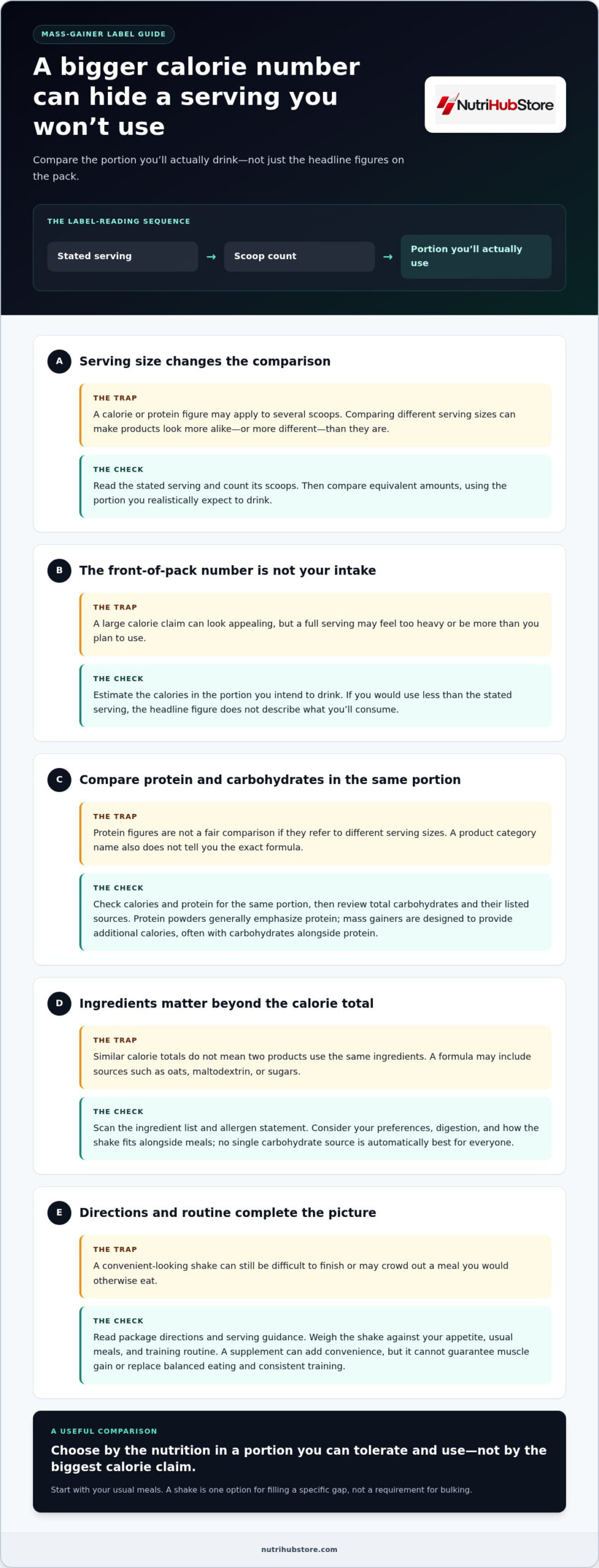
A large calorie number can look impressive until you notice that it applies to several scoops. Serving size changes every nutrition comparison: if portions differ, the calorie and protein figures aren’t being measured on equal terms. Start with the stated serving, count the scoops it includes, and decide whether that amount suits your appetite.
Which label details matter most when comparing mass gainers?
Read the nutrition panel alongside the directions. Note the calories and protein per stated serving, then check the scoop count. If you’d realistically use less than the full serving, the headline figures won’t reflect what you’ll consume. Compare equivalent amounts rather than choosing by the largest front-of-pack number.
Carbohydrates contribute energy, while protein provides amino acids used by the body to build and repair tissue. Check both the total carbohydrate amount and the listed sources. Ingredients such as oats, maltodextrin, or sugars may appear in different formulas, but no single source is automatically best for every person. Consider your food preferences, digestion, and how the shake fits with meals.
- Calories: Estimate the energy in the portion you plan to use.
- Protein: Compare the amount in that same portion, not a different serving size.
- Ingredients: Scan for allergens and components you prefer to avoid.
- Directions: Check preparation instructions and any serving guidance on the package.
Read ingredient lists and allergen statements carefully, especially if you have a known allergy or sensitivity. Don’t assume that two products with similar calorie totals use the same ingredients. For broader context on a different category, the Mayo Clinic’s guidance on performance-enhancing drugs addresses risks associated with those substances. It shouldn’t be read as evidence that a standard mass gainer is one of them.
How can protein powder and mass gainer differ?
Protein powders generally emphasize protein, while mass-gainer formulas are designed to provide additional calories, often with carbohydrates alongside protein. Formulas vary, so labels matter more than category names. If you’re weighing a protein-focused option against a calorie-dense shake, compare the nutrition panels and browse sports-nutrition products to see how protein options fit your needs. Use a partial serving only if the product directions allow it, and account for what you already eat.
Mass-gainer formula types compared: which trade-offs fit your routine?
A shake with more calories can save time, but it can also feel like a meal you didn’t have room for. Compare formulas by the portion you’ll actually use and the job you need them to do, not by a “best” label or a large number on the front.
The profiles below are comparison lenses, not standardized industry classifications. Products vary, so use each label to assess calorie density, protein emphasis, serving size, and fit with your day.
| Formula profile | Calorie density | Protein emphasis | Serving size and trade-off |
|---|---|---|---|
| Higher-calorie mass gainer | More energy in the stated serving | Protein alongside a larger calorie contribution | A larger serving may be hard to finish or fit between meals. |
| More moderate-serving mass gainer | Less energy per stated serving than a higher-calorie profile | Check the label; emphasis varies by formula | May be easier to fit into a day, but could contribute less energy per serving. |
| Protein-focused whey | Not necessarily designed to add as many calories as a mass gainer | Generally centered on protein | May suit someone seeking protein without a large calorie serving; check its actual nutrition panel. |
| Food-based addition | Depends on the meal or snack chosen | Can vary with ingredients | Offers control over ingredients, but takes planning and preparation. |
Higher-calorie versus more moderate-serving approaches
A large stated serving can be inconvenient if your appetite, meal timing, or schedule makes it difficult to drink at once. A smaller portion may feel more manageable, or you might divide intake across the day if the product directions permit it. Don’t assume a partial serving matches the label’s full nutrition figures. Calculate from the amount you actually use.
Mass gainer versus whey protein or food-based calories
A mass gainer is intended to add calories as well as nutrients; whey protein generally focuses on protein, though formulas differ. Kevin Levrone Gold Whey is a protein-focused option, not a mass gainer. Ordinary food can also add energy through a snack or meal that fits your preferences, but it may take more preparation than a shake.
Compare ingredients and directions before choosing. The FDA’s warning on bodybuilding supplements describes risks linked to some bodybuilding products. It isn’t evidence that mass gainers as a category contain hidden drugs. For a mass gainer UAE comparison, focus on the specific product label. You can also browse sports-nutrition options while weighing food and supplement approaches.
How to choose a mass gainer in the UAE without overbuying
Buying a large tub before you know what your routine needs can leave you with a shake that’s hard to finish and difficult to use consistently. Identify an actual gap first, then match the label and serving format to your appetite, meals, and training schedule.
Use this decision path before you buy:
- Track your usual intake. Note regular meals and snacks over a consistent period, along with your weight trend. A single weigh-in or a missed meal doesn’t establish a lasting shortfall.
- Identify the practical gap. Is it hard to eat enough during workdays, around training, or because your appetite is limited? Consider whether a meal or snack could address it just as well.
- Compare labels. Check calories and protein for the serving you’d realistically use, then review ingredients, allergens, and directions.
- Assess the fit. Choose a format you can prepare and tolerate without crowding out meals or disrupting your routine.
How can you tell whether you need extra calories?
Look for a consistent pattern in your meals and weight trend rather than reacting to short-term fluctuations, which can happen for several reasons. If your weight changes without explanation or you have health concerns, seek guidance from a qualified health professional. A mass gainer UAE shoppers consider should address a genuine practical gap, not replace that assessment.
How should a mass gainer fit around meals and training?
Treat a shake as a convenient addition, not an automatic meal replacement. The best timing depends on your routine and comfort, so follow the product’s directions instead of relying on a universal schedule. If a full serving feels too heavy, don’t chase the largest portion. Review the label and choose an approach you can use comfortably.
Follow the package’s storage directions. Don’t assume a particular storage method is suitable based on the weather alone; use the instructions printed on the product. Before buying, make sure the label and directions are clear, and compare the serving size with your actual needs.
Quick check: track your usual intake, identify a specific gap, compare label details, assess comfort, and follow storage directions.
Build a realistic bulking plan and choose your next step
A shake only helps if it makes your routine easier to maintain. It can add energy with little preparation, but it also comes with trade-offs: cost, personal tolerance, and the chance it may leave you too full for meals. No mass gainer guarantees muscle gain or a particular timeline. Training, regular eating, and your overall intake still shape progress.
What does a sensible mass-gainer trial look like?
Choose based on the nutrition label and how the product fits your day, then follow its serving directions. Track whether you use it consistently, how your appetite and comfort respond, and how your longer-term progress changes. One day isn’t enough to judge a plan. If the shake repeatedly replaces balanced meals or makes eating harder on training days, reconsider whether it belongs in your routine.
Keep the rest of your bulking habits steady as you assess the change. That makes it easier to tell whether the shake helps fill a practical gap or simply adds another task. The aim isn’t to finish the largest serving; it’s to find an approach you can sustain alongside meals and resistance training.
Where can you continue comparing sports-nutrition options?
Nutrihub Store serves customers across the UAE with sports supplements and broader nutrition products. Browse sports-nutrition options with your goals in mind, but don’t assume every category or formula will suit your needs. Consider how any supplement fits with your usual meals and training routine.
Before choosing a mass gainer UAE option, compare its serving size, nutrition details, ingredients, directions, and fit with your appetite. Then decide whether a shake offers a practical advantage over food-based calories. If you choose to try one, follow the label and review how it affects your routine over time.
Choose the option your routine can sustain
The biggest serving won’t help if it crowds out meals or feels uncomfortable. A practical mass gainer UAE choice starts with your actual eating pattern, then compares calories, protein, ingredients, and serving size against what fits your day. A shake can make extra energy more convenient, but it can’t guarantee muscle gain or replace consistent eating and resistance training.
Nutrihub Store serves customers across the UAE with sports-nutrition products, including Kevin Levrone Gold Whey. Use the label, not front-of-pack claims, to guide your comparison.
Choose what you can use comfortably, then build your bulking routine one consistent step at a time.
Frequently Asked Questions
What is a mass gainer?
A mass gainer is a calorie-dense supplement designed to make it easier to add energy and nutrients when meals don’t fit your appetite or daily routine. Formulas vary, so check the nutrition panel and serving size rather than judging by the product name. It won’t guarantee weight gain or muscle growth. Your overall food intake, resistance training, and consistency all contribute to progress.
Is a mass gainer suitable for beginners?
A mass gainer may suit a beginner who finds it difficult to eat enough, but it isn’t a required part of starting fitness. First consider whether regular meals, appetite, and a consistent training routine meet your needs. When comparing products, check the serving size and nutrition details against your actual eating pattern. Seek qualified professional advice if you have a health condition, unexplained weight change, or dietary concern.
How do I choose a mass gainer in the UAE?
Compare the serving size, calories, protein, carbohydrates, ingredients, and allergen information on each label. Then consider whether that serving fits your appetite, schedule, and usual meals. Follow the package’s storage directions, especially if you’re storing supplements in warm conditions. Don’t choose based on a front-label claim alone or assume a larger serving is automatically better. A mass gainer UAE shoppers compare should suit their routine, not just look high in calories.
Can a mass gainer replace meals?
A mass gainer can offer a convenient way to add energy, but it shouldn’t automatically replace balanced meals. Meals can include a broader mix of foods and nutrients, while a shake may be easier to prepare when time or appetite is limited. Check the product directions and consider how it fits your usual eating pattern. If you have specific health or nutrition needs, seek individual advice from a qualified professional.
Is a mass gainer better than whey protein?
Neither category is automatically better; they’re generally designed for different purposes. Mass-gainer formulas aim to add calories as well as nutrients, while whey protein products typically place more emphasis on protein. Formulas vary, so compare the nutrition panels and serving sizes rather than relying on category names. If you’re looking to add protein without as many extra calories, a protein-focused option may fit more closely.
How should I use a mass gainer for weight gain?
Follow the serving directions on the specific product and fit it into a consistent eating and training routine. There isn’t one schedule that suits everyone. Track your usual meals and longer-term progress, then assess whether the shake helps or makes eating uncomfortable. If your nutrition needs are complex or a health condition affects your diet, a qualified nutrition professional can offer guidance suited to your circumstances.
Can mass gainers cause unwanted weight gain?
Yes. A mass gainer can contribute to weight gain if it adds more energy than your body uses, and that change won’t necessarily be muscle alone. Serving size, your overall eating pattern, and activity all affect the outcome. Read the label and consider your routine instead of choosing the highest-calorie serving. If you experience concerning symptoms, stop using the product and seek appropriate professional guidance.