


The average flight time from Birmingham to Lanzarote is 3 hours and 38 minutes. That duration helps with arrival planning, but it doesn’t show how often the service operates each week or how punctual it is. Those details answer different questions and should be assessed separately.
It makes sense to check both figures before planning a trip. Weekly frequency helps you compare travel dates, while on-time performance can help you decide how much flexibility to allow around arrival. These measure different things: the schedule shows planned departures, and punctuality records show how flights operated.
Check the timetable for your travel dates to see the operating pattern, then review performance information separately. This guide explains what a flight identifier tells you and how to distinguish it from aircraft details, helping you use service information accurately when planning.
Key Takeaways
- Separate weekly operating frequency from on-time performance; each describes a different part of planning your trip.
- Use the average Birmingham-to-Lanzarote flight time of 3 hours and 38 minutes as a duration reference.
- Distinguish flight details from aircraft specifications when reviewing the LS1201 reference.
- Understand that disruption and baggage compensation eligibility may involve frameworks such as EC 261/2004 or UK261.
Weekly operating frequency
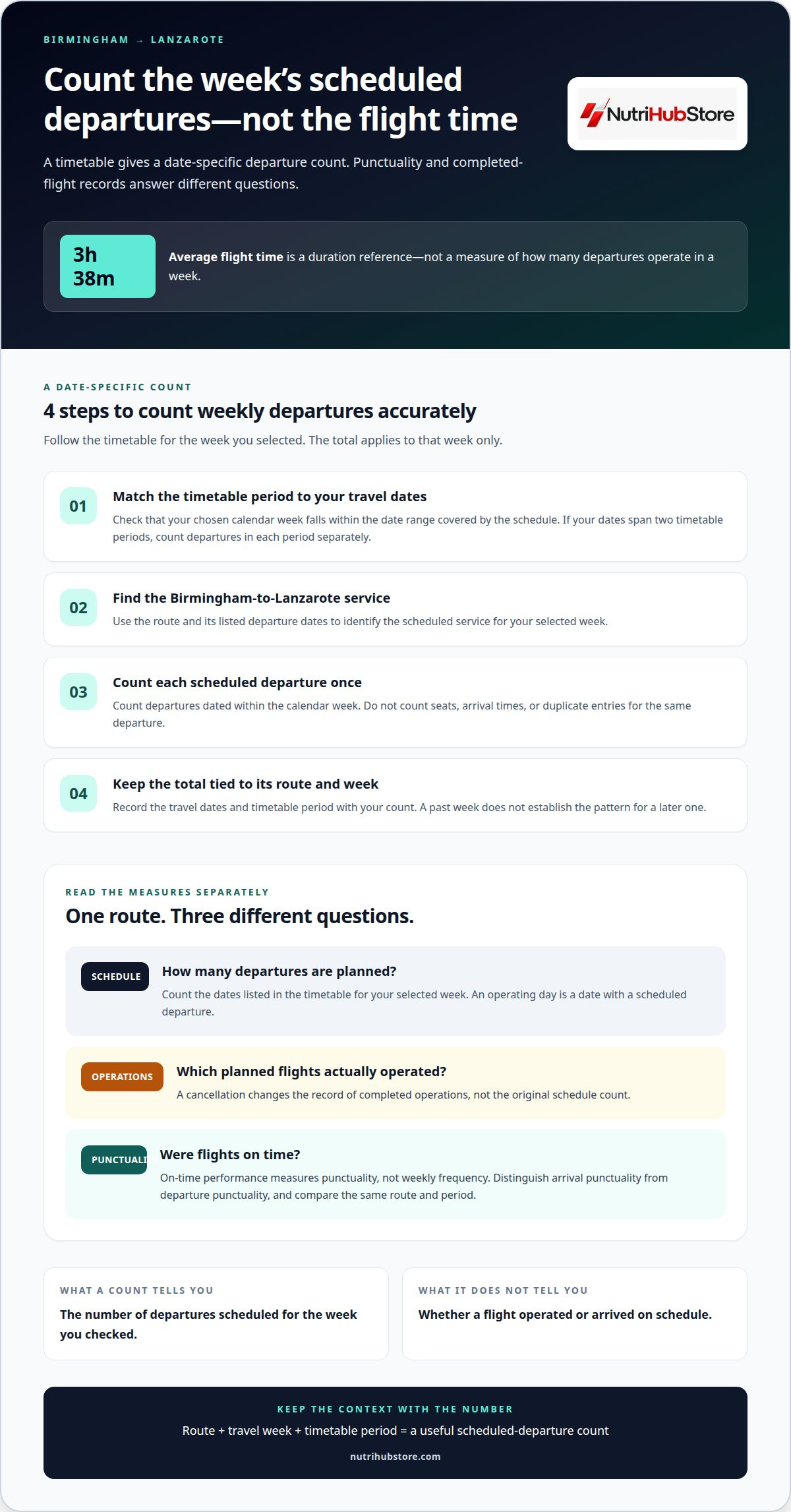
Weekly operating frequency is the number of scheduled departures in a calendar week. For the Birmingham-to-Lanzarote service, count the departures dated within the timetable period that includes your travel week. Journey duration does not indicate weekly frequency. Only the schedule shows how many departures are planned for a particular week.
A timetable lists planned departures by date. Find the Birmingham-to-Lanzarote route and check the dates shown for the service. Count each scheduled departure in your chosen week once. Do not count seats, arrival times, or duplicate entries for the same departure. Your total applies only to the week you selected.
An operating day is a date with a scheduled departure. A timetable may show service on selected days rather than every day. Count only the departures listed for the relevant dates, and do not assume that the same pattern applies throughout the year. The timetable’s date range determines which operating pattern applies.
A timetable period is the date range covered by a schedule. Select your travel week and confirm that it falls within the displayed period. If your dates span two timetable periods, count departures in each period separately. A total from a past week does not establish the pattern for a later one.
Use this simple process:
- Locate the schedule period that includes your travel dates.
- Find the Birmingham-to-Lanzarote service and its departure dates.
- Count scheduled departures within the selected calendar week.
- Keep that total separate from completed-flight records.
Scheduled frequency and completed operations are different measures. A timetable shows planned departures; a cancellation means a planned departure did not operate. The cancellation changes the record of completed operations, not the original schedule count. Keep these figures separate when describing how often the service is planned to run.
On-time performance measures punctuality, not weekly frequency. A departure count cannot show whether a flight arrived on schedule, and a delay on one date does not establish a wider pattern. When reviewing performance, distinguish arrival punctuality from departure punctuality, and compare records for the same route and period.
To plan your trip, use the flight identifier to locate the service, then count only the departures listed for your chosen week. Keep the route and travel dates with your count, especially when comparing timetable periods. This gives you a date-specific count of scheduled departures, not a guarantee about every week or a measure of punctuality.
What are the specifications of the LS1201?
A flight specification is a set of operational details for a particular journey. Useful fields for passengers include scheduled departure and arrival times, the operating carrier, and any terminal information shown. These details apply to the travel date and booking, so read them from the itinerary for your specific departure rather than assuming they stay the same.
The scheduled departure time is when the flight is planned to leave the origin airport. The scheduled arrival time is when it is planned to reach its destination. Check both times alongside the date, especially for journeys crossing midnight. The arrival date may differ from the departure date, so use the full date and time rather than relying on the weekday alone.
The operating carrier is the airline responsible for conducting the flight. An itinerary may show it separately from other booking details. Check this field to identify the airline operating your journey. Keep it distinct from the route and timing fields, which answer different practical questions.
Terminal information identifies the airport area shown for departure or arrival. Treat it as a detail for your specific journey, not a permanent feature of the service. If your itinerary lists a terminal, use the one shown for your travel date. Note whether each terminal label refers to the departure or arrival airport.
Other useful booking fields include:
- Travel date: identifies the particular departure you booked.
- Departure and arrival times: show the planned schedule.
- Operating carrier: names the airline conducting the flight.
- Baggage allowance: describes the allowance attached to your booking.
- Seat assignment: identifies your allocated seat when shown.
Baggage and seating details are booking conditions, not universal service specifications. Check the allowance shown on your own itinerary rather than assuming another passenger has the same terms. Apply the same rule to seating: use the assignment or selection listed for your journey.
Review the fields in a practical order: match the travel date, check departure and arrival times, then note the carrier and airport details. Finally, review the baggage and seat information tied to your booking. This helps prevent a general service description from being mistaken for the conditions of your own itinerary.
For the LS1201 reference, treat “specifications” as the travel details relevant to a dated booking, not as a fixed equipment sheet. Use the itinerary to interpret the actual departure and its passenger-specific terms. That gives you a useful planning record without assuming that every date or booking carries identical operational details.
Who manufactures the LS1201?
LS1201 is a flight number, not an aircraft model. A flight number identifies a scheduled air service; it doesn’t identify who built the aircraft. The route associated with this service is Birmingham to Lanzarote. That distinction matters because airlines operate flights, while aircraft manufacturers build aircraft.
An operating airline is the carrier responsible for conducting a flight. Its name identifies the airline, not the manufacturer of the aircraft. A ticket or itinerary can show a flight number and carrier information as separate details. Read those labels separately instead of treating “LS1201” as a manufacturer’s model code.
An aircraft manufacturer is the company that designs and builds an aircraft type. Airbus and Boeing are examples of aircraft manufacturers. Their names describe makers, not airlines or flight numbers. Nothing in the identifier LS1201 itself names Airbus, Boeing, or another aircraft maker. It also doesn’t establish which aircraft type serves a particular departure.
A marketed flight is a service sold under a particular flight number. An operating flight is the journey actually conducted by an airline. Those labels can differ in some airline arrangements, so the operating-carrier field is more useful than the flight number alone. For example, an itinerary could show a marketing carrier separately from its operating carrier. That example explains the labels, not a claim about LS1201.
Use these terms distinctly:
- Flight number: identifies the scheduled service, such as LS1201.
- Operating airline: conducts the flight.
- Aircraft manufacturer: builds the aircraft type.
- Aircraft model: names the specific type used.
To identify the manufacturer of the aircraft on a particular Birmingham-to-Lanzarote departure, first find the operating airline. Then identify the aircraft model assigned to that departure and match the model to its manufacturer. The route, flight number, or average journey duration alone cannot identify the manufacturer.
Keep the average flight time in its proper category: Birmingham to Lanzarote takes 3 hours and 38 minutes on average. That is a route-duration reference, not evidence of an aircraft maker or model. Two aircraft types can serve the same route, and a flight identifier doesn’t turn into a permanent aircraft assignment.
The direct answer is that LS1201 itself has no aircraft manufacturer because it is a flight identifier. The airline operates the service; a separate manufacturer builds the aircraft used. For accurate identification, distinguish the flight number from the operating airline and aircraft model on the specific itinerary. Those are three different pieces of information, and only the model points to a manufacturer.
What is the LS1201 used for?
A flight number identifies a scheduled air service. LS1201 identifies the Birmingham-to-Lanzarote service in this reference. Travellers can use it to distinguish that flight from other departures, especially when checking an itinerary or discussing a disruption. It is not a gym model, aircraft specification, or manufacturer’s product code. The identifier helps connect a route with its schedule and flight records.
For trip planning, the flight number helps match a booking to the correct departure. Compare LS1201 with the route and travel date shown on your itinerary. The route is Birmingham to Lanzarote, while the average flight time is 3 hours and 38 minutes. Those details help identify the journey and estimate time in transit. The flight number itself doesn’t tell you the aircraft model or cabin layout.
A timetable records planned departure and arrival times. Use the flight number to find the service for your travel date, then compare the scheduled times with your booking. This is useful when an itinerary includes several flights or connections. Keep the route, date, and flight number together, since a matching number alone may not describe every detail of your journey.
Flight records can help identify a disruption. A delay, cancellation, or baggage issue relates to a particular journey, and the flight number can help distinguish that service in your travel documents. Keep your booking and relevant travel records together. The number is an identifier, not proof of compensation eligibility or a guarantee of a particular outcome.
Potential compensation eligibility for disruptions or baggage issues may depend on different frameworks. The frameworks named include:
- EC 261/2004 and UK261
- The Montreal Convention
- US GoodWill and BR-ANAC
- SA-GACA and TK-SHY
These names identify frameworks that may affect eligibility; they don’t establish that every framework applies to every LS1201 journey. The route, circumstances, and type of issue matter. For example, a baggage concern and a delayed flight are different situations. Keep those categories separate when organising your records or describing what happened.
For a practical check, match the flight number to the travel date and route first. Next, identify whether your question concerns timing, cancellation, or baggage. Use the 3 hours and 38 minutes average duration only as a journey-time reference. It doesn’t show punctuality, establish a disruption, or determine eligibility under any named framework.
The useful role of LS1201 is identification: it links the Birmingham-to-Lanzarote service with the relevant itinerary and flight records. Use it to keep travel details organised, then assess schedule information and any issue separately. A flight code can point to the right service, but it cannot replace the journey’s specific records or explain every decision about a disruption.
Is the LS1201 still available or discontinued
“Discontinued” describes a product withdrawn from sale, not a flight number. LS1201 identifies a Birmingham-to-Lanzarote air service, so its status is better assessed through dated schedules. A flight number alone doesn’t establish whether a departure operates on a particular date. It also doesn’t show whether the service runs every week.
A scheduled departure is a flight listed to operate on a specific date. For Birmingham to Lanzarote, match the LS1201 identifier with the travel date and route. A timetable covering that date can show whether a departure is planned. A listing for another date doesn’t establish the schedule for your chosen week.
Current operation and permanent discontinuation are different claims. A service may not appear for one date or timetable period but may appear in another. Its absence alone does not prove that the flight has been permanently withdrawn. To assess a particular trip, use the schedule for the exact travel date and compare the route and flight number.
Use this practical sequence:
- Start with the intended Birmingham-to-Lanzarote travel date.
- Find the schedule covering that date.
- Match both the LS1201 identifier and route.
- Separate a scheduled departure from a completed flight.
A timetable shows planned operation, while flight records describe what happened. A cancellation can affect one scheduled departure without proving permanent discontinuation. Similarly, a flight operating on one date does not establish that it runs on every later date. Keep the schedule period and specific departure in view.
The available duration reference is an average flight time of 3 hours and 38 minutes between Birmingham and Lanzarote. That figure describes journey duration, not current availability or operating frequency. It cannot confirm that LS1201 is scheduled for a chosen date, nor show whether a particular departure was completed.
For a travel decision, note the date, route, and flight number together. Then consider three separate questions: Is a departure scheduled? Did it operate? Is the service listed for a different period? Each question concerns a different record. Combining them can lead to a mistaken conclusion that a flight has been discontinued.
Disruption and baggage matters also involve separate considerations. Possible frameworks named for LS1201 issues include EC 261/2004, UK261, the Montreal Convention, US GoodWill, BR-ANAC, SA-GACA, and TK-SHY. Their mention doesn’t establish that every framework applies to every journey. These names concern potential eligibility, not whether the service remains scheduled.
The useful answer is date-specific: LS1201 is a flight identifier, and its operation should be assessed against the timetable for the intended Birmingham-to-Lanzarote date. A single missing listing or completed flight cannot establish a permanent status. Keep schedule evidence distinct from journey duration and disruption records.
Nutrihub Store: Ronnie Coleman Creatine XS
Nutrihub Store can support fitness planning beyond travel, with training nutrition products such as Ronnie Coleman Creatine XS and Kevin Levrone Gold Whey. For a training space, its Gym Setup and Fitness & Sports Flooring offerings address equipment and flooring needs.
Choose the option that matches your goal: explore a supplement for your routine, or consider setup and flooring for a dedicated workout area. These offerings are separate from LS1201 flight information, so they won’t answer schedule or punctuality questions. For help with a fitness-related next step, contact Nutrihub Store.
Make your next plan with confidence
Use the LS1201 reference as a starting point, then match your plans to the exact travel date and itinerary. That small step keeps the flight identifier separate from aircraft details and any disruption records. It also helps you make decisions from information tied to your own journey, rather than assumptions based on a flight code.
Once your travel arrangements are in place, consider the training routine you want to maintain. Nutrihub Store offers products for fitness and nutrition needs, separate from flight information. Choose options that fit your training priorities and keep your plans practical and manageable.
Clear plans make it easier to focus on what comes next. Keep working toward your travel and training goals at a pace that suits you.
Frequently Asked Questions
What does LS1201 refer to?
LS1201 refers to a scheduled flight service between Birmingham and Lanzarote. On an itinerary, use the code alongside the travel date and route to identify the relevant departure. It’s a flight identifier, not a multi-gym model name or aircraft manufacturer’s model number. For a booking with connecting flights, match each flight code to its own route segment before reviewing departure details.