

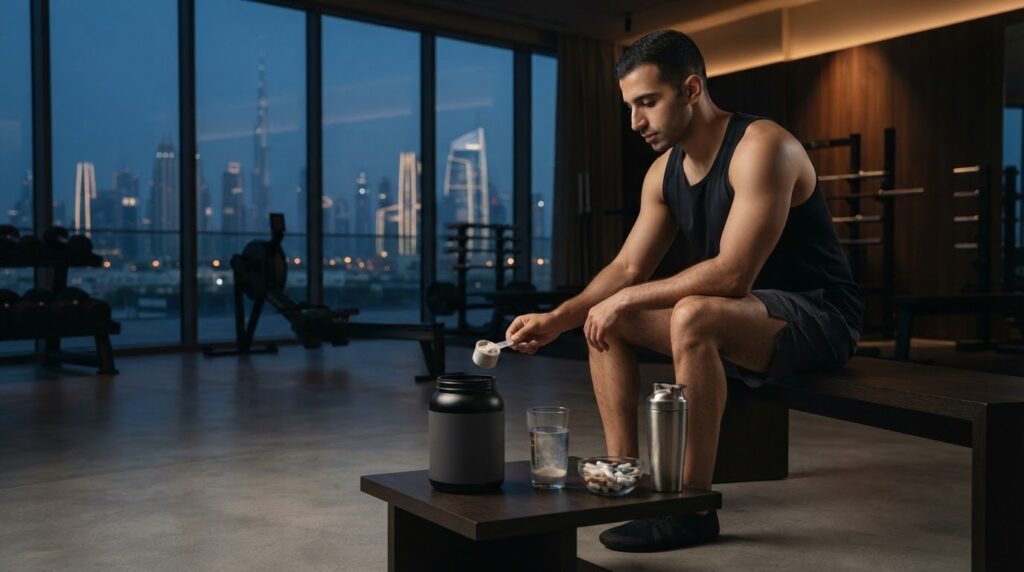
A caffeine-free scoop can still be the wrong choice before bed. If late workouts leave you wired, a non stimulant pre workout powder for late evening training may sound like an easy fix, but “stimulant-free” does not promise uninterrupted sleep. Formula details, serving size, timing, and your individual response all matter.
It makes sense to look beyond caffeine. Products marketed as pump-focused can still include caffeine or other stimulants, while stimulant-free formulas can differ sharply in ingredients and amounts. A blend that hides its quantities makes comparison harder, not easier. The useful question is not simply whether a tub says caffeine-free, but what a full serving contains and whether it suits your training and health needs.
Use the ingredient panel to compare disclosed amounts and spot claims that need a closer look. Weigh a supplement against simpler late-session choices, and pay attention to your own response. If you have a health condition or take medication, discuss supplement use with a qualified healthcare professional. Start with the label, not the promise on the front of the tub.
Key Takeaways
- Separate genuinely stimulant-free formulas from low-stimulant options by checking the full ingredient panel for caffeine and other stimulants.
- Compare ingredient amounts and serving sizes, not just front-label claims. L-citrulline and beta-alanine, for example, have different intended roles.
- Consider your training time and other caffeine sources when deciding whether a non stimulant pre workout powder for late evening training fits your routine.
- Follow the product’s serving directions rather than copying someone else’s dose, then pay attention to your own response.
- Use a formula-first checklist to compare options in Nutrihub Store’s sports nutrition shop. A stimulant-free label alone cannot predict your sleep.
Why late-evening training calls for a different pre-workout decision
A pre-workout that helps you feel ready to train can also make it harder to settle down afterward. This tension matters more in the evening, when your session ends close to bedtime and there is less time for stimulation to wear off. The question is not just “Will this give me energy?” It is whether the full formula suits both your workout and the hours that follow.
Non-stimulant describes a formula’s stimulant content, not its effect on your sleep or performance. A non stimulant pre workout powder for late evening training may avoid added caffeine, but that label alone cannot predict how you will respond. For general context on the product category, see What is a pre-workout supplement?
What does non-stimulant mean on a pre-workout label?
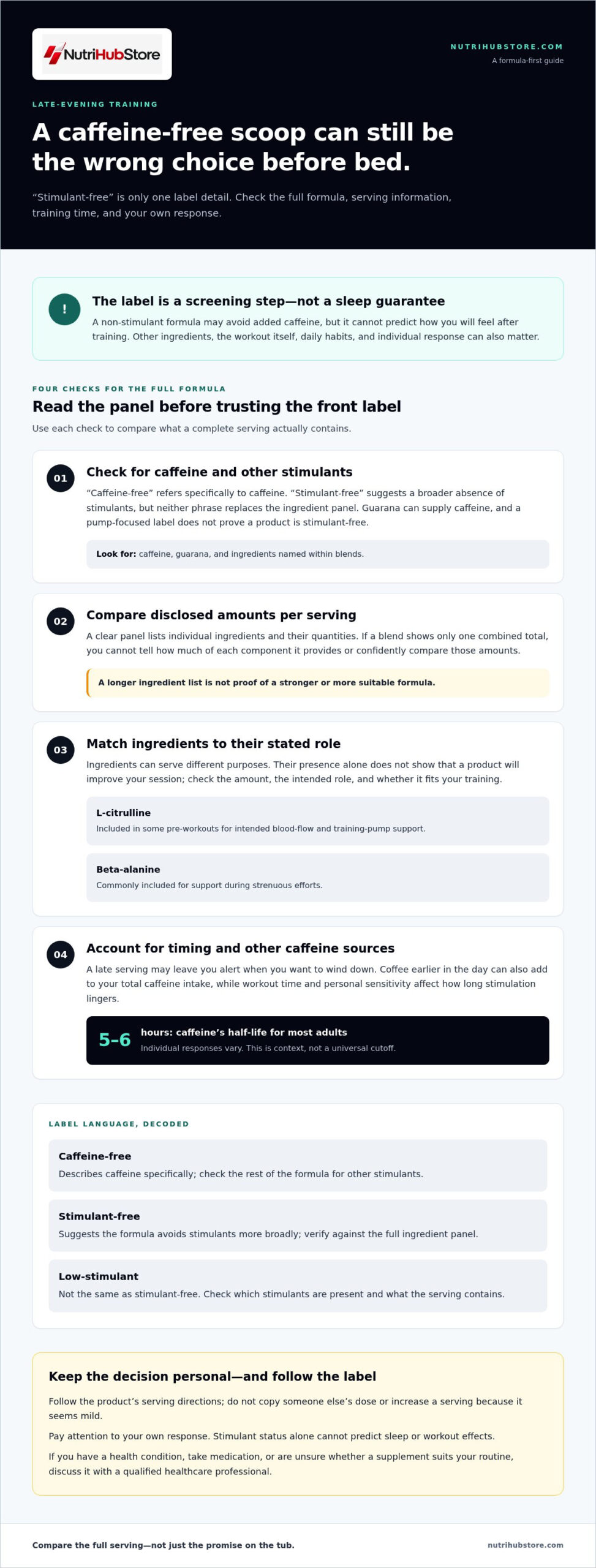
“Caffeine-free” refers specifically to caffeine. “Stimulant-free” suggests the formula avoids stimulants more broadly, but marketing terms are not a substitute for the ingredient panel. Check the full list, including ingredients named within blends, and read the serving directions to understand what a complete serving contains. If the label does not disclose each ingredient’s amount in a blend, you cannot confidently compare those quantities.
Look beyond the front label, too. A product described as pump-focused or suitable for night use is not automatically free of stimulants. Ingredients such as guarana can supply caffeine, while other compounds may have stimulating effects. Do not infer the formula’s full contents or likely effects from one phrase on the tub. The label gives you better grounds for comparison.
Why can late training and caffeine create a trade-off?
Caffeine can increase alertness partly by blocking adenosine receptors. Adenosine builds up during waking hours and contributes to the body’s drive for sleep. Caffeine can mask some of that signal without removing the underlying need for rest. That is why a late serving may leave someone feeling alert when they would rather wind down.
The trade-off depends on more than the clock. Caffeine’s half-life is about five to six hours for most adults, though individual responses vary. The amount consumed, workout time, caffeine from other sources, and personal sensitivity can all affect how long its effects linger. Coffee earlier in the day may also contribute to your total intake.
There is no universal cutoff that suits everyone, and removing caffeine does not guarantee better sleep. Training itself, other ingredients, daily habits, and individual health can also shape how you feel afterward. If you have a health condition, take medication, or are unsure whether a supplement suits your routine, speak with a qualified healthcare professional before using it. Treat stimulant status as one screening step, then consider the full formula and your own response.
How non-stimulant pre-workout formulas support training
A long ingredient list can look impressive without showing what a serving is likely to do. Non-stimulant formulas vary: one may focus on blood-flow support, another may include ingredients associated with muscular endurance, and others may use different combinations. Judge a formula by each ingredient’s intended role, the amounts disclosed, and whether its claims fit your training. Ingredient count and bold promises are poor substitutes for those checks.
Formula transparency makes ingredient comparison possible, not outcome certainty. Even when a product lists every ingredient and amount, it cannot establish that everyone will notice the same effect in every workout. Training type, nutrition, health, and personal response all influence the experience. Assess a non stimulant pre workout powder for late evening training as a supplement with a stated purpose, not as a guaranteed route to a better session.
How to assess pump and endurance ingredients
L-citrulline appears in some pre-workouts for its intended role in blood-flow and training-pump support. Beta-alanine is another example, commonly included for support during strenuous efforts. Neither ingredient appears in every stimulant-free powder, and its presence alone does not prove that a product will improve your session. Check the amount per serving and compare it with reliable evidence before drawing conclusions. A front-label claim is not proof.
Ingredient effects can depend on the amount, use pattern, and type of exercise. A formula’s intended support may be more relevant to one session than another, but that still does not guarantee a noticeable benefit. For broader context on exercise timing, Harvard Health Publishing’s discussion of evening exercise and sleep can help explain why a supplement choice should be considered alongside your wider routine.
What ingredient panels reveal about formula quality
A clear panel lists individual ingredients and their quantities per serving. That lets you compare like with like and spot when a blend conceals amounts. If a label gives only a combined blend total, you cannot tell how much of each component it provides. A longer panel is not automatically stronger or more suitable. Extra ingredients can make a formula harder to assess without proving greater value.
Follow the product’s own serving directions. Do not copy another person’s routine or increase a serving because a formula appears mild. When comparing pre-workout options in the sports nutrition shop, start with the full ingredient panel and ask whether the stated purpose matches your session. That is more useful than counting claims on the front of the tub.
Compare non-stimulant, low-stimulant, and caffeine-based pre-workouts
The category name is only a starting point. A “low-stim” serving can still contain caffeine that matters to someone training late, while a non-stimulant formula may include ingredients that do not suit everyone. Compare the full serving, not just the product’s front label.
| Type | Stimulant status | Ingredients to check | Intended use and label clarity |
|---|---|---|---|
| Non-stimulant | Designed without caffeine; inspect the full panel for other stimulants. | Check each listed ingredient and amount, including components of blends. | May suit people limiting caffeine. Clear amounts make the formula easier to assess. |
| Low-stimulant | Contains caffeine or other stimulants, generally positioned as a lower-stimulation option. | Find total caffeine per serving and note serving directions. | May offer a less stimulating alternative to a stronger formula, but the label needs to show what “low” means. |
| Caffeine-based | Uses caffeine as a stimulant; amounts can vary by product and serving. | Check caffeine per serving and account for other caffeine sources that day. | Often intended to support alertness for training. Transparent quantities help you compare servings. |
When might non-stimulant suit a late workout?
A non-stimulant option can make sense if you are limiting caffeine but still want a formula with training-focused ingredients. Start with your goal. A multi-ingredient product may not be necessary if you prefer a simpler choice or want to know which ingredients you are taking. Your past response to supplements matters, too. Non-stimulant does not mean sleep-promoting, and you can complete a workout without pre-workout supplementation.
When choosing a non stimulant pre workout powder for late evening training, compare ingredient disclosure with the demands of your session. A single-purpose option may be easier to assess than a complex blend, especially if you prefer fewer ingredients. But “simpler” does not guarantee better results or suitability. Follow the product label and consider your personal health needs before adding a supplement.
When does low-stimulant or caffeine-based make comparison harder?
“Low” is not useful for comparison unless you can see the caffeine amount in a full serving. Add up caffeine from all sources, including coffee, tea, energy drinks, and other supplements. People respond differently to caffeine, so a serving that feels manageable to one person may not suit another, particularly before a late workout.
Timing and sensitivity can matter as much as the category label. If a product hides its caffeine quantity in a blend or makes the total unclear in its serving directions, you cannot reliably compare it with another option. Choose based on disclosed amounts and your own response, not the reassuring sound of “low-stim.”
Use a practical checklist to choose and time a late-session powder
A powder is only one part of an evening workout. A late meal, limited fluid intake, a demanding session, or a bedtime soon after training can all shape how you feel. Use this checklist to assess the routine around the supplement, not just the scoop.
- Training time: Note when your workout starts and ends, and how soon you plan to sleep.
- Caffeine exposure: Include coffee, tea, energy drinks, and any other supplements taken that day.
- Ingredient panel: Read the full list and serving amounts. Do not rely on front-label claims.
- Serving directions: Follow the specific product label rather than copying someone else’s serving routine.
- Personal response: Pay attention to how the product and your overall evening routine affect you.
What to check before buying a powder
Before choosing a non stimulant pre workout powder for late evening training, check that the label names each ingredient, gives its amount per serving, and explains serving directions. Look for caffeine and other stimulants in the full panel, including blends. Read warnings and suitability information, too. If you have a health condition or take medication, get qualified medical advice before using a supplement.
A label that leaves important amounts unclear makes comparison difficult. An appealing flavour, a long ingredient list, or a nighttime claim cannot tell you whether the formula suits your needs. Check that the serving size you compare matches the product directions, and do not treat a partial serving as equivalent to a full one.
How to test personal tolerance without overpromising
For a first trial, follow the label and avoid combining unfamiliar supplements. Otherwise, if you feel different during training or at bedtime, it is hard to tell which product or ingredient contributed. Keep the rest of your routine as consistent as practical, and note workout timing, perceived effects, meal timing, hydration, and sleep.
One night is not enough to establish a reliable pattern. A late meal or unusually intense workout may affect your evening independently of the powder, so record those details rather than automatically crediting or blaming the supplement. If you are pregnant, have health concerns, or take medication, ask a qualified healthcare professional whether supplement use is appropriate. They can advise on your individual circumstances.
Fueling matters beyond the tub. Consider how meal timing and hydration support your session, and do not use a pre-workout to compensate for a routine that leaves you under-fuelled. A simple record of what you ate and drank, when you trained, and how you slept can help you decide whether the product adds value. If the effects feel unwanted, stop using it and seek professional advice if you are concerned.
Use the same label-first approach while comparing options in the sports nutrition shop, then choose according to your routine rather than another person’s experience.
Choose your next step with a clear formula-first approach
The best choice is not the powder with the boldest promise. It is the option whose stimulant content, disclosed formula, and directions fit your training goal and evening routine. Even a non-stimulant label cannot promise better sleep, so keep your bedtime and personal response in view as you compare.
Match the product choice to your actual training goal
Start by naming what you want support with. Pump-focused products, endurance-oriented formulas, and general workout-support blends are not interchangeable. A longer ingredient list does not make one more suitable by default. Look for disclosed ingredients that match the stated purpose, then read their amounts and serving directions. If sleep is a priority, weigh caffeine content and timing carefully rather than assuming a category label predicts how you will feel later.
A non stimulant pre workout powder for late evening training may be worth comparing if you are limiting caffeine, but it still needs to make sense for your session and health needs. You can also train without a pre-workout. If the formula’s purpose is unclear or its label does not give you enough information to assess it, do not let a strong benefit claim fill in the gaps.
Make a considered purchase and review the response
Use the same checks for every option: stimulant status, full ingredient panel, amounts per serving, directions, and suitability information. Then consider when you train, how close the session is to bedtime, and how you have responded to similar products before. In NutrihubStore.com’s sports nutrition shop, compare pre-workout supplements by their labels rather than assuming a particular powder is caffeine-free or designed for late workouts.
Once you choose, follow that product’s own directions. Track the session and your response over time without treating one workout or one night as proof. If the experience does not suit your routine, reassess whether the formula, timing, or supplement itself is right for you. For personal health concerns or medication questions, ask a qualified healthcare professional before use.
- Stimulant status: Check the full ingredient panel, not only the front label.
- Formula: Compare disclosed ingredients and amounts with your specific training goal.
- Timing: Consider your session and bedtime when deciding whether caffeine fits.
- Directions: Follow the serving guidance on the product you choose.
- Response: Review how the formula fits your routine rather than expecting a guaranteed result.
Before adding a powder to your late routine, compare its label against this checklist.
Make your next session a considered choice
A supplement should earn its place in your routine. Before trying one, decide what you want it to contribute to your training and whether that benefit is worth adding another product to your evening. Keep the first choice simple, then judge how well it fits your sessions over time.
If you are considering a non stimulant pre workout powder for late evening training, browse sports nutrition options with your own goals in mind. NutrihubStore.com’s shop includes pre-workout supplements, giving you a place to compare products and review their labels.
Choose a product by its label and your training needs. Browse NutrihubStore.com’s sports nutrition shop to compare supplements for your routine.
Frequently Asked Questions
Can a non-stimulant pre-workout still affect sleep?
Yes. Removing caffeine does not guarantee an undisturbed night. Other ingredients, workout timing, and individual response can still matter. To spot a pattern, keep your usual bedtime routine steady when trying a product and notice whether you take longer to fall asleep or feel less rested in the morning. This can help separate a possible supplement effect from changes such as a later-than-usual workout or bedtime.
Is caffeine-free pre-workout the same as stimulant-free pre-workout?
No. “Caffeine-free” makes a claim about caffeine specifically, while “stimulant-free” refers more broadly to stimulant content. Read the full ingredient information and serving details instead of treating either phrase as a complete description of the formula. If the package uses broad wording but does not clearly explain what a serving contains, the label may not answer whether it fits your preferences.
Can beginners use non-stimulant pre-workout powder?
Beginners can consider it, but keep a first supplement trial separate from other new changes. Try it on a familiar training day rather than before a competition, personal-record attempt, or session where you need to assess a new programme. That makes it easier to judge whether the product suits your routine. If you have a health concern or take medication, seek qualified medical advice first.
Should I take non-stimulant pre-workout on rest days?
A pre-workout is generally considered in relation to exercise, so a rest day may not call for it. Do not take it simply to preserve a habit or because you used it the day before. Product directions differ, so use the package as your guide rather than creating a schedule from another person’s routine. If the directions leave you unsure about non-training days, a qualified healthcare professional can advise on your situation.
Can I combine non-stimulant pre-workout with creatine?
Possibly, but check whether either product already contains creatine and compare the complete ingredient lists before combining them. This matters with multi-ingredient formulas, where a familiar ingredient may appear in another part of the panel. Follow each product’s directions and do not add extra servings to compensate for uncertainty. For advice based on your health, medication, or supplement routine, consult a qualified healthcare professional.
What should I do if a pre-workout powder causes an unexpected reaction?
Stop taking it, and seek appropriate medical help for symptoms that are severe, worsening, or concerning. Keep the container or a clear photo of its label, and note when you took it and what you experienced. That information may help a healthcare professional assess the situation. Do not take another serving to see whether the reaction happens again, and follow medical advice about any next steps.
Does a non-stimulant pre-workout powder need to be mixed with water?
Not necessarily. Preparation instructions depend on the specific product. Check its package for directions on whether to mix it and which method to use. Do not assume another powder’s instructions apply, and avoid improvising if the directions are unclear. The product label is the best guide for preparing a serving. If you have trouble interpreting it, seek clarification from a qualified professional before use.