


More ingredients don’t automatically mean better joint support. A joint support supplement with glucosamine chondroitin and msm may look comprehensive, but the combination alone doesn’t show whether the amounts are useful or whether the formula suits your needs. Evidence for glucosamine and chondroitin remains mixed, according to the National Center for Complementary and Integrative Health.
Before spending money, it’s reasonable to ask whether these ingredients suit your goals or whether the label is making a stronger case than the evidence. Comparing supplements can be difficult because ingredient forms, serving amounts and quality information vary between products.
This guide explains what glucosamine, chondroitin and MSM are, how to assess a combination, and what the research can and can’t tell you. You’ll find practical label checks, ways to weigh evidence and quality information, and safety considerations, including when to speak with a qualified healthcare professional. The aim is a more informed choice, with realistic expectations.
Key Takeaways
- Learn what glucosamine, chondroitin, and MSM are without mistaking ingredient names for proof of benefit.
- Assess a joint support supplement with glucosamine chondroitin and msm by the evidence for the specific formula, not simply its ingredient count.
- Compare labels by checking each ingredient’s identity, amount per serving, and serving size; proprietary blends can obscure useful details.
- Review your health circumstances and the full ingredient list, and seek qualified medical advice when appropriate before supplementing.
- Use a clear decision process based on your goals, label transparency, evidence, and personal suitability, with realistic expectations.
What does a glucosamine, chondroitin, and MSM joint supplement contain?
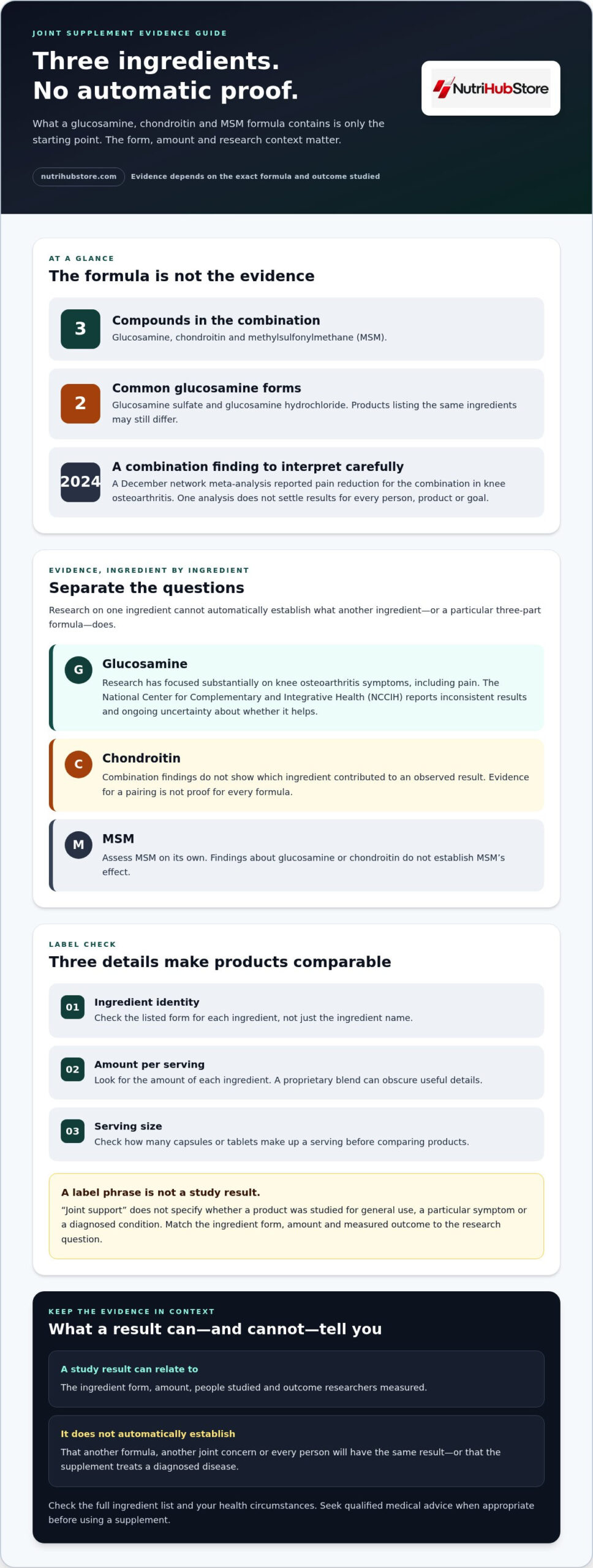
Three ingredients on a label don’t prove that a formula works better. A joint support supplement with glucosamine chondroitin and msm combines three compounds commonly marketed for joint health, but the ingredient forms, amounts and research on the specific formula all matter. The combination’s name describes what is in it. It doesn’t establish that the product treats a condition or suits everyone.
In plain English: it’s a dietary supplement that puts glucosamine, chondroitin and methylsulfonylmethane (MSM) in one formula with the aim of supporting joint health. That description doesn’t establish that taking it eases symptoms or treats a diagnosed disease.
Labels can make different formulas look alike. Glucosamine may appear as glucosamine sulfate or glucosamine hydrochloride, while chondroitin is often listed as chondroitin sulfate. The amount per serving and the number of capsules or tablets in a serving can differ, too. Don’t assume two products are interchangeable just because both list the same three ingredients. You need the form and amount of each ingredient to compare them meaningfully.
What are glucosamine, chondroitin, and MSM?
Glucosamine is a compound found naturally in the body and used to make molecules involved in cartilage. Supplement labels commonly feature it as a joint-health ingredient. For background on the compound and its reported uses, see the Glucosamine Wikipedia article. Chondroitin is also associated with cartilage and is marketed in supplements for joint support.
MSM, short for methylsulfonylmethane, is a sulfur-containing compound included in some joint formulas. These descriptions explain what the compounds are and how manufacturers position them. They don’t show that taking them produces a measurable benefit. A proposed role in the body is not the same as proof of a real-world effect.
What does ‘joint support’ mean on a supplement label?
“Joint support” is broad wellness language. It doesn’t tell you whether a product has been studied for general use, a specific symptom or a diagnosed condition such as knee osteoarthritis. Those are different questions. Evidence for an ingredient in one context doesn’t automatically answer another.
Look for details behind the wording: which ingredient form was studied, how much was used, and what outcome researchers measured. A general label claim can’t replace that evidence. Your goals and health circumstances matter, too. An ingredient or amount that seems suitable for one person may not be appropriate for another.
Use the ingredient names as a starting point, not a verdict. Next, compare the formula details and assess what the evidence actually supports.
How strong is the evidence for glucosamine, chondroitin, and MSM?
A positive result for one ingredient doesn’t validate a three-ingredient formula. Studies ask different questions: they may test individual ingredients or combinations, use different formulations, and measure outcomes in people with a particular condition. Findings about knee osteoarthritis, for example, don’t automatically predict results for other joint concerns or for every person who takes a supplement.
What research says about glucosamine and chondroitin
Research on glucosamine and chondroitin has focused substantially on symptoms of knee osteoarthritis, including pain. Results have been inconsistent, and the National Center for Complementary and Integrative Health says it remains uncertain whether these ingredients help with knee osteoarthritis symptoms. Its overview explains why study results and recommendations don’t always align: NIH on Glucosamine and Chondroitin for Osteoarthritis.
Formulation matters. Studies may use different forms or amounts, and results in one study population may not apply to another. A finding about glucosamine alone can’t establish that chondroitin adds a benefit or that a particular product matches the study conditions.
What research says about MSM and combination formulas
MSM needs its own evidence assessment. A finding about glucosamine or chondroitin doesn’t establish MSM’s effect. Likewise, evidence for all three ingredients together can’t reveal which ingredient contributed to an observed result unless the study compares them separately. A December 2024 network meta-analysis reported pain reduction for the combination in knee osteoarthritis, but that single analysis doesn’t settle whether the formula works for everyone or for other goals.
Evidence for a combination applies to the formula and outcome studied, not automatically to every product with the same ingredients. That distinction matters when evaluating any joint support supplement with glucosamine chondroitin and msm.
| Ingredient or formula | Research question | Evidence caveat | Buyer takeaway |
|---|---|---|---|
| Glucosamine | Can it affect knee osteoarthritis symptoms? | NCCIH reports inconsistent results and ongoing uncertainty. | Check the form and study context before comparing products. |
| Chondroitin | Can it affect symptoms, alone or with glucosamine? | Combination findings don’t show which ingredient contributed. | Don’t treat evidence for a pairing as proof for every formula. |
| MSM | What effect does it have on the studied outcome? | Results for other ingredients can’t answer this question. | Look for evidence specific to MSM and the intended use. |
| Three-ingredient formula | Can the combination affect knee osteoarthritis pain? | A reported result doesn’t guarantee the same outcome elsewhere. | Compare the exact formula and outcome studied with the label. |
Use the evidence as a filter, not a promise. NutrihubStore.com offers sports nutrition products, including Ronnie Coleman Creatine XS and Kevin Levrone Gold Whey. To explore its broader range, visit the general sports-nutrition shop.
How to compare a joint support supplement label
A crowded label can make a formula look complete while hiding the details that matter most. Compare ingredient forms and amounts first. Marketing phrases and a long ingredient list don’t show whether a product matches the research or suits your needs.
Check ingredient forms and amounts per serving
Start with the Supplement Facts panel. Note the form listed for glucosamine and chondroitin, the amount of each ingredient, and the serving size. MSM should have its own amount, too. If the label gives only a combined blend total, you can’t tell how much of each ingredient the serving provides.
Compare like with like. Check amounts per full serving, not just per capsule or tablet, and note how many units make up that serving. Don’t assume a larger serving or a similar-sounding ingredient form matches the formula used in a study. Don’t use another product’s label to choose an amount. Follow the product directions and ask a qualified healthcare professional for advice about your circumstances.
Assess transparency and quality information
Clear labels name each ingredient and show its individual amount. A proprietary blend may list several ingredients but disclose only the blend’s total weight, making ingredient-by-ingredient comparisons difficult. Look for product information that explains the ingredients and serving directions rather than relying on broad claims such as “advanced support.”
Quality marks answer a different question from clinical research. A genuine USP Verified or NSF certification relates to label accuracy and manufacturing or contaminant checks within that program’s scope. It doesn’t prove that the product produces a specific joint-health outcome. Treat certification as a quality signal, not proof of effectiveness.
Use this quick comparison for each product you’re considering:
- Ingredient identity: Record the form listed for glucosamine and chondroitin, plus the name used for MSM.
- Amount: Check the amount of each ingredient per full serving. If a blend hides individual quantities, mark them as unknown rather than assuming.
- Serving size: Note how many capsules, tablets, or scoops make one serving so you compare equivalent portions.
- Quality information: Check what a certification or testing statement verifies, and distinguish it from evidence of a health effect.
This method helps you compare a joint support supplement with glucosamine chondroitin and msm without mistaking a longer ingredient list for stronger evidence. For other nutrition products, browse the sports nutrition shop.
Who should take extra care before using this combination?
A familiar ingredient list doesn’t make a supplement suitable for everyone. A joint support supplement with glucosamine chondroitin and msm may raise different questions depending on your medicines, allergies, health conditions or stage of life. Review those factors before deciding to use it.
Supplement suitability depends on individual health circumstances, not just the ingredients on the front of the bottle. If you take prescription medicines or manage a health condition, a pharmacist or clinician can review the full label alongside your medication list. Don’t stop or change prescribed treatment based on a supplement label.
Medication use and existing health conditions
People taking blood thinners such as warfarin should consult a doctor before using glucosamine or chondroitin, as these ingredients may interact with the medicine. People with diabetes should also seek medical advice before use. The National Center for Complementary and Integrative Health outlines these precautions in its information on glucosamine and chondroitin.
Bring the whole product label to the conversation, not just the front panel. A combination formula may contain additional ingredients, and a professional needs the complete list to consider potential interactions alongside your medicines and health history. This is especially useful if you use several medicines or supplements, since overlapping ingredients can be easy to miss.
Allergies, pregnancy, and other personal considerations
Some glucosamine is derived from shellfish. If you have a shellfish allergy, inspect the label for the ingredient source and ask a qualified healthcare professional if the information leaves you unsure. Don’t assume every glucosamine product uses the same source.
Glucosamine and chondroitin can cause mild digestive effects, including nausea, heartburn, diarrhoea or constipation. These are possible effects, not a prediction that you’ll experience them. Stop and seek appropriate medical advice if you’re concerned about a reaction.
During pregnancy or breastfeeding, get advice from a qualified healthcare professional before starting a joint supplement. Do the same if you’re managing a health condition, preparing for a medical procedure or considering the supplement for someone else. Personal circumstances can affect whether an ingredient is appropriate, even when the formula is widely sold.
Use a simple order of checks before taking a product:
- Read the complete label. Check every active ingredient, its source where stated, and the serving directions.
- Consider your circumstances. Note allergies, pregnancy or breastfeeding, health conditions, and all medicines or supplements you use.
- Ask a qualified professional when relevant. A pharmacist or clinician can review the label and medication list with you.
A supplement can’t replace diagnosis or care for persistent or worsening joint symptoms. Get qualified medical guidance rather than relying on a combination formula to explain or manage a health concern.
How to make a confident, realistic joint-supplement choice
A supplement label can look convincing and still leave the central question unanswered: does the formula match your goal, and is it appropriate for you? Make your choice by weighing evidence and label clarity, not by counting ingredients or trusting confident wording.
A supplement isn’t a substitute for diagnosing a joint problem, following prescribed treatment or getting broader health guidance. Evidence for glucosamine, chondroitin and MSM is mixed, so no combination can promise a particular result for every person. Keep expectations measured, and don’t treat a purchase as a way to find out whether a symptom has a medical cause.
A practical checklist before choosing
Before buying a joint support supplement with glucosamine chondroitin and msm, work through these checks. If the label leaves key details unclear, pause rather than filling in the gaps yourself.
- Match the formula to your goal. Identify the outcome you’re interested in, then look for research on that outcome and the relevant ingredient or combination. Evidence for one ingredient alone doesn’t establish that a three-ingredient product has the same effect.
- Confirm all three ingredients. Check that glucosamine, chondroitin and MSM appear by name on the label, not just in front-of-pack claims or a broad “joint complex” description.
- Check amounts and serving size. Look for a separate amount for each ingredient and note how many capsules, tablets or scoops make one serving. A combined blend total can prevent a fair comparison.
- Weigh evidence and transparency together. Compare the product’s ingredient forms and disclosed amounts with the research you’re using. Quality or testing information can help assess product standards, but it doesn’t prove a health outcome.
- Review personal suitability. Consider medicines, allergies, pregnancy or breastfeeding, and existing health conditions. Ask a qualified professional if any of these raise questions for you.
Set expectations before starting: decide what you hope to learn, and keep track of your experience without assuming that a change proves the supplement caused it. Don’t increase the serving or combine products to chase a result. Follow the label, and get professional guidance if you’re unsure how it fits your wider health plan.
When to pause and seek professional guidance
Speak with a qualified healthcare professional if symptoms persist, you have questions about a diagnosis, or you take medication and want to check for possible interactions. A pharmacist or clinician can review the complete product label alongside your medication list. Don’t delay assessment to try a supplement first.
New, severe or worsening symptoms call for medical assessment, not a supplement decision. The same applies if pain or stiffness limits daily activities or you’re unsure what may be causing it. A professional can help determine the next step; this guide can’t diagnose or treat a joint condition.
For a broader look at nutrition products, visit the supplement shop with your checklist in hand.
Choose your next step with confidence
Choosing a joint support supplement with glucosamine chondroitin and msm doesn’t need to become a search for a perfect formula. Write down what matters most to you, then use that priority to guide your comparison instead of changing criteria with every new claim.
Give yourself room to decide. If the available information doesn’t answer your questions, pausing is a sound choice. You don’t have to buy a supplement simply because it combines familiar ingredients.
Nutrihub Store offers sports nutrition products, including Ronnie Coleman Creatine XS and Kevin Levrone Gold Whey. Browse the range with your priorities in mind, and use each product’s information to decide what fits your needs.
Keep your expectations grounded, then take the next step that fits your goals.
Frequently Asked Questions
Does glucosamine, chondroitin, and MSM work better together?
Not necessarily. A combination label tells you the ingredients are together, not that combining them improves an outcome. If comparing a single-ingredient product with a blend, identify which ingredient and outcome matter to your decision. Otherwise, it’s difficult to judge what you’re paying for or interpret any change you notice. A joint support supplement with glucosamine chondroitin and msm isn’t inherently a better choice simply because it contains three ingredients.
How long does glucosamine, chondroitin, and MSM take to work?
There’s no dependable timeframe that applies to every product and person. A study’s observation period describes how researchers assessed that specific formula, not a deadline by which you should expect a result. If you and a healthcare professional decide to try a supplement, agree in advance on when to review your experience. Don’t treat a lack of early change as a reason to exceed the label directions.
Can I take glucosamine, chondroitin, and MSM with medication?
It depends on the medication and your health history, so get advice from a pharmacist or clinician before combining them. Mention medicines you take only occasionally as well as regular prescriptions, and bring the supplement’s full label. Don’t skip or change a prescribed dose to accommodate a supplement. If you’ve already started taking the combination, ask a qualified professional before changing either your medication routine or supplement use.
What are the common side effects of glucosamine, chondroitin, and MSM?
Reported mild effects can include digestive discomfort, such as nausea, heartburn, diarrhoea or constipation. If you notice a new symptom after starting a supplement, write down when it began and any other products you started around the same time. That record can help a healthcare professional assess what may be contributing. Don’t assume every symptom is caused by the supplement, or dismiss a concerning reaction.
Is glucosamine suitable for people with a shellfish allergy?
Some glucosamine comes from shellfish, so a person with a shellfish allergy shouldn’t infer the source from the word “glucosamine” alone. Look for source and allergen information on the product packaging and accompanying product details. If the source isn’t clear, get advice from a healthcare professional before using it rather than guessing. Formulations can differ, so don’t assume one product’s sourcing applies to another.
Should I take this supplement for joint pain instead of seeing a doctor?
No. A supplement can’t establish why a joint hurts. If you’re unsure whether symptoms need assessment, ask a qualified healthcare professional what signs to monitor and when to follow up. Before an appointment, note when the discomfort began and which movements or activities affect it. Those details can help make the conversation more useful, without delaying care while you test a supplement.
Can competitive athletes use supplements containing these ingredients?
Athletes shouldn’t assume a joint-health formula will improve training or competition performance. The research discussed for these ingredients focuses on joint-related outcomes, which doesn’t establish a performance benefit. If you compete, consider your sporting goals and discuss supplement use with a qualified sports dietitian or healthcare professional familiar with your training demands. They can help assess whether the product has a relevant role in your nutrition plan.