


BCAAs can start the muscle-building signal, but they don’t supply every ingredient your muscles need to build new protein. That’s the key to the essential amino acids vs bcaa for muscle protein synthesis question, and it explains why a drink marketed around leucine may sound more complete than it is.
It’s reasonable to feel unsure: leucine is an essential amino acid and a BCAA, while all three BCAAs are only part of the nine essential amino acids. Muscle protein synthesis needs the full set of building blocks. So does an EAA supplement outperform BCAAs, or can a protein-rich meal or whey already cover the need?
The practical answer depends less on supplement claims than on what you eat across the day. This guide separates the biology from the marketing, compares what EAAs and BCAAs can contribute, and explains when complete protein may be the more useful choice. It also distinguishes short-term changes in muscle protein synthesis measured after a dose from evidence about long-term muscle growth, so you can decide whether either supplement fills a real gap in your diet and training.
Key Takeaways
- For essential amino acids vs bcaa for muscle protein synthesis, know the key distinction: BCAAs are only three of the nine essential amino acids.
- Leucine can signal muscle protein synthesis, but building new muscle protein also requires the amino acids that supply its building blocks.
- Study results depend on what researchers measure; a short-term change in muscle protein synthesis doesn’t automatically prove greater muscle size or strength over time.
- Before choosing a supplement, assess your dietary protein, training routine, and practical constraints to see whether amino acids fill a genuine gap.
- Complete protein from food or a supplement such as whey may make standalone amino acids unnecessary for some people.
EAAs vs BCAAs: What Each Supplement Contains
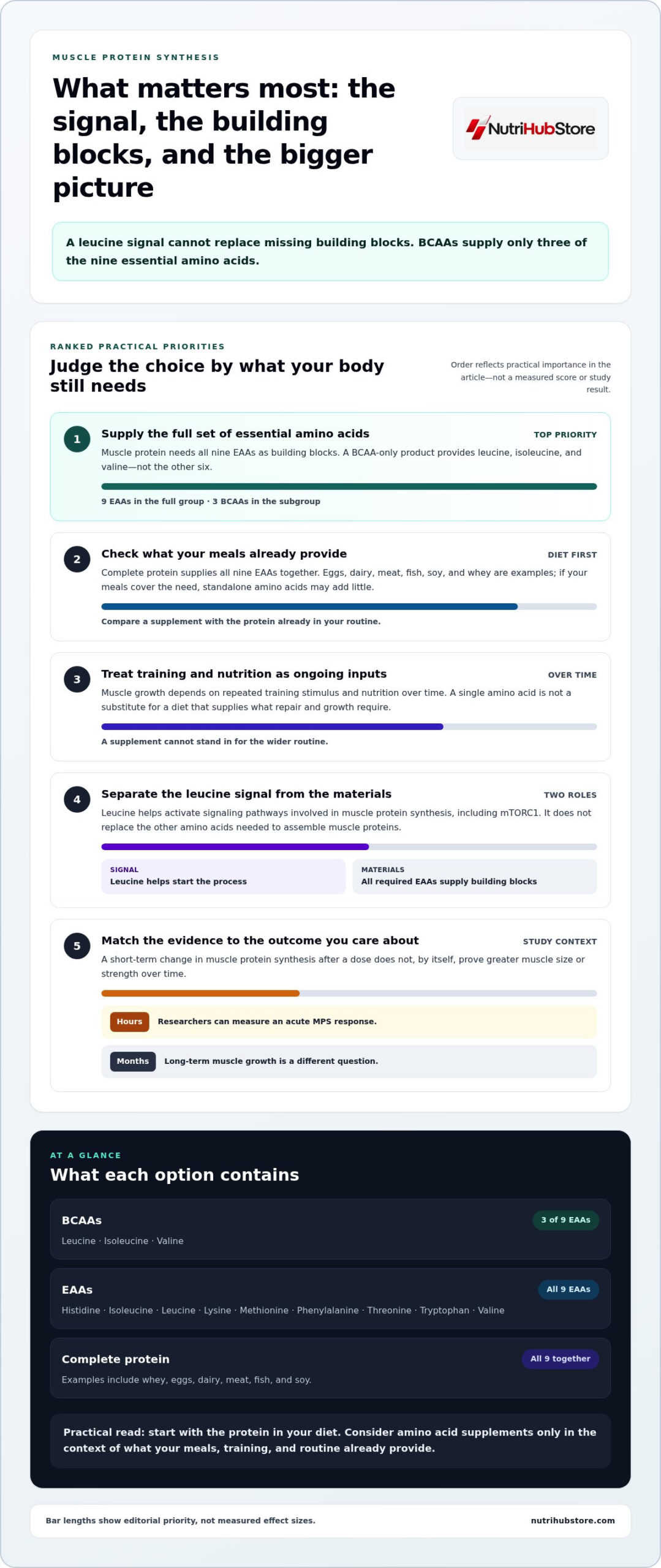
Amino acid labels can make two products sound more different than they are. The key distinction is scope: essential amino acids (EAAs) are the full group the body must obtain from food or supplements, while branched-chain amino acids (BCAAs) are three members of that group.
Which amino acids are included in each group?
Humans need nine EAAs: histidine, isoleucine, leucine, lysine, methionine, phenylalanine, threonine, tryptophan, and valine. The Essential Amino Acids reference lists these and explains the broader classification. The BCAAs are leucine, isoleucine, and valine. A BCAA supplement supplies those three, not the other six essential amino acids.
EAAs are the whole set of nine essential amino acids; BCAAs are the leucine, isoleucine, and valine subgroup within that set. This distinction matters when comparing labels: an EAA formula includes BCAAs by definition, but a BCAA-only formula does not provide all EAAs.
How do supplements differ from complete protein?
A complete protein food provides all nine essential amino acids together. Eggs, dairy, meat, fish, and soy are familiar examples; whey is another option. With a protein source, amino acids come together rather than as only three isolated components. That describes composition, not a claim that one format is automatically necessary for everyone.
| Category | Composition | Role in the diet | Common source |
|---|---|---|---|
| EAAs | All nine essential amino acids | Supply amino acids the body cannot make in sufficient amounts | Foods containing protein or an EAA supplement |
| BCAAs | Leucine, isoleucine, and valine | Provide three specific EAAs, not the full set | Protein foods or a BCAA supplement |
| Complete protein | All nine EAAs together in a protein source | Contributes protein and its amino acid components to the diet | Whey, eggs, dairy, meat, fish, or soy |
For essential amino acids vs bcaa for muscle protein synthesis, composition is the starting point, not the whole answer. Leucine is one BCAA, but a BCAA product still lacks the other essential amino acids unless they come from the rest of the diet. Whey is one complete-protein option; it isn’t a requirement if your meals already meet your needs.
If whey fits your routine, Kevin Levrone Gold Whey is one complete-protein option in the sports nutrition supplement range. Compare what each choice adds to your existing meals, not simply which label sounds more targeted.
How EAAs and BCAAs Relate to Muscle Protein Synthesis
Muscle protein synthesis (MPS) is the process of building new muscle proteins from amino acids. Training can stimulate this process, but a signal to build is not the same as having all the materials needed. That distinction explains why leucine attracts attention, yet a BCAA supplement cannot guarantee muscle growth.
Why leucine draws attention in BCAA discussions
Leucine helps activate signaling pathways involved in MPS, including mTORC1, a regulator of cell growth and protein-building activity. This is why it is often described as a trigger. But a trigger doesn’t supply the full set of amino acids muscle tissue must assemble into protein.
Think of signaling as the instruction to begin a job. The body still needs the materials. If leucine raises the signal while other essential amino acids remain limited, the process can’t keep building indefinitely. The NIH-hosted review BCAAs and Muscle Protein Synthesis: Myth or Reality? examines why BCAA-focused claims need to be judged against human research, rather than inferred from leucine’s signaling role alone.
Why all essential amino acids matter
Muscle proteins contain multiple amino acids arranged in specific sequences. Leucine can’t stand in for lysine, threonine, or the other amino acids required in those structures. If the supply of one or more essential amino acids is inadequate, that shortage may limit how much new protein the body can assemble, even when a signal to begin synthesis is present.
Human studies help distinguish these steps. Researchers can measure short-term changes in MPS after participants consume amino acids, but that result doesn’t show by itself that a supplement builds more muscle over months. The review linked above discusses the limits of interpreting BCAA studies, including why an acute response and a sustained training outcome are different questions.
A short-term rise in muscle protein synthesis is a measured response, not proof of long-term muscle gain. Muscle growth also depends on repeated training stimulus and nutrition over time. A single amino acid isn’t a shortcut or a substitute for a diet that supplies the materials needed for repair and growth.
For essential amino acids vs bcaa for muscle protein synthesis, focus on both the signal and the available building blocks. If a convenient complete-protein option fits your routine, you can browse the shop’s protein and nutrition supplements as one way to support your wider diet. Next, look at what the studies actually measure before deciding which supplement works better.
EAA vs BCAA Evidence: What the Comparison Can and Cannot Prove
A study can show that amino acids change muscle protein synthesis over a few hours without showing that a supplement builds more muscle over months. To judge the evidence on essential amino acids vs bcaa for muscle protein synthesis, check who took part, what they ate beforehand, whether they trained, and what researchers measured.
What human studies say about BCAAs
A human trial by Jackman and colleagues examined BCAA intake after resistance exercise in young adults and measured muscle protein synthesis over a short period. It found an acute response compared with a placebo, but the trial wasn’t a long-term test of muscle size or strength. Its findings also don’t establish that BCAAs outperform complete protein or work equally well across different diets.
That context matters. A fasted participant and someone who has eaten a protein-rich meal don’t start a study in the same nutritional state. Results from a small, short experiment can explain a response under those conditions, but they can’t settle whether BCAAs add meaningful gains for people already eating adequate protein.
What human studies say about EAAs
Human research has also tested EAA intake in relation to muscle protein synthesis, including around resistance exercise. These studies support the ability of essential amino acids to stimulate an acute response, but an EAA trial and a BCAA trial aren’t a head-to-head comparison unless their participants, exercise, prior meals, dose, and measurement period closely match.
Exercise itself can affect the outcome, as can participants’ total protein intake. A rise in synthesis after EAAs doesn’t prove that the supplement alone caused a long-term increase in muscle or strength. Researchers need longer training studies that measure those outcomes directly.
Use the study design to judge the claim, not just the headline. Before applying a result to your routine, look for these details:
- Participants: Were they trained adults, beginners, older people, or another specific group?
- Starting nutrition: Did participants fast, eat beforehand, or follow a controlled protein intake?
- Comparison: Was the supplement compared with a placebo, complete protein, or another amino acid formula?
- Outcome and duration: Did researchers measure short-term synthesis, or track muscle size and strength over a training period?
Reviews such as Wolfe’s 2017 analysis of BCAAs discuss why short-term synthesis findings shouldn’t be treated as direct proof of lasting muscle gain. For a fair EAA-versus-BCAA comparison, prioritize direct trials with comparable conditions and meaningful long-term outcomes. If a study measures only an acute response, keep your conclusion just as narrow.
How to Decide Whether EAAs or BCAAs Fit Your Routine
A supplement won’t fix inconsistent training or fill a gap you haven’t identified. Before comparing labels, follow this sequence to decide whether an amino acid product would add anything useful to your routine.
- Assess your dietary protein. Look across typical meals and snacks, not just what you eat after training. Note the protein sources you rely on and whether your pattern changes on busy days.
- Review your training. Consider how often you train and how meals fit around your sessions. Consistent resistance training and adequate overall nutrition matter more than choosing between two amino acid labels.
- Identify practical constraints. A tight schedule, appetite, or dietary restriction may make it harder to get protein from meals. Pinpoint the obstacle before choosing a supplement.
- Set a clear supplement rationale. Decide what gap the product would address, then consider whether a complete protein or a broader change to meals would address it better.
Start with your current protein intake
Needs vary with body size, diet, training, and health context, so another person’s routine isn’t a reliable template. Review a few typical days and note whether meals regularly include protein sources or intake becomes uneven on certain days. If a medical condition or special dietary need affects your choices, discuss your protein plan with a qualified clinician rather than relying on a supplement comparison for individualized advice.
Match supplement choice to a real dietary gap
Convenient amino acids may be worth considering when eating around training is difficult, but convenience alone doesn’t prove a benefit. Fasted training is one such context: either supplement may be convenient, yet it doesn’t guarantee a unique muscle-building outcome. If dietary restrictions limit your protein sources, planning for complete protein may be more useful than defaulting to BCAAs.
For the essential amino acids vs bcaa for muscle protein synthesis decision, check your overall pattern first. If meals already provide a suitable mix of protein sources and training is consistent, a standalone amino acid product may add little. If your routine has a specific gap, compare practical options that address it, including complete protein. The goal isn’t to add another product by default, but to choose an approach you can sustain.
Before selecting a product, identify what your meals and training routine actually need. If you’ve found a genuine gap, compare options that fit your plan.
A Practical Takeaway: Prioritize Complete Protein Before Amino Acid Supplements
BCAAs are a subset of EAAs, not a separate route around the rest of your diet. Neither replaces overall nutrition, and neither guarantees muscle growth. If meals already provide enough complete protein for your needs, adding isolated amino acids may have little practical rationale.
A simple decision summary for different starting points
Start with what your routine already provides. If your meals regularly include complete protein sources, consider whether a standalone amino acid supplement addresses a specific gap or simply duplicates what you get from food. If dietary restrictions make protein planning harder, assess suitable complete-protein options first rather than assuming BCAAs solve the problem.
If you’re still considering a supplement, read the label carefully. Check which amino acids it contains and compare its claims with the evidence: a short-term change in muscle protein synthesis doesn’t establish lasting gains in muscle size or strength. The essential amino acids vs bcaa for muscle protein synthesis comparison is useful, but it shouldn’t distract from the bigger question: does this product meet a need your current diet leaves unmet?
Keep muscle-building expectations realistic
Muscle growth reflects a consistent training stimulus alongside sufficient nutrition and recovery over time. A supplement can be a convenient tool within that routine, but it can’t replace progressive resistance training or make up for missed meals and irregular workouts. Changes in acute synthesis markers are not the same as visible muscle gain.
That distinction keeps expectations grounded. A study may measure how the body responds to amino acids over a short period, while your goal is a change that develops across weeks or months. Those are different outcomes, so don’t treat a promising short-term marker as a promise about your physique.
For a practical option that contributes complete protein, whey may fit some routines, while ordinary meals may suit others. The right choice depends on your overall intake, food preferences, and schedule. If a medical condition or special dietary need affects your choices, seek guidance from a qualified clinician.
If you’ve identified a genuine gap and want to compare nutrition options, browse the sports nutrition shop without assuming you need a standalone amino acid product.
Before selecting another supplement, review what you eat on a typical day and identify what, if anything, your current routine is missing.
Make Your Next Supplement Choice Count
A supplement earns its place through usefulness, not a promise on the label. Set a simple standard before buying: can you explain what role it serves in your routine, and will it make that routine easier to maintain?
For essential amino acids vs bcaa for muscle protein synthesis, keep the research in perspective as you weigh the options. A short-term response in a study isn’t a guarantee of a visible result, so don’t judge a product by a bold claim alone.
Nutrihub Store serves customers across the UAE with sports nutrition options, including Kevin Levrone Gold Whey as a complete-protein choice. Choose a product because it suits your preferences and routine, not because you feel pressured to add another supplement.
Make your next choice with a clear purpose: browse Nutrihub Store’s sports nutrition range and choose an option that fits your routine.
Frequently Asked Questions
Can a plant-based diet provide all essential amino acids for muscle protein synthesis?
Yes. A varied plant-based diet can cover essential amino acid needs. Build meals from options such as tofu, lentils, beans, peas, grains, nuts, and seeds, and pay attention to your overall protein intake rather than relying on one food. Soy foods can be a convenient protein choice. If you’re unsure whether your usual meals provide enough variety, tracking a few typical days can help reveal patterns.
Are essential amino acids absorbed faster than whey protein?
Free-form amino acids may enter the bloodstream sooner because they don’t need to be released from an intact protein first. Whey is also digested relatively quickly, and absorption speed alone doesn’t tell you which is more useful. Compare the amount of protein or amino acids in a serving, how it fits your meals, and whether you value a drink that provides protein as a whole or isolated amino acids.
Do you need to take amino acids immediately after a workout?
No. There’s no need to rush a supplement the moment training ends. If you ate a protein-containing meal before your session, your next meal can follow your normal schedule. If you trained without eating and won’t have a meal soon, a convenient protein option may suit your routine. Prioritize a pattern you can follow consistently instead of letting workout timing create unnecessary pressure.
Can you take EAAs and BCAAs together?
Usually, there’s little reason to stack them. Before combining supplements, compare their ingredient panels and serving information to see whether the same amino acids appear in both. Also consider whether each product serves a separate purpose in your routine. If the labels show substantial overlap, choosing one approach may simplify your supplement plan and help avoid paying for duplicate ingredients.
Do essential amino acid supplements have side effects?
Some users may experience digestive discomfort, and reactions can vary with the formula and the individual. Check the label for ingredients you know you don’t tolerate, follow its directions, and stop using the product if you experience an unwanted reaction. If you take medication, have a medical condition, or are pregnant or breastfeeding, speak with a qualified clinician or pharmacist before adding an amino acid supplement.
Does fasted training change whether BCAAs or EAAs make sense?
It may change what feels practical, but it doesn’t tell you which supplement will improve results. Consider why you train fasted: perhaps it fits your schedule, or perhaps eating beforehand feels uncomfortable. Pay attention to whether your sessions feel manageable and whether you can maintain your training quality. If you feel unwell or your performance suffers, reassess the routine rather than assuming an amino acid drink is the answer.
Can leucine alone support muscle protein synthesis?
Leucine alone isn’t a sound replacement for complete protein food or a balanced meal. For practical meal planning, don’t use a product’s leucine content as your only measure of protein value. Consider the serving’s full nutritional contribution and how it fits the rest of your diet. The phrase essential amino acids vs bcaa for muscle protein synthesis can focus attention on one ingredient, but your overall protein choices matter more than a single amino acid.