

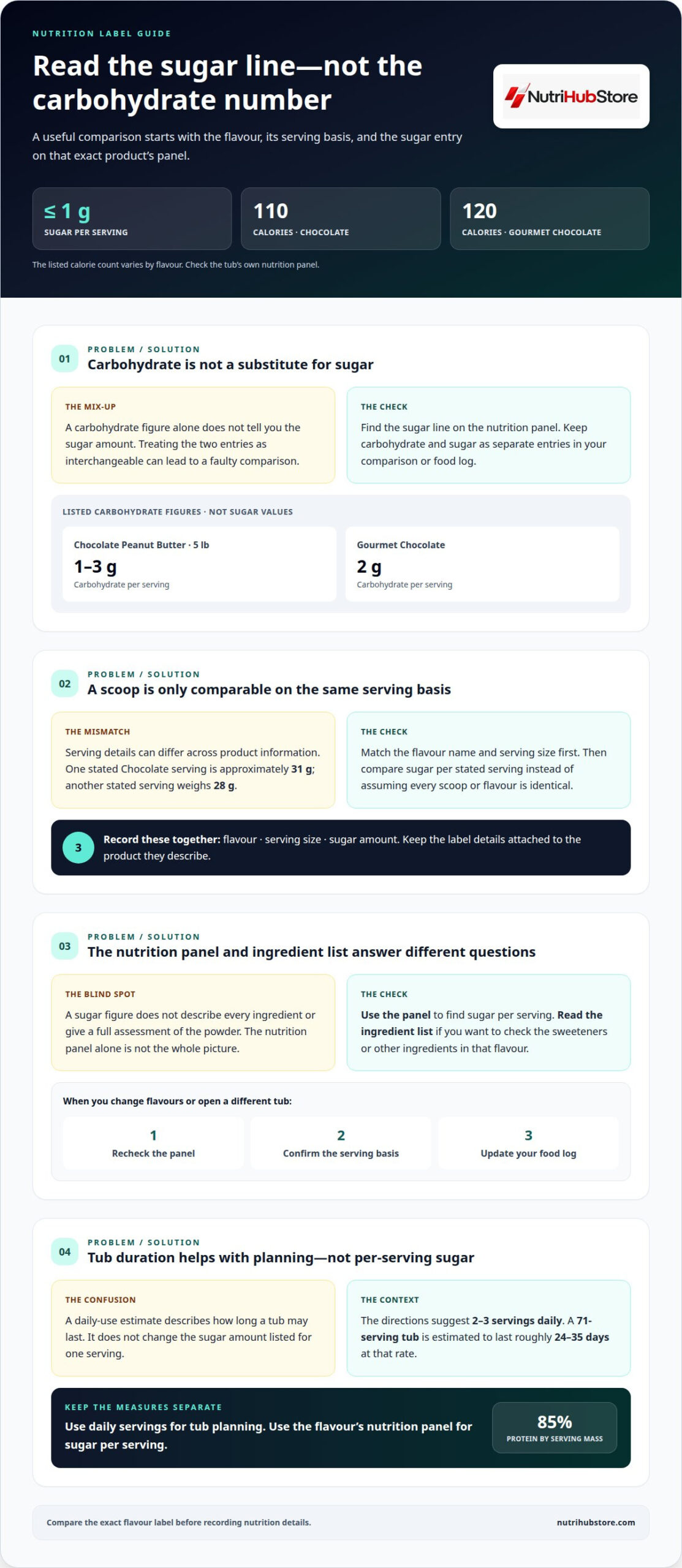
A serving of Dymatize ISO100 5lbs contains no more than 1 g of sugar and no more than 120 calories. The listed calorie count depends on the flavour: Chocolate has 110 calories per serving, while Gourmet Chocolate has 120. So the sugar figure is a useful starting point, but the full nutrition panel gives you a clearer picture of what you’re adding to your daily intake.
If you’re comparing protein powders, it makes sense to focus on sugar, calories and serving size before choosing a tub. Those details can affect how well a powder fits your meal plan, especially if you’re tracking your intake closely. This guide breaks down the per-serving nutrition, the number of servings in a 5 lb tub and the basic mixing directions, so you can assess the product against your routine without relying on the front-label claims alone.
Key Takeaways
- Use the flavour’s nutrition panel to compare calories and sugar per serving, since figures can vary by variant.
- Check the serving size alongside protein and amino acid amounts to understand what each scoop provides.
- Match the mixing liquid amount to the directions for your specific flavour and adjust the texture to your preference.
- Use the tub’s serving count to plan how it fits into your routine, rather than relying on the 5 lb size alone.
- Consider lactose content and other ingredients when assessing how a whey isolate fits your dietary needs.
Protein, BCAA and leucine per serving
Dymatize ISO100 protein figures vary across the listed serving information. Some product details give 25 g of protein per serving, while another reports 24 grams. Treat the flavour’s own nutrition label as the practical reference: compare its serving size and protein figure together, rather than assuming every tub uses an identical scoop or formula. That distinction matters when tracking intake precisely or comparing two flavours side by side.
The serving-size details also differ. A Dymatize ISO100 Chocolate serving is approximately 31 g, while another stated serving weighs 28 grams. These figures shouldn’t be combined as though they describe one scoop. Check the product’s flavour name and serving size, then use that same serving as the basis for your protein calculation. A 25 g protein figure means the stated serving supplies that amount, not that every scoop across all variants does.
BCAAs and leucine
Dymatize ISO100 provides 5.5 g of BCAAs per serving. BCAAs are branched-chain amino acids; leucine is one of them, alongside isoleucine and valine. The leucine amount therefore belongs within the BCAA total. Don’t add the leucine figure to 5.5 g as if it were a separate amino acid serving. That would count leucine twice.
Leucine figures also depend on the product detail being referenced. Dymatize ISO100 Chocolate lists 2.7 g of L-leucine per serving, while a general ISO100 figure gives 2.6 g. Read these as variant-specific or differently reported values, not as amounts to combine. If you’re comparing labels, match the flavour first, then compare leucine per stated serving. Small differences can affect the accuracy of a nutrition log.
For a simple check, note three label details before recording a scoop: flavour, serving size, and protein amount. Then record the BCAA and leucine values shown for that same product. This keeps a Chocolate serving’s 2.7 g L-leucine figure separate from another listed serving’s 2.6 g. It also prevents a 28-gram serving from being treated as equal to a 31-gram serving without checking its panel.
For shoppers comparing dymatize iso100 5lbs tubs, the useful question isn’t just “How much protein?” It’s “How much protein and leucine does this flavour provide per labelled serving?” Use the tub’s own serving details when planning your intake. A clear, flavour-matched comparison gives you a more reliable basis for choosing protein powder than relying on one headline figure across every variant.
Sugar content per serving
A low-sugar claim is useful only when you know what the label measures. Start with the nutrition panel, find the sugar entry, and note the serving size. This keeps your comparison tied to the amount you actually prepare, rather than a front-of-pack phrase without its full context.
If you’re tracking particular sweeteners, check the ingredient list too. The nutrition panel reports the sugar amount, while the ingredients show what the product contains. These details answer different questions, so read both rather than treating either as a complete picture of the flavour.
For a useful comparison, choose the flavours you’re considering and note each label’s serving description and sugar entry. Keep the details together. If serving sizes differ, compare equivalent amounts before deciding which option better suits your preferences.
Don’t mistake a sugar figure for a full assessment of the powder. It doesn’t describe protein content, calories, or every ingredient. A product may suit a sugar-conscious choice while still requiring you to consider its other nutrition details and how it fits your overall eating pattern.
Use the same routine whenever you change flavours or open a different tub: read the panel, identify its serving basis, then update your food log. This avoids carrying an old entry forward when the product details you’re using have changed. For a broader choice, compare the protein selection against your preferences and the nutrition information on each product.
When you compare labels, keep carbohydrate and sugar as separate entries rather than treating them as interchangeable. The product listing for Dymatize ISO100 Chocolate Peanut Butter 5 lb states 1-3g of carbohydrates per serving; Dymatize ISO100 Gourmet Chocolate has 2g of carbohydrate per serving. Those figures can help you compare the carbohydrate information for the named flavours, but they do not supply a sugar value. For a sugar-focused decision, return to the sugar line and serving basis on the tub you have, and avoid substituting a carbohydrate figure for missing sugar information. Dymatize ISO 100 is also described as containing 0 fats and carbohydrates per serving. Keep each figure attached to its specific product name rather than transferring it to another flavour.
The product directions suggest taking 2-3 servings daily as part of a balanced diet and consistent resistance training programme. At 2 to 3 servings daily, a 71-serving tub is estimated to last roughly 24 to 35 days. That estimate is a use-planning detail, not a sugar measure: it does not change the amount reported for a serving, so keep the panel’s serving basis consistent when recording what you consume. Protein makes up 85% of a serving of Dymatize ISO 100 by mass, another detail that describes composition rather than replacing the sugar entry. Read the sugar amount alongside these other label details, and keep the intended daily use separate from per-serving comparisons. This helps prevent a figure for carbohydrate, fat, or protein from being mistaken for the sugar amount when considering the product as part of your eating pattern.
Suggested mixing instructions
The liquid amount depends on the flavour’s directions, so one ratio won’t fit every Dymatize ISO100 tub. Many listed directions call for one scoop with 150-180 ml of liquid. Gourmet Vanilla, however, lists 180-240 ml. Use the instructions for your specific flavour rather than carrying one variant’s ratio across the range.
For Dymatize ISO100 Gourmet Chocolate, the directions specify one rounded scoop with 150-180 ml of liquid. That range gives you room to adjust the drink’s consistency. Start at the lower end for a thicker shake, or use the higher end for a more diluted mix. Keep the powder portion at one rounded scoop when following those directions.
Mixing one serving
- Measure the liquid amount stated for your flavour, such as 150-180 ml for Gourmet Chocolate.
- Add one scoop, or one rounded scoop where the label specifies that measure.
- Mix until the powder is evenly dispersed, then drink the prepared serving.
Follow the listed scoop directions, but don’t assume every flavour is prepared identically. Birthday Cake directions specify mixing one scoop into a drink, while Gourmet Vanilla gives a larger liquid range. Check the flavour label: the scoop instruction defines the powder portion, and the liquid amount helps determine the final texture.
If your shake feels too thick, increase the liquid within that flavour’s stated range. If it feels too thin, use the lower end next time. For Gourmet Chocolate, stay within 150-180 ml; for Gourmet Vanilla, use its stated 180-240 ml range. Don’t use the Vanilla range as a substitute for another flavour’s directions.
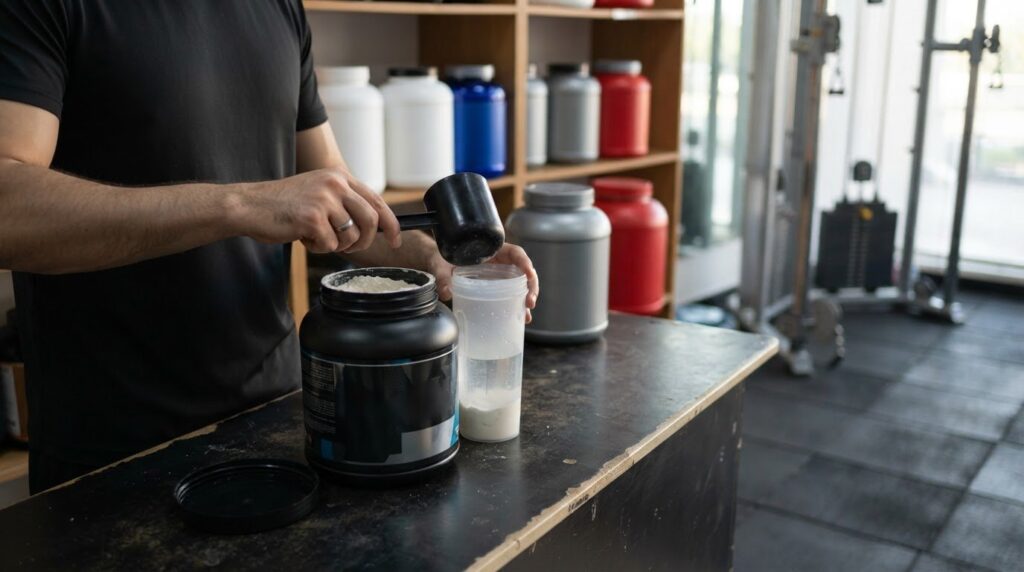
Measure with a marked cup rather than estimating from an unmarked glass. For a 150-180 ml direction, even a small pour difference can change the powder-to-liquid balance. The label’s unit is millilitres, so use that measurement directly. If you prepare a second serving, repeat the listed scoop and liquid ratio instead of doubling powder into the first mix.
Keep the serving size consistent when comparing prepared shakes. A 28-gram serving and an approximately 31-gram serving are different powder amounts, so they shouldn’t be treated as interchangeable scoops. Follow the serving instruction for the flavour in your tub, then use its matching liquid direction. This keeps the preparation aligned with the product details, rather than relying on a universal protein-shake ratio.
Keep the flavour-specific direction attached to the powder you are using: the product instructions recommend mixing one scoop of Dymatize ISO 100 Birthday Cake protein powder into a drink. For Gourmet Vanilla, one serving is mixed with 6-8 fl oz (180-240 ml) of liquid. Treat these as separate instructions rather than borrowing the liquid quantity from one flavour for the other.
Before preparing a serving, check the package for both the scoop direction and liquid amount. Using clear measurements makes it easier to repeat the same mix. If you switch flavours, adjust the liquid to match that flavour’s directions instead of assuming the previous preparation still applies. This keeps your method product-specific and avoids treating a flavour-specific range as a general rule.
Calories and sugar
Calorie figures are most useful when they inform a real meal-planning choice. Decide whether the shake will replace a usual snack or accompany your regular meals. That affects how it fits into your day, even if you prepare the same flavour in the same way.
Record the powder separately from the rest of your food. This makes it easier to see where a serving fits, rather than assuming a shake is a complete meal. If you’re comparing Chocolate with Gourmet Chocolate, assess each flavour against your plan and preferences, not just its name or packaging.
Consider the shake’s role before selecting a variant. Someone looking for a convenient protein serving between meals may assess the label differently from someone planning to have it with breakfast. The nutrition information can help guide that choice, but the rest of the meal still matters to your overall intake.
Use a consistent method to record your serving. Follow the label’s serving description and note whether you had the powder alone or with food. Update your record if your routine changes. Notes from a previous flavour or preparation may no longer reflect what you’re using now.
Calories and sugar answer different questions, so don’t treat one as a substitute for the other. Review both entries on the chosen flavour’s nutrition panel, then consider how they relate to your tracking priorities. Comparisons are most useful when they use the same product form and serving basis, rather than details from different variants.
Before switching flavours, identify what you want from the change. You might prefer a different taste or want to compare nutrition details for your food plan. Keep those reasons separate. A single label value shouldn’t decide the whole choice when taste, routine, and the rest of your meals also affect whether you’ll use it consistently.
A simple decision sequence keeps the comparison focused:
- Choose the flavour you’re considering.
- Read its panel and identify the serving used for its nutrition details.
- Decide whether the shake replaces food or accompanies it.
- Record it consistently alongside the rest of your meals.
This approach makes the label a planning tool, not a verdict on your entire diet. Use the flavour-specific information to make a deliberate choice, then consider how it fits your usual eating routine.
Digestibility
Dymatize ISO100 is described as easily digestible, but that phrase doesn’t tell you how every person will respond. Product details identify whey protein isolate as its protein source. That description gives useful context, yet it doesn’t replace checking the ingredient and allergen information for the specific flavour you use.
One concrete figure stands out for Gourmet Chocolate: each serving contains less than 0.5 g of lactose. That is a low listed amount, not the same claim as “lactose-free.” If lactose is a concern for you, read the full label and consider the stated amount alongside your own dietary needs. Don’t treat a single product detail as a guarantee of personal tolerance.
Also check the allergen information. Dymatize ISO100 contains milk and soy. Whey comes from milk, so the milk allergen is relevant even when a product is described as an isolate. Low lactose does not mean dairy-free, and it does not remove the need to review ingredients if you avoid milk or soy.
How to assess your response
Use a consistent approach when trying a new flavour. First, read the tub’s allergen and nutrition panels. Next, prepare one serving according to that flavour’s directions. Then note how it fits your routine and whether you experience an unwanted response. Record the flavour and serving details so you can make clearer comparisons if you switch variants.
For example, Gourmet Chocolate’s lactose figure applies to that named flavour. Don’t assume another ISO100 flavour has the same lactose amount. Check its own panel instead. The same rule applies when comparing a new tub with a previous one: match flavour to flavour, and use the serving information printed for each product.
What you mix the powder with can also affect how a serving fits your diet. A shake made with water differs from one prepared with another drink or added ingredients. Check those additions separately, especially if you’re tracking ingredients or avoiding specific foods. The powder’s lactose figure describes the powder serving, not every possible prepared shake.
Digestibility claims can help narrow a comparison, but ingredient details should guide the decision. For Dymatize ISO100, review the flavour, lactose amount where listed, and milk and soy allergen information before adding it to your routine. If a dietary restriction is strict, use the full product label as your reference, rather than relying on the words “easily digestible” alone.
Nutrihub Store: Ronnie Coleman Creatine XS
Nutrihub Store offers Ronnie Coleman Creatine XS for readers considering creatine alongside their protein routine. It’s a separate supplement, so choose it according to your training and nutrition plan, not as a replacement for whey protein. Kevin Levrone Gold Whey is another protein option available from Nutrihub Store.
For a broader fitness project, Nutrihub Store also provides Gym Setup and Fitness & Sports Flooring. Those services may suit readers planning a training space rather than choosing supplements alone.
Review the product details and consider how each option fits your goals. Visit nutrihubstore.com to explore Nutrihub Store’s offerings.
Make Your Next Nutrition Choice Deliberately
A supplement works best as part of a routine you can follow consistently. Before choosing a dymatize iso100 5lbs tub, decide how you’ll fit it into your meals, training schedule, and broader nutrition plan. That practical decision matters more than buying a product because it appears popular or convenient.
Keep your goal clear as you compare options. If you want to review protein and other sports nutrition products in one place, explore Nutrihub Store’s shop and consider what fits your routine. Choose according to your preferences and training needs, then build a plan you can maintain.
Take the next step at a pace that feels right for you. A thoughtful choice can help you stay consistent over time.
Frequently Asked Questions
What are the Dymatize ISO100 5 lb nutrition facts and protein per serving?
Protein per serving and the broader nutrition facts depend on the flavour and serving size printed on your tub. For an accurate comparison, match the flavour name to its nutrition panel, then use the stated scoop serving when logging intake. To estimate the protein in the full container, multiply the label’s protein per serving by the container’s listed serving count. This gives a flavour-specific estimate for your dymatize iso100 5lbs tub.
Dymatize ISO100 5 lb price in UAE
Dymatize ISO100 5 lb flavors available in UAE
Listed flavours include Chocolate, Gourmet Chocolate, Gourmet Vanilla, Chocolate Peanut Butter, and Birthday Cake.
Dymatize ISO100 5 lb serving count and scoop size
Serving counts vary by flavour: Chocolate has approximately 73 servings, Gourmet Chocolate and Chocolate Peanut Butter have 71, and Gourmet Vanilla has 76. The listed serving sizes include approximately 31 g for Chocolate and 28 g for another ISO100 serving; check your flavour’s label for its scoop size.
Is Dymatize ISO100 5 lb authentic in UAE and how to verify it
ISO100 is tested for banned substances and undergoes five quality-control procedures.
Dymatize ISO100 5 lb reviews and taste ratings
The Chocolate Peanut Butter listing has a rating of 4.6 out of 5 from 2,977 ratings.