


Loading doesn’t produce better long-term results; it reaches muscle saturation sooner. If you’re weighing the creatine loading phase vs consistent daily dosing protocol, the real choice is speed versus a simpler routine, not whether creatine can work without loading. Conflicting advice about dose and timing can make that distinction easy to miss.
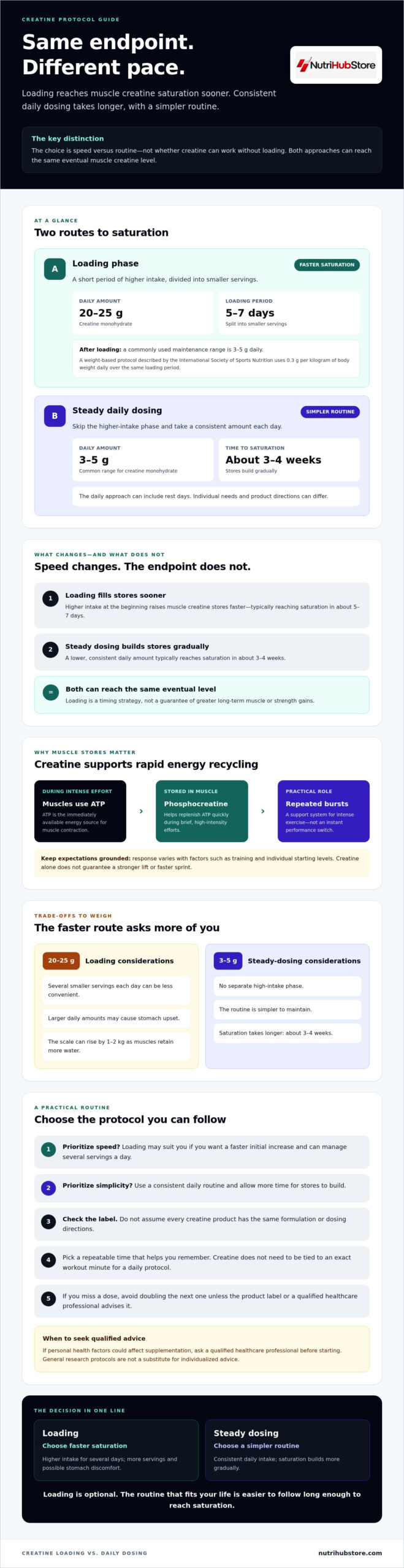
A loading phase typically uses 20 to 25 grams daily for 5 to 7 days, split into smaller servings. A steady approach uses 3 to 5 grams each day and reaches saturation in about 3 to 4 weeks. Both can lead to the same eventual level of muscle creatine, so loading is optional.
What does loading cost in convenience and comfort? Larger daily amounts may cause stomach upset, and the scale can rise by 1 to 2 kilograms as muscles retain more water. This comparison will help you weigh those trade-offs, choose a routine you can stick with, and understand when to seek qualified medical advice before taking creatine.
Key Takeaways
- Understand how muscle creatine stores and phosphocreatine support ATP regeneration during brief, high-intensity efforts.
- Use the creatine loading phase vs consistent daily dosing protocol comparison to decide which routine better matches your priorities and tolerance.
- Check the product label before choosing a schedule, and don’t assume every creatine product has the same directions.
- Know when personal health factors make it sensible to ask a qualified healthcare professional before starting supplementation.
- See how Ronnie Coleman Creatine XS fits into your supplement options without assuming its dosing instructions or formulation.
Creatine loading vs. daily dosing: what is the actual difference?
Loading raises muscle creatine stores faster, but it asks more of your routine for several days. Consistent daily dosing takes longer and is simpler to maintain. The creatine loading phase vs consistent daily dosing protocol choice changes the pace of saturation, not the eventual goal: building up muscle creatine stores over time.
Creatine supports repeated, high-intensity efforts by helping replenish phosphocreatine, a compound muscles use to rapidly regenerate ATP, the energy source for muscle contraction. For background on how creatine works and how loading and maintenance protocols are described, see Creatine supplementation protocols.
What does a creatine loading phase mean?
Loading is a short period of higher intake, followed by a lower maintenance amount. Its purpose is to raise muscle creatine stores more quickly than a steady, lower daily dose.
A commonly used protocol is 20 to 25 grams of creatine monohydrate per day for 5 to 7 days, divided into smaller servings. The International Society of Sports Nutrition describes a weight-based approach of 0.3 grams per kilogram of body weight daily over the same period. After loading, a typical maintenance range is 3 to 5 grams daily. These are general research protocols, not a substitute for checking a product’s label or getting qualified advice when needed.
Loading is optional. It may suit someone who wants a faster initial increase and can manage several servings a day. The higher intake can be less convenient and less comfortable for some people.
What does consistent daily dosing mean?
With steady dosing, you skip the separate high-intake phase and take a consistent daily amount. A commonly used range for creatine monohydrate is 3 to 5 grams per day, including rest days. Individual needs and product directions can differ, so don’t assume one amount suits everyone.
This approach builds muscle creatine stores gradually. Full saturation typically takes about 3 to 4 weeks, compared with around 5 to 7 days with loading. The wait is the trade-off for a less complicated routine.
Creatine doesn’t need to be tied to an exact workout minute to work as a daily protocol. Choose a repeatable time that helps you remember it, then follow the product label consistently. If you miss a dose, avoid doubling the next one unless the label or a qualified healthcare professional advises you to do so.
In practical terms, choose loading for speed or steady dosing for simplicity. Faster saturation isn’t proof of better long-term results. The protocol that fits your routine is easier to follow long enough to reach saturation.
How creatine saturation works: why the two protocols differ in timing
Loading changes how quickly muscle stores rise, not what the body does with creatine once those stores build. That distinction explains why loading can reach saturation sooner without guaranteeing greater long-term gains.
What happens to creatine in muscle?
Muscle creatine stores are the creatine held in muscle tissue, including phosphocreatine, a stored form that helps replenish energy during intense effort. When you sprint or perform a hard set of lifts, muscles use ATP, their immediately available energy source. Phosphocreatine helps regenerate ATP quickly, supporting repeated short bursts of work.
This is a support system, not an instant performance switch. The scientific review of creatine’s effects discusses how supplementation can increase muscle creatine availability and support high-intensity exercise. The response still depends on factors such as training and individual starting levels. Taking creatine alone doesn’t guarantee a stronger lift or faster sprint.
Does loading produce better results or just faster saturation?
Think of muscle creatine stores as a reservoir that fills over time. Loading adds more at the beginning, so the reservoir fills sooner. A steady daily intake adds less at a time, building stores gradually. Once both approaches reach saturation, loading hasn’t created a higher endpoint simply by getting there faster.
Loading is a timing strategy, not a guarantee of greater gains. A faster rise in muscle stores may be useful if you have a specific reason to reach saturation sooner, but it doesn’t mean loading alone builds more muscle or strength over the long term.
Creatine’s potential performance support should be considered alongside the training program, diet, study conditions, and individual response. Results won’t be identical for everyone, and changes in training performance don’t automatically translate into a particular amount of muscle gain. The practical question is whether faster saturation matters enough to justify a more demanding short-term routine.
If you’re considering creatine, compare the product’s label directions with the protocol you plan to follow. You can also browse the sports supplement selection to review available options while deciding which routine fits your needs.
Loading phase vs. daily dosing: compare speed, routine, and trade-offs
Loading shortens the time before saturation but adds more servings to your day. Steady dosing takes longer and requires less adjustment. The creatine loading phase vs consistent daily dosing protocol decision comes down to whether faster saturation is worth the extra short-term effort.
| Factor | Loading phase | Steady daily dosing |
|---|---|---|
| Typical time to saturation | About 5 to 7 days | About 3 to 4 weeks |
| Routine | Higher daily intake, usually divided into smaller servings, then maintenance | A consistent daily amount, with no separate loading period |
| Tolerance considerations | More likely to feel inconvenient; larger amounts may cause stomach discomfort | Lower daily intake may feel simpler, though individual tolerance varies |
| Possible scale change | Some people notice short-term water-weight gain as muscle stores increase | Changes may occur more gradually |
The protocols described in common methods of creatine supplementation include loading with 20 to 25 grams daily for 5 to 7 days, followed by 3 to 5 grams daily for maintenance. These are general research protocols, not directions for every product. Check the label before using a schedule, and don’t exceed its directions.
When might a loading phase suit your priorities?
Loading may suit you if you want to raise muscle creatine stores sooner and can reliably divide the daily amount into smaller servings. The trade-off is a busier routine for several days. Larger doses can cause gastrointestinal discomfort in some people. Splitting the total may help, but doesn’t guarantee you’ll avoid it.
Some people also see a short-term scale increase, often around 1 to 2 kilograms, as water is retained within muscle. That isn’t a universal response, and it shouldn’t be mistaken for fat gain. If this change would concern you, a slower approach may feel more manageable.
When might steady daily dosing be the better fit?
Choose steady dosing if you prefer one repeatable habit and are comfortable waiting longer for saturation. Skipping loading doesn’t stop creatine stores from building; it simply takes more time. For many people, a routine they can sustain is more useful than adding complexity for a faster start.
Whichever approach you consider, follow the label and keep the routine consistent. If you’re comparing products, you can browse the sports supplement selection and check the product directions before settling on a protocol.
How to choose and follow a creatine protocol safely
A complicated plan isn’t automatically a better plan. The best choice depends on whether reaching saturation sooner matters to you and whether you can follow the schedule comfortably. Use the creatine loading phase vs consistent daily dosing protocol comparison to choose a routine, then give it time before judging its effects.
A simple decision process for choosing your approach
Start with your timeline. If you want to raise muscle creatine stores sooner and can manage divided servings for a short period, consider a loading schedule based on verified guidance. If that feels impractical, steady daily dosing avoids a separate loading phase, though saturation takes longer.
Next, check the product label. Products can have different directions, so don’t assume a general research protocol applies to every supplement. Follow the label and don’t exceed its directions. If you’re unsure how a product fits a protocol, ask a qualified healthcare professional or pharmacist.
The most useful protocol is one you can follow consistently and safely. Before switching approaches, ask whether you’ve followed your current routine regularly enough to assess it. Changing the plan after only a few sessions makes it harder to separate the effects of inconsistent use from the effects of training, diet, or individual response.
What should you monitor, and when should you ask a clinician?
Keep a simple record of whether you take your daily serving, your training routine, and any unwanted effects, such as stomach discomfort. This helps you spot patterns without treating a single workout or scale reading as proof that a protocol is working or failing.
Ask a clinician or pharmacist for guidance before starting if you have kidney disease, take medication that could be relevant, are pregnant or breastfeeding, or have another health concern. Don’t rely on general supplement guidance to answer questions about your medical history or possible interactions. Seek professional advice if you develop concerning symptoms after starting a supplement.
This information is educational and can’t replace individualized medical advice. A clinician can consider your health circumstances and medications when discussing whether creatine is appropriate for you.
Putting your creatine routine into practice with a suitable supplement
Choosing a protocol is only useful if the product’s directions support the routine you intend to follow. Loading prioritizes speed; steady daily dosing prioritizes simplicity. Neither is a universal winner, and a general research schedule shouldn’t override the instructions for a specific product.
What to check before selecting a creatine product
Read the specific product label before deciding how to take it. Check the ingredient panel, serving instructions, and warnings. Confirm that the directions fit your intended routine, especially if you’re considering a loading schedule with multiple servings in a day.
Don’t assume every product contains the same form of creatine, uses the same serving size, or supports the same schedule. If the label doesn’t make the directions clear, ask a qualified healthcare professional or pharmacist rather than estimating a serving or exceeding the stated instructions.
This is where the creatine loading phase vs consistent daily dosing protocol choice becomes practical. Pick the approach that fits your priorities, then check whether the product’s own directions align. If they don’t, don’t try to force the product into a generic protocol.
Where to explore the available creatine option
Ronnie Coleman Creatine XS is one creatine product offered by Nutrihub Store. Check its current product information and label for details before deciding whether it suits your chosen routine. Don’t assume ingredients, serving directions, or formulation details from the product name alone.
A useful final check is simple: can you follow the directions consistently, and do you understand the label’s warnings? If you have a health concern or take medication, ask a qualified professional whether creatine is appropriate for you before starting. Your supplement choice should support an informed routine, not push you into a schedule that doesn’t fit.
If you’re ready to review the available options, browse the sports supplement shop and check each product’s label before choosing.
Choose the routine you can sustain
Loading can bring muscle creatine stores to saturation sooner, while steady daily dosing keeps the routine simpler. The creatine loading phase vs consistent daily dosing protocol choice is about timing and practicality, not a promise that one approach delivers better long-term results.
Choose a schedule you can follow, check the directions on the specific product label, and track consistency and tolerance before deciding whether to change course. If you have a health concern or take medication, ask a qualified healthcare professional before starting creatine.
Ronnie Coleman Creatine XS is one option offered by Nutrihub Store, which offers authentic sports nutrition products. Review the product information and label before deciding whether it fits your routine.
Make your choice, keep the habit manageable, and give your training routine time to work. Consistency is a strong place to start.
Frequently Asked Questions
Is a creatine loading phase necessary?
No, loading isn’t required. It raises muscle creatine stores faster, while consistent daily use can build them gradually without a separate high-intake phase. The creatine loading phase vs consistent daily dosing protocol decision is a trade-off between faster saturation and a simpler routine, not a choice between results and no results. If you choose loading, follow evidence-based guidance and the directions on your specific product label.
How long does creatine take to work without loading?
Without loading, consistent daily dosing typically takes about 3 to 4 weeks to fully saturate muscle creatine stores. That’s a general research estimate, not a guarantee of when you’ll notice a change. Your response can vary, and performance also depends on training and nutrition. Track consistent use and your training over time rather than judging the supplement’s effect after only a few sessions.
Can I start with a loading phase and then switch to daily dosing?
Yes. Commonly described protocols use a brief loading period followed by a lower daily maintenance intake. Research protocols often describe 20 to 25 grams per day for 5 to 7 days, then 3 to 5 grams daily, but these figures may not match every product’s directions. Check the label before following a schedule, and ask a qualified clinician if you have relevant health concerns.
Does creatine loading cause stomach discomfort or weight gain?
It can, but neither outcome is inevitable. Some people experience stomach discomfort during loading, particularly when they take a large amount in one serving. Creatine may also increase water stored in muscle, which can affect scale weight; that short-term change isn’t the same as gaining fat. If discomfort persists or you notice symptoms that concern you, stop and seek advice from a qualified healthcare professional.
Should I take creatine every day, including rest days?
Common creatine protocols use regular daily intake, including on rest days, rather than taking it only around workouts. A repeatable schedule can make it easier to stay consistent. Check the directions on your specific product and don’t copy a schedule that doesn’t fit its label. For questions about the appropriate amount or how creatine fits your circumstances, consult current guidance or a qualified healthcare professional.
Is creatine safe for everyone to use?
No supplement is suitable for everyone. If you have kidney disease, take medication, are pregnant, or manage another health condition, speak with a qualified clinician before using creatine. Read the product’s warnings as well. This general information can’t assess your medical history, diagnose a condition, or replace individualized advice, so get professional guidance if you’re unsure whether supplementation is appropriate for you.