

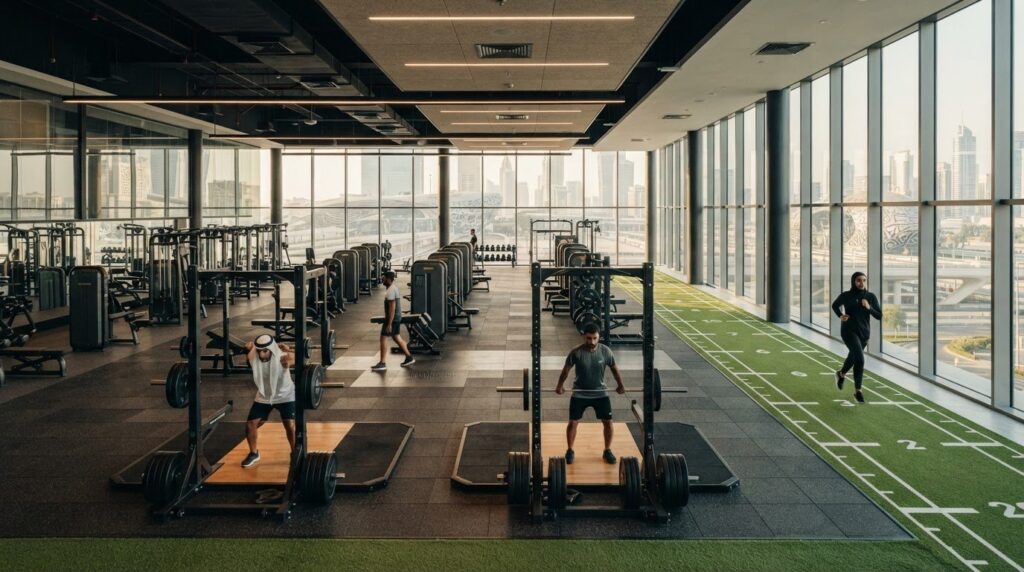
The sleekest equipment brands cannot save a facility built on a fragile foundation. For any modern commercial gym installation UAE operators plan, lasting success does not stem from luxury labels or decorative finishes. It depends on structural floor engineering, intelligent traffic flow, and mechanical endurance. You already know the operational friction: nonstop air conditioning cycles stress electronic consoles, heavy member turnover wears down cables, and poorly isolated drop zones trigger cracked subfloors and acoustic complaints.
Peak-hour bottlenecks between free-weight areas and selectorized stations create frustration and compromise safety. Discover how modern UAE commercial gyms combine engineered sports flooring, biomechanical layouts, and preventative maintenance for peak performance.
From multi-density rubber assemblies that neutralize heavy barbell vibrations to circulation corridors that satisfy life-safety clearances, this guide outlines the physical infrastructure standards required to keep high-capacity facilities operating at full capacity.
Key Takeaways
- Replace congested rows of selectorized machines with dedicated Olympic platforms and turf tracks to match contemporary athletic training demands.
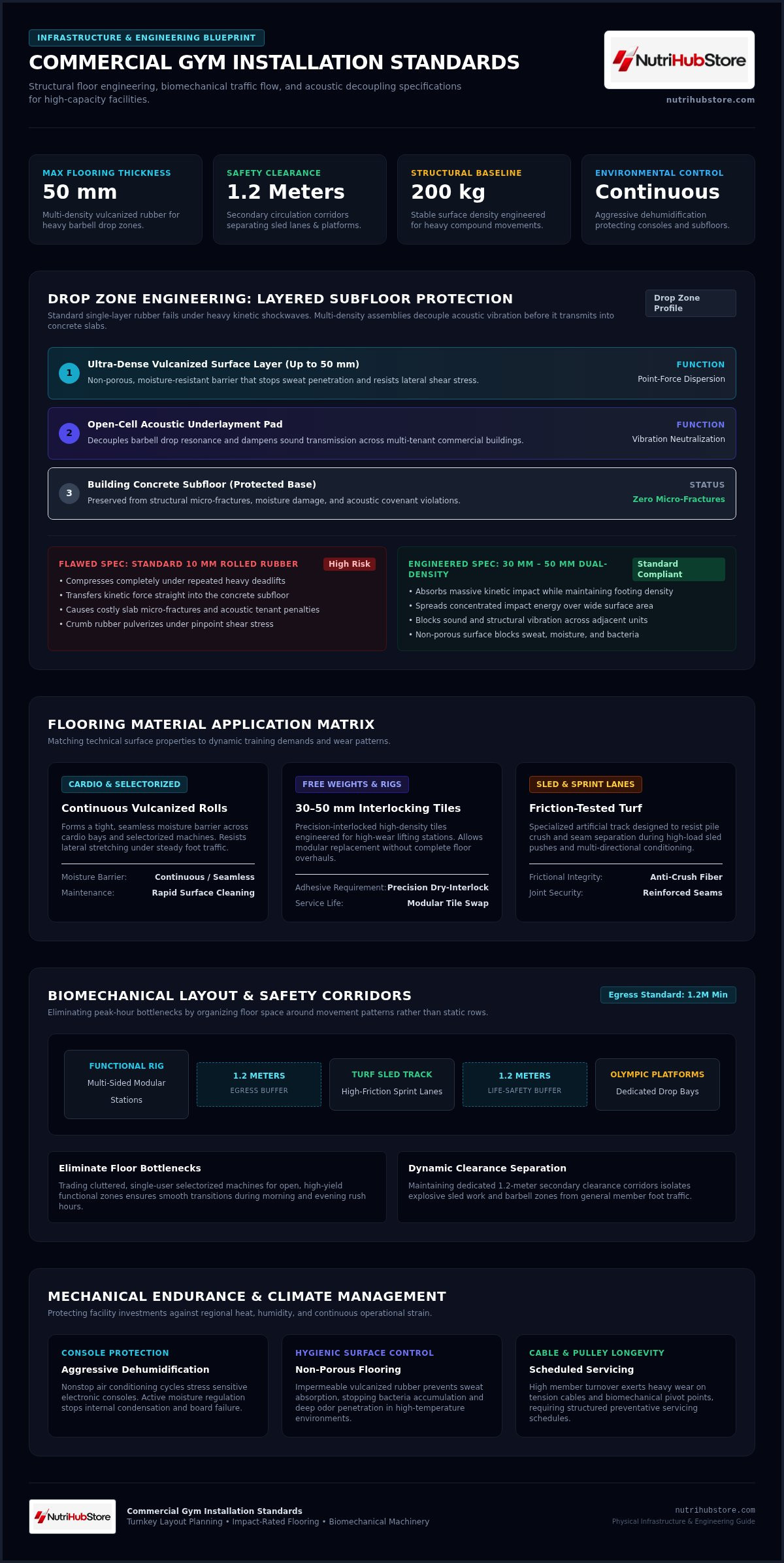
- Deploy multi-density vulcanized rubber up to 50 mm thick in drop zones to protect structural slabs and stop acoustic transmission through commercial buildings.
- Organize training equipment around biomechanical movement patterns while maintaining 1.2-meter egress corridors to eliminate peak-hour floor bottlenecks.
- Protect your commercial gym installation UAE investment against regional heat and humidity by pairing aggressive moisture dehumidification with scheduled preventative servicing.
- Streamline technical execution by sourcing layout planning, impact-rated sports flooring, and machinery through a single turnkey partner.
Modern Commercial Gym Installation UAE: 2026 Facility Shifts
A successful commercial gym installation UAE developers execute today looks radically different from the equipment showrooms of the past decade. High-performance standards in the national fitness market now mandate an intentional balance between structural engineering, spatial efficiency, and equipment durability. Operators cannot simply pack rooms with rows of static selectorized machines.
Modern facilities must withstand punishing morning and evening rushes, where dozens of lifters transition rapidly between heavy compound lifts, sled sprints, and high-intensity intervals. Designing for this reality means trading cluttered floor space for open, high-yield training ground.
The Rise of Hybrid Strength and Conditioning Spaces
Traditional bodybuilding setups consume massive footprints while serving single users at a slow pace. Modern training spaces prioritize open, modular zones featuring multi-sided functional rigs alongside dedicated Olympic lifting stations.
Sled runs and sprint tracks require specialized, friction-tested artificial turf engineered to resist pile crush and seam separation under heavy friction. Because athletic conditioning involves explosive, multi-directional movements, modern commercial gym facility layout planning dictates secondary clearance corridors of at least 1.2 meters to separate dynamic sled lanes from active lifting platforms.
Acoustic Control and Structural Floor Protection
Every dropped deadlift sends seismic shockwaves directly into the building structure. In multi-tenant commercial properties across the UAE, property managers enforce strict noise covenants, penalizing operators whose vibration travels through concrete slabs into neighboring commercial units.
Standard 10 mm rolled rubber fails under continuous heavy impacts. It compresses completely, transferring kinetic force straight into the concrete subfloor and causing costly micro-fractures. Modern facilities install dual-density vulcanized rubber tiles measuring up to 50 mm thick in designated drop zones. These high-density composites absorb impact energy at the surface while decoupling acoustic vibration before it travels into structural framing.
Engineered Fitness and Sports Flooring for Heavy Loads
Sports flooring forms the structural bedrock of every commercial gym installation UAE operators execute. Treating flooring as a cosmetic afterthought destroys subfloors within months. When an athlete drops a loaded barbell, standard crumb rubber pulverizes under pinpoint shear stress, pulverizing the material while failing to prevent concrete degradation beneath.
Performance flooring must solve a difficult physical paradox. It must absorb massive kinetic impact while remaining dense enough to provide stable footing for a 200 kg squat. In our regional climate, surfaces must also be non-porous to resist sweat absorption, bacteria buildup, and moisture-driven odors. You can review how structural engineering integrates with our complete gym setup services UAE operators rely on for facility planning.
Vulcanized Rubber Rolls vs Interlocking High-Density Tiles
Continuous vulcanized rubber rolls provide a tight, seamless moisture barrier across cardio and selectorized strength bays. They resist lateral stretching and clean easily, preventing moisture from seeping under the subbase. High-traffic facilities often pair these with our specialized fitness and sports flooring collections to maintain hygienic surfaces under high member volume.
Dedicated free-weight bays require heavy 30 mm to 50 mm interlocking vulcanized tiles. These tiles offer modular replacement when high-wear lifting stations degrade. High-density tiles withstand intense shear forces without needing wet-set polyurethane adhesives throughout the entire footprint, though they demand precision interlocks to prevent joint separation during sled pushes.
Drop Zones and Subfloor Preservation Mechanics
Single-layer rubber cannot dissipate the kinetic energy of repeated deadlifts. Dual-layer platform assemblies solve this by placing an ultra-dense, force-dispersing top layer over an open-cell acoustic underlayment pad. This sandwich construction spreads concentrated impact energy across a wide surface area, cutting peak vibration transfer.
Managing structural vibration is just as critical as managing ambient air quality under recognized ASHRAE ventilation and indoor air quality standards. Without proper force-dispersal underlayment, shockwaves fracture concrete slabs, triggering catastrophic repairs and tenant lease disputes.
Equipment Zoning: Balancing Biomechanics and Traffic Flow
Cramming maximum machine units onto a floor does not boost profitability. It creates frustrating bottlenecks that drive member churn. A well-engineered commercial gym installation UAE operators execute maps out spatial movement before uncrating a single piece of steel. Proper planning prevents lifters from bumping into moving weight stacks or blocking busy circulation paths during peak evening hours.
High-volume facilities depend on strict spatial hierarchies. Primary egress pathways require 1.2 to 1.5 meters of clear corridor width, allowing smooth transit and accessible wheelchair routing under national life-safety codes. Secondary clearances between individual stations must maintain at least 0.9 meters along moving weight paths to protect passersby from pinch points.
Cardio Station Placement and Ventilation Corridors
Cardiovascular equipment generates intense sensible and latent heat. Line treadmills, rowers, and stair climbers along primary fresh-air delivery routes to keep air circulating across working users. Never push treadmills flush against rear walls; always maintain at least 1.5 meters of clear safety run-off behind the belt to prevent trapped falls. Position cardio banks along exterior glazing to use natural light, which keeps members alert and visually expands the room.
Selectorized vs Plate-Loaded Machine Footprint Planning
Selectorized units operate on compact, predictable footprints. Their enclosed weight stacks and quick pin selections suit fast-paced circuit routines. In contrast, plate-loaded stations require nearly 30% more floor space to account for Olympic plate loading, wide lever arms, and dedicated plate storage trees.
Organize training zones along a logical biomechanical progression:
- Compound Free-Weight Hubs: Position multi-racks and deadlift stations along load-bearing perimeters away from high-traffic doorways.
- Plate-Loaded Leverage Zones: Group plate-loaded presses and rowers in dedicated clusters equipped with their own plate trees to keep walkways clear of loose weight.
- Selectorized Isolation Arcs: Arrange pin-loaded cable units and isolation machines closer to central walkways to manage high member turnaround without disruption.
Preventative Equipment Servicing and Climate Management
Waiting for a cable to snap or a treadmill motor to smoke before scheduling service guarantees operational failure. Relentless outdoor heat and heavy indoor HVAC cycles place continuous thermal stress on workout machinery. A reliable commercial gym installation UAE operators manage requires a rigid preventative maintenance framework, not reactive repairs after an expensive machine breaks down.
Commercial treadmills run significantly hotter in sealed indoor facilities. Continuous member turnover combined with constant room cooling accelerates deck friction, wears down drive belts, and fries internal motor control boards. Daily cleaning routines must strip acidic perspiration from steel components before galvanic corrosion permanently pits polished guide rods.
Managing Ambient Humidity and Dust Infiltration
Facilities must maintain indoor relative humidity strictly between 40% and 60% alongside steady workout temperatures. When humidity spikes, moisture condenses on cold steel frames and slips into sensitive electronic consoles. Fine airborne dust particles also infiltrate cardio motor compartments, forming an insulating layer over inverter drives that traps heat. Technicians must conduct weekly air filter maintenance and motor bay blowouts across all cardiovascular units to prevent sudden board failure.
Routine Cable, Pulley, and Guide Rod Servicing Cycles
Cable cross-overs and selectorized weight stacks endure thousands of repetitions daily. Keep mechanics reliable by enforcing strict maintenance intervals:
- Weekly Cable Audits: Inspect high-tensile aircraft cables for jacket peeling, internal wire fraying, or cable slack. Replace any cable showing outer wear immediately to protect users during heavy loads.
- Silicone Rod Maintenance: Clean steel guide rods daily and lubricate them exclusively with dry silicone spray. Never apply petroleum-based oils, which trap dust and form an abrasive paste that ruins nylon bushings.
- Quarterly Structural Checks: Re-torque frame assembly bolts across rigs, racks, and benches to stop structural shifting caused by persistent harmonic vibrations.
Executing Complete Commercial Facility Setups with NutrihubStore
Sourcing sports flooring from one vendor, strength machines from a second, and technical servicing from a third creates operational friction. Misaligned delivery schedules, disputes over subfloor readiness, and delayed machine commissioning drain capital before opening day. Nutrihub Store eliminates fragmented contracting by providing turnkey commercial facility solutions nationwide, managing every stage from initial layout planning to equipment assembly under a single operational scope.
A cohesive execution protects your physical investment while ensuring every training zone functions smoothly. This unified approach transforms how a modern commercial gym installation UAE operators manage develops from an empty shell into an active performance center.
End-to-End Gym Setup and Flooring Installation Services
Professional installation teams handle precision floor layout marking, subfloor bonding, and heavy machine assembly. Technicians integrate multi-density sports flooring directly beneath power racks and deadlift bays, ensuring level transitions that prevent trip hazards and withstand heavy member volume. Managing flooring installation and workout equipment under one contract eliminates contractor finger-pointing and guarantees structural compliance from day one.
Following installation, ongoing equipment servicing protects the machinery against heavy daily wear. Technicians inspect cable tensions, calibrate selectorized guide rods, and audit moving components, preventing minor mechanical strain from developing into major equipment breakdowns.
Fueling Facility Members with Authentic Sports Nutrition
Leading athletic facilities function as complete performance ecosystems rather than simple machine warehouses. Modern fitness members demand immediate access to authentic sports nutrition to support their strength and recovery goals. Incorporating an on-site nutrition station builds strong member loyalty and establishes valuable recurring revenue streams.
Stocking verified supplements like Kevin Levrone Gold Whey and Ronnie Coleman Creatine XS gives members instant access to reliable training nutrition right off the gym floor. You can explore premium sports nutrition and equipment solutions to unify your athletic facility infrastructure, equipment setup, and member retail strategy.
Build Your High-Performance Facility Foundation
A thriving commercial gym installation UAE operators manage isn’t built by simply scattering weight stacks across an empty room. Long-term facility performance requires multi-density sports flooring that protects concrete subfloors, spatial zoning that keeps traffic flowing during peak training hours, and disciplined preventative maintenance that shields electronics from ambient humidity.
Partnering with a single turnkey provider aligns your CAD layout planning, impact-rated flooring installation, and technical servicing under one contract. Pairing that resilient foundation with authentic sports nutrition creates an environment where members stay consistent and training standards remain high.
Your members depend on reliable equipment and safe platforms every time they step through your doors. Build a space that supports their athletic goals today while safeguarding your infrastructure for years to come.
Frequently Asked Questions
What flooring thickness is recommended for commercial free weight zones?
Free-weight drop zones require high-density vulcanized rubber tiles between 30 mm and 50 mm thick. Thinner 10 mm to 20 mm flooring works well for general cardio or selectorized strength areas, but deadlifts and dropped Olympic barbells demand maximum shock absorption. Heavy multi-density tiles protect the concrete subfloor beneath from micro-fractures while deadening acoustic vibrations that could disturb adjacent tenants in commercial buildings.
How much clearance space is required between commercial gym machines?
Commercial fitness layouts require at least 0.9 meters of clearance around moving weight stacks and lever arms to ensure lifter safety. Primary egress corridors must provide 1.2 to 1.5 meters of clear width to satisfy fire safety and accessibility standards. Proper spacing prevents pinch-point accidents during peak hours and guarantees smooth member flow without traffic jams between adjacent training stations.
How often should commercial gym cables and pulleys be serviced?
High-traffic commercial facilities require weekly cable inspections to detect fraying nylon sheathing or cable stretch before failure happens. Pulleys and guide rods need daily cleaning alongside dry silicone lubrication. Complete hardware torque checks across structural frames should take place quarterly. Establishing a preventative maintenance schedule preserves equipment lifespans and protects members from unexpected mechanical breakdowns under heavy loads.
Can commercial fitness equipment withstand continuous air-conditioned operation?
Commercial equipment handles continuous indoor operation effectively if facility relative humidity stays strictly between 40% and 60%. While climate-controlled indoor spaces shield workout machinery from intense outdoor heat, nonstop air conditioning can circulate fine dust into motor compartments. Regularly vacuuming cardio motor bays and scheduling routine equipment servicing prevents inverter drive boards from overheating during heavy, uninterrupted training sessions.
What is the advantage of turnkey commercial gym installation over individual sourcing?
Choosing a turnkey commercial gym installation UAE package removes vendor conflicts and scheduling delays. Sourcing gym setup, sports flooring, and workout equipment through separate contractors often creates disputes over subfloor readiness and installation timelines. A single-source provider aligns layout planning, floor bonding, machine assembly, and technical maintenance under one contract, ensuring every zone meets commercial safety standards.
Does NutrihubStore install both fitness flooring and commercial workout equipment?
Yes, NutrihubStore provides comprehensive commercial gym installation UAE solutions nationwide. Services cover professional gym setup, impact-absorbing fitness and sports flooring installation, and ongoing commercial equipment servicing. By combining structural flooring execution with heavy workout equipment assembly and authentic sports nutrition supply, NutrihubStore supports your fitness center throughout its operational lifecycle without the headache of managing separate trade contractors.