


The protein that best supports muscle growth isn’t necessarily the one with the most direct research on tendon adaptation. That’s why collagen peptides vs whey protein for tendon and ligament strength isn’t a simple either-or choice, even when conflicting claims make it seem that way.
It’s reasonable to ask whether whey can support connective tissue, whether collagen is worth taking before training, and whether you need another supplement at all. The evidence points to different roles: whey provides complete protein that supports muscle protein synthesis, while collagen supplies amino acids found in connective tissue. Research on collagen and tendon changes is promising, but a supplement cannot guarantee stronger tendons or ligaments.
The practical choice depends on your goal and your overall diet. Consider what each protein can and can’t contribute, where the research has limits, and how exercise and total daily protein fit into the decision. Then choose a straightforward strategy, whether that means meeting your protein needs with food and whey or considering collagen as a targeted addition.
Key Takeaways
- Judge collagen peptides vs whey protein for tendon and ligament strength by their different roles, not as interchangeable powders.
- Separate human research on tendon outcomes from proposed mechanisms and general protein findings before weighing collagen claims.
- Start with your overall dietary protein and training goals. Whey may be a practical way to fill a general protein gap.
- Collagen research is promising, but supplementation does not guarantee stronger connective tissue or replace training.
- Kevin Levrone Gold Whey is one option to consider if you’re looking for whey to support general protein intake.
Why tendon and ligament strength is not just a protein-powder question
A scoop of protein can’t promise stronger tendons or ligaments. These tissues adapt to the forces placed on them over time, and nutrition is only one part of that process. Collagen peptides vs whey protein for tendon and ligament strength is a relevant question, but the answer depends partly on how you train, recover, and meet your broader dietary needs.
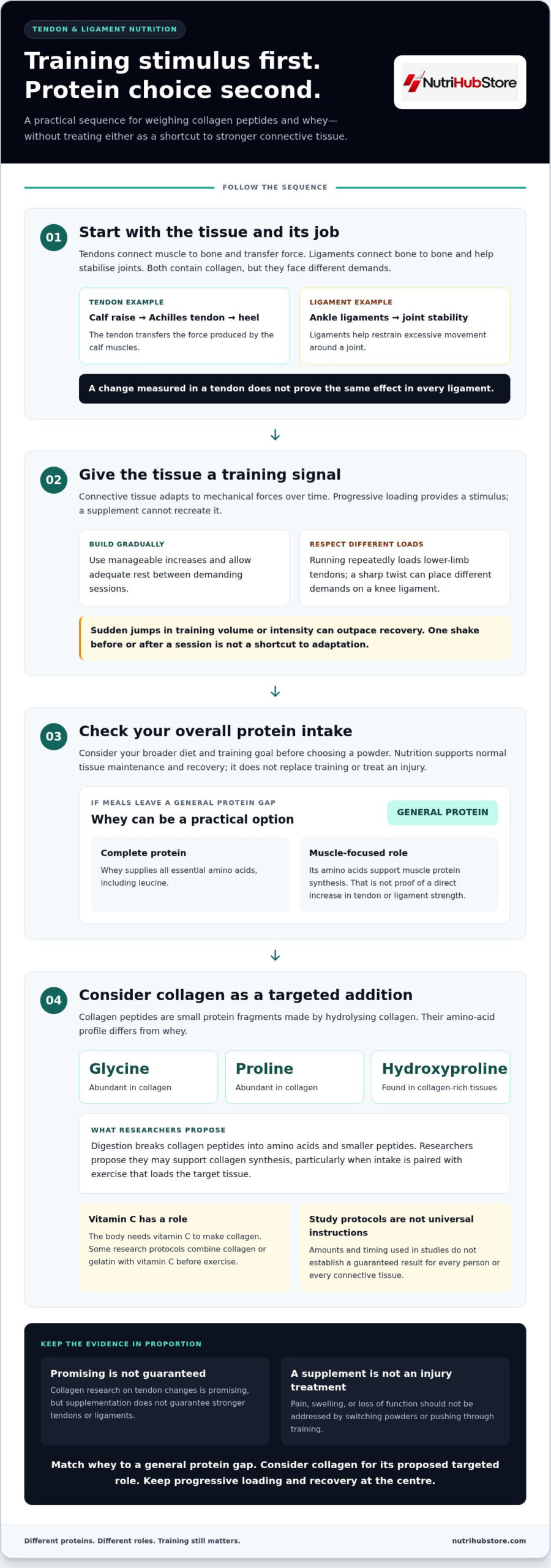
Tendons connect muscles to bones and transmit the force that moves a joint, while ligaments connect bones to bones and help stabilise joints. Both contain collagen, the structural protein that gives connective tissue much of its tensile strength. For background on collagen’s structure and role in connective tissues, see Collagen: The Main Structural Protein.
What tendons and ligaments do during training
During a calf raise, the calf muscles contract and the Achilles tendon transfers that force to the heel. Ligaments have a different job: around the ankle, they help restrain excessive joint movement and support stability. These tissues face different demands, so findings about tendon adaptation shouldn’t automatically be treated as proof of the same effect in ligaments.
Training exposes tissues to mechanical forces, but the type, direction, and amount of force depend on the movement. Running repeatedly loads the lower-limb tendons; a sharp twist can place very different demands on a knee ligament. That distinction matters when reading supplement claims. A study that measures a change in tendon stiffness does not, by itself, show that a supplement strengthens every ligament or prevents injury.
Why protein choice cannot replace progressive loading
Connective tissue needs a reason to adapt. Progressive loading provides that stimulus: training applies an appropriate challenge, then increases it gradually as capacity improves. Sudden jumps in volume or intensity can outpace recovery. A supplement without a suitable loading stimulus can’t recreate the training signal. Adaptation takes time, so a shake before or after one session is not a shortcut to stronger tissue.
Build training around manageable increases and adequate rest between demanding sessions. Nutrition supports the process by supplying energy and protein for normal tissue maintenance and recovery; it doesn’t treat a tendon or ligament injury. If pain, swelling, or loss of function changes how you move, don’t try to solve it by switching powders or pushing through training.
This is the practical filter for the collagen peptides vs whey protein for tendon and ligament strength debate: first consider the training stimulus and recovery your tissues receive, then assess whether your diet supplies enough overall protein. A powder may help fill a dietary gap, but it can’t compensate for poorly managed training load or replace appropriate care for an injury.
How collagen peptides and whey protein work differently
Collagen and whey are both proteins, but their amino-acid profiles point to different nutritional roles. That difference can inform your supplement choice; it doesn’t prove that either powder will strengthen a tendon or ligament. Rather than treating collagen peptides vs whey protein for tendon and ligament strength as a head-to-head contest, ask whether you need general dietary protein or are considering collagen for a more targeted role.
Collagen peptides are small protein fragments produced by hydrolysing collagen, while whey is a dairy-derived, complete protein used to help meet overall protein needs. Collagen contains abundant glycine, proline, and hydroxyproline, amino acids found in collagen-rich tissues. Whey supplies all essential amino acids, including leucine, which helps stimulate muscle protein synthesis. Different ingredients, different roles.
Collagen peptides, amino acids, and collagen synthesis
After digestion, collagen peptides are broken down into amino acids and smaller peptides. Researchers propose that these may support collagen synthesis, particularly when intake is paired with exercise that loads the target tissue. That proposed mechanism is not the same as showing that a supplement directly rebuilds an injured tendon or guarantees a stronger ligament.
Vitamin C also has a defined role: the body needs it to make collagen. Some research protocols combine collagen or gelatin with vitamin C before exercise, but that doesn’t establish a guaranteed result for every person or every connective tissue. The amounts and timing used in studies shouldn’t be treated as a universal prescription.
Whey protein and whole-body protein intake
Whey offers a convenient way to add complete protein when meals don’t meet someone’s needs. Its leucine and other essential amino acids support muscle protein synthesis, the process involved in muscle repair and growth after training. That benefit is relevant to training nutrition, but it isn’t proof that whey directly increases tendon or ligament strength.
Those distinctions matter: collagen is being studied for a possible targeted role in connective-tissue collagen turnover, while whey serves a broader role in supplying complete protein, especially for muscle protein synthesis. Neither description amounts to an injury-treatment claim. UC Davis Health’s overview of research on collagen and whey offers context for separating supplement claims from established outcomes.
Choose based on the gap you’re trying to fill. If you struggle to get enough protein from meals, whey may be a practical option. If you’re considering collagen, weigh the early connective-tissue research against its limits rather than treating it as a replacement for complete protein. Kevin Levrone Gold Whey is one option for general protein needs. You can browse whey protein options as part of your wider nutrition plan.
Collagen peptides vs. whey protein: what the evidence can actually tell you
A change in tendon stiffness is not the same as proof of fewer injuries or stronger ligaments. That distinction matters in the collagen peptides vs whey protein for tendon and ligament strength debate: research on each supplement asks different questions, and the evidence summarized here doesn’t establish a direct head-to-head trial comparing their effects on tendon or ligament strength.
| Protein | Intended role | Evidence type | Key limitation | Practical fit |
|---|---|---|---|---|
| Collagen peptides | Targeted source of collagen-rich amino acids | Human tendon measures, alongside proposed mechanisms | Findings don’t prove ligament benefits or injury prevention | A targeted option to consider alongside loading, with realistic expectations |
| Whey protein | Convenient complete dietary protein | General protein and muscle-related research | Muscle outcomes don’t establish tendon or ligament strength | Useful if it helps meet overall protein needs |
What collagen research does, and doesn’t, show
A 2025 randomized controlled trial studied healthy young men who took 10 g of collagen peptides daily for 16 weeks. Researchers reported increased Achilles tendon stiffness and rate of torque development, a measure of how quickly force can be produced. These are human outcomes, but they don’t show that collagen prevents injuries, repairs a damaged tendon, or produces the same effect in ligaments.
A March 2026 systematic review of eight randomized controlled trials reported evidence that collagen supplementation, particularly alongside resistance training, can increase tendon cross-sectional area and stiffness. These structural measures are relevant, but they aren’t interchangeable with fewer injuries, less pain, or better performance in every setting. Proposed mechanisms, such as supplying amino acids involved in collagen formation, help explain why researchers study collagen; they aren’t outcome evidence on their own. Animal findings also can’t establish the same effect in people.
There’s another limit: the same review found no additional muscle-strength benefit from collagen beyond training alone, consistent with a 2024 meta-analysis that found no significant effect on strength-related performance. Evidence for a tendon measure shouldn’t be stretched into a claim about muscle gains.
What whey research can support
Whey is a complete protein rich in leucine, an amino acid involved in stimulating muscle protein synthesis. That supports its role in meeting dietary protein needs and supporting muscle-related outcomes. But a muscle response isn’t a measurement of ligament strength, tendon structure, or injury risk. Research on general protein intake can inform training nutrition without proving a direct connective-tissue effect.
The evidence doesn’t crown either powder a guaranteed winner for connective tissue. Collagen has promising human tendon findings, while whey has a clearer general role as complete protein. Neither conclusion substitutes for direct comparison data, and neither justifies treating a supplement as a guaranteed route to stronger tendons or ligaments.
How to choose a protein approach for your training and diet
The best supplement choice may be no supplement at all. First identify what your meals and training already cover, then consider whether collagen or whey fills a specific gap. That’s a more useful way to approach collagen peptides vs whey protein for tendon and ligament strength than choosing a powder based on a promise neither can guarantee.
Start with your overall protein intake and training goal
Look at a typical day of meals and snacks before adding another product. Consider your body size, activity level, training demands, appetite, and dietary restrictions. Protein needs vary, so a single daily target won’t fit everyone. If your meals already provide enough protein for your circumstances, another powder may add cost without solving a real problem.
Use this decision sequence:
- Check your food intake. Note where protein comes from across the day and whether a busy schedule or low appetite makes meals difficult.
- Define the goal. For a general protein gap, whey can be convenient. Collagen is a separate consideration if you’re interested in emerging connective-tissue research, not a replacement for complete protein.
- Weigh preference and budget. Choose an approach you can comfortably use and afford over time. If food works for your needs, a supplement isn’t essential.
Whey may help if work or training leaves little time for a protein-containing meal. It’s a practical way to add dietary protein, not a special treatment for a tendon or ligament. Count it as part of your overall intake rather than assuming more is automatically better.
Consider tolerance, dietary preference, and product information
Whey comes from dairy, so it may not suit someone avoiding dairy or who experiences problems with a product’s ingredients. Check the label for the protein source, ingredient list, allergen information, and serving details. Compare those details with your preferences and daily diet. Product information helps you assess fit, but it can’t establish a connective-tissue outcome.
Collagen also has a limitation: it isn’t a complete protein and shouldn’t displace varied sources of dietary protein. If you’re weighing a collagen product, consider whether it’s an optional addition you can justify, not the foundation of your nutrition. Keep the evidence in proportion to your goal.
Persistent pain, swelling, or a suspected tendon or ligament injury calls for assessment by a qualified healthcare professional. A powder can’t diagnose the cause or replace appropriate care. Make nutrition decisions for training support, and treat ongoing symptoms as a separate issue.
A practical next step: match your protein choice to the evidence
A supplement should solve a real nutrition need, not promise a tendon outcome the evidence hasn’t established. For collagen peptides vs whey protein for tendon and ligament strength, the practical distinction is straightforward: consider whey for convenient general protein, and consider collagen only if you understand that its connective-tissue research is promising but limited.
Where whey can fit into an everyday nutrition plan
Whey is an option, not a requirement for every athlete. If meals already provide enough protein for your needs, adding a shake may bring little benefit. If a busy schedule makes a protein-containing meal difficult, a whey product can offer a convenient way to add protein to your daily intake. It supports general nutrition, not a guaranteed tendon or ligament result.
Kevin Levrone Gold Whey is one option for readers exploring whey protein. Before choosing it or another product, compare its label with your dietary needs and preferences. For further background, the Kevin Levrone whey protein science guide can help frame whey’s role in a wider training-nutrition plan.
Choose the next step that fits your goal
Make the choice in this order: identify whether your diet has a protein gap, decide whether a supplement would make it easier to meet that need, then compare products by their ingredient and allergen information. Factor in taste, tolerance, and budget too. A powder you don’t tolerate or won’t use consistently isn’t a practical fit.
If you’re considering collagen, treat it as an optional addition, not a substitute for complete protein sources or a stand-in for progressive training and recovery. Research on tendon measures doesn’t establish that collagen prevents injury or strengthens every ligament. For broader sports-nutrition context, the UAE sports nutrition guide can help you consider supplements alongside your overall approach to training and diet.
The clearest decision is often the simplest: use whey if it helps fill a general protein gap; don’t add collagen just because a claim sounds specific. If neither addresses a genuine need, skip both and focus on meals, training, and rest. Browse options as part of your wider nutrition choices, not as a tendon-specific fix.
Make your next nutrition choice with purpose
Before adding anything new, notice where your current routine works and where it creates friction. Are you missing protein-containing meals because of a packed schedule, or are you drawn to collagen mainly because of a tendon-strength claim? The collagen peptides vs whey protein for tendon and ligament strength question becomes more useful when it helps you identify the difference.
Choose one practical next step: adjust a meal, consider whether a protein supplement would make your routine easier, or hold steady because your current approach already suits you. Tie the decision to your actual diet and preferences, not a promise of a specific connective-tissue result. A supplement should earn its place in your routine by meeting a real need.
If you’re ready to compare sports nutrition options, browse at your own pace and use the product information to guide your choice.
Small, informed choices can make training nutrition clearer. Keep building a routine that supports your goals.
Frequently Asked Questions
Can collagen peptides heal a torn tendon or ligament?
No reliable evidence shows collagen peptides heal a torn tendon or ligament. A suspected tear needs an assessment to identify what tissue is affected and how serious the damage may be; symptoms alone can’t confirm the injury or its grade. Share your training history and when the pain began with a qualified healthcare professional. That information can help guide appropriate next steps rather than leaving you to judge progress by supplement use.
How much collagen should I take for tendon strength?
For everyday use, follow the directions on the specific product label and note how much collagen its serving provides. Don’t assume a larger serving will produce a greater tendon effect, or combine several collagen products without checking their total contribution. If you take regular medication, have a health condition, or are unsure whether a product suits you, ask a qualified healthcare professional before adding it to your routine.
Can I take collagen peptides and whey protein on the same day?
Yes, you can generally take both on the same day if they suit your diet and you tolerate them. There’s no need to combine them in one drink: use each at a time that fits your meals and routine. If a shake causes stomach discomfort, try it separately from other supplements so you can identify which product may be responsible. Check both labels for ingredients and allergen information.
Does collagen count as a complete protein?
No. If you track protein, record collagen separately rather than treating its grams as interchangeable with protein from a complete source. For example, don’t rely on a collagen drink alone to supply the protein in a post-training meal. Build meals around foods that provide a broader amino-acid profile, then decide whether collagen has a separate place in your diet.
Are collagen peptides suitable for vegetarians?
Generally, no. Collagen peptides come from animal tissue, so they don’t meet vegetarian dietary preferences. Check the ingredient list for the source, especially if you also avoid specific animal-derived ingredients for religious or personal reasons. Plant-based products marketed for collagen support may contain nutrients or other ingredients, but their label should make clear what they provide; the phrase “collagen support” doesn’t mean the product contains collagen peptides.
Should I keep training if my tendon hurts?
Don’t continue an exercise that causes sharp pain or makes you alter your movement to get through a repetition. Stop that movement and avoid testing the painful area repeatedly during the same session. If you can train comfortably, choose activities that don’t provoke the symptoms while you monitor how they respond. Seek qualified assessment if pain persists, worsens, or limits normal movement, rather than using a supplement to decide whether training is safe.