


A bigger pump can feel like proof of a better workout, but it isn’t. For a noticeable workout pump, citrulline malate vs l arginine for muscle pumps generally points toward citrulline malate as the more promising option, though neither supplement guarantees a visible or lasting result. A change in blood flow is not the same as better training progress.
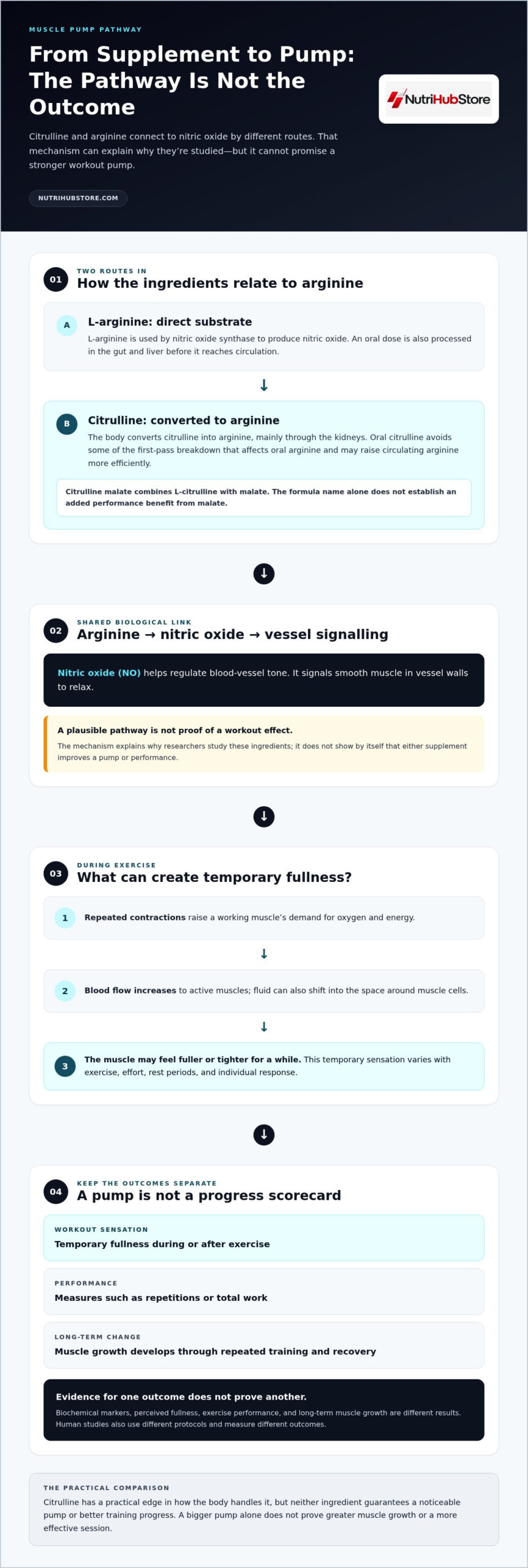
The difference starts with how your body handles each ingredient. L-arginine is used directly in nitric oxide production, while citrulline is converted into arginine and may raise arginine levels more efficiently. That gives citrulline a practical edge, but it doesn’t prove that everyone will feel a stronger pump or perform better.
To compare them, look at the mechanisms, the outcomes human studies measured, and how dose and digestive tolerance may affect your choice. A pump is one workout sensation, not a measure of progress. If you have a health condition or take medication, seek qualified advice before trying either supplement.
Key Takeaways
- A workout pump is temporary. Its intensity does not prove muscle growth or better training progress.
- For citrulline malate vs l arginine for muscle pumps, compare how each relates to nitric oxide and what that may mean for blood flow.
- Human studies use different protocols and measure different outcomes, so promising findings don’t guarantee a noticeable pump.
- Choose based on your goal and personal tolerance, with realistic expectations about what a supplement can change.
- If you have health concerns, review possible risks and medication interactions with a qualified health professional before trying either ingredient.
Citrulline Malate vs. L-Arginine for Muscle Pumps: What a Pump Actually Means
A sleeve-stretching pump can feel satisfying, but it isn’t a scorecard for lasting progress. A muscle pump is a temporary feeling of fullness as blood flow and fluid distribution in working muscles change during exercise. The sensation often fades after training. Exercise physiology reviews, including Joyner and Casey’s review of muscle blood flow during exercise in Physiological Reviews (2015), describe how active muscles receive increased blood flow to meet exercise demands.
What causes the temporary muscle-pump sensation?
As you contract a muscle repeatedly, its demand for oxygen and energy rises, and local blood flow increases. Fluid can also shift into the space around muscle cells during exercise. Together, these changes may make the muscle feel fuller or tighter for a while. The sensation varies with the exercise, effort, rest periods, and individual response.
That short-lived fullness is different from hypertrophy, the longer-term increase in muscle size that develops through repeated training and recovery. It’s also different from a lasting strength gain. A stronger pump alone does not prove greater muscle growth, better workout performance, or a more effective training session. Treat it as one sensation to notice, not a measure of whether you’re progressing.
Why compare citrulline malate with L-arginine?
Both ingredients are linked to nitric oxide, a molecule involved in blood-vessel function. L-arginine is used in nitric oxide production, while the body can convert citrulline into arginine. The Citrulline overview explains this biochemical relationship. But sharing a pathway doesn’t mean the ingredients work equally well as supplements or reliably create a noticeable pump.
That distinction matters when weighing citrulline malate vs l arginine for muscle pumps. A supplement might affect a blood-flow measure without changing how your workout feels. It might also change a reported sensation without improving repetitions, total work, or long-term muscle growth. These are separate outcomes, and evidence for one does not prove another.
A useful comparison goes beyond the label. Consider:
- Mechanism: how each ingredient relates to nitric oxide and blood-vessel function.
- Human evidence: what researchers measured, who took part, and whether the result involved sensation, blood flow, or performance.
- Tolerability and goal: how the supplement sits with you and whether you want a temporary pump or a measurable workout benefit.
Keep those distinctions in mind when assessing claims. A pump can be enjoyable, but lasting results depend on more than how full a muscle feels during one session.
How Citrulline Malate and L-Arginine Relate to Nitric Oxide
A plausible pathway is not a promise of a bigger pump. Both ingredients connect to nitric oxide, but the route a nutrient takes through the body does not show by itself whether it will change your training.
How L-arginine fits into the nitric oxide pathway
L-arginine is a substrate for nitric oxide synthase, the enzyme that produces nitric oxide (NO). NO helps regulate blood-vessel tone by signalling the smooth muscle in vessel walls to relax. That mechanism explains why researchers have studied arginine supplements for blood-flow effects, but taking oral arginine does not automatically produce a measurable workout benefit.
The body processes an oral dose before it reaches circulation, including through metabolism in the gut and liver. In a pharmacokinetic study of healthy volunteers, Schwedhelm and colleagues compared oral L-citrulline and L-arginine, measuring changes in plasma amino acids and markers related to nitric oxide metabolism. The study examined short-term biochemical responses, not muscle pumps or exercise performance. It can inform the pathway, but it does not prove a training effect.
How citrulline may affect arginine availability
L-citrulline can be converted into L-arginine, mainly through the kidneys. Because oral citrulline avoids some of the first-pass breakdown that affects oral arginine, researchers have examined whether it can raise circulating arginine levels more effectively. This difference in how the body handles the ingredients does not prove that everyone will notice a stronger pump.
Citrulline malate combines L-citrulline with malate, a compound involved in cellular energy metabolism. The formula’s name alone does not establish that malate adds a performance benefit or that the combination works better than citrulline on its own. Those questions require human studies that measure relevant outcomes.
The nitric oxide pathway makes a workout effect biologically plausible, but it does not prove that either supplement improves pumps, performance, or muscle growth. That distinction is central to citrulline malate vs l arginine for muscle pumps: biochemical markers, perceived fullness, and completed repetitions are different results. Evidence for one cannot stand in for the others.
When comparing research, check what investigators measured, who took part, and whether the trial tested an ingredient alone or in a blend. If you’re also reviewing other sports nutrition options, browse the sports nutrition supplement range and compare each product’s purpose with your goal.
Citrulline Malate vs. L-Arginine: What Human Evidence Shows
Studies don’t all measure the same thing. A blood-flow marker, a fuller-feeling muscle, more repetitions, and long-term muscle growth are separate outcomes. For citrulline malate vs l arginine for muscle pumps, the key limitation is that the available exercise findings don’t establish that either supplement reliably creates a noticeable pump or builds more muscle.
| Ingredient and study | What researchers measured | What the result can tell you |
|---|---|---|
| Citrulline malate, 8 g before high-volume bench press (Pérez-Guisado & Jakeman, 2010) | Repetition performance and post-exercise muscle soreness | The study reported improved repetition performance and less soreness. It did not establish greater muscle growth or a stronger perceived pump. |
| L-citrulline compared with L-arginine, 6 g daily for 7 days (2015 comparative study) | Exercise tolerance and total work completed | L-citrulline improved these outcomes in the study; L-arginine showed no performance effect. This was not a direct test of citrulline malate or pump sensation. |
| L-arginine in the same comparative study | Exercise performance | The reported lack of effect applies to that protocol and outcome. It doesn’t settle every possible effect on blood-flow markers or every population. |
What studies report about citrulline malate
The bench-press trial by Pérez-Guisado and Jakeman tested citrulline malate, not pure L-citrulline. Its findings give researchers a reason to study the combination for acute exercise performance, but the protocol focused on a particular workout and specific outcomes. The separate 7-day comparison used L-citrulline, so its results should not be treated as proof for citrulline malate. Neither result demonstrates lasting changes in muscle size.
What studies report about L-arginine
The comparative study found no improvement in exercise performance with L-arginine under its tested conditions. That is useful evidence, but it does not prove that arginine can never affect a blood-flow measure. The study summary also does not report whether participants felt a stronger pump. Don’t confuse claims about nitric oxide mechanisms with an athlete-noticeable result.
Perceived pump: The cited exercise findings don’t establish a reliable difference in pump sensation. Muscle growth: These acute or short-term protocols don’t show that either ingredient produces hypertrophy. Study protocols and participant groups also limit how broadly results apply. Match each claim to the outcome researchers actually measured, not just the proposed mechanism.
How to Choose Between Citrulline Malate and L-Arginine
Start with the result you want, not the supplement claim that sounds most impressive. A temporary pump, improved exercise performance, and general interest in nitric oxide are different goals, so they call for different evidence.
Match the ingredient comparison to your training goal
If you’re mainly curious about a pump, remember that it’s temporary. Hydration, exercise selection, rest periods, training effort, and individual response can all affect how full your muscles feel. A stronger sensation in one session does not show that an ingredient improved performance or long-term progress.
If performance matters more, focus on studies that measure outcomes such as repetitions completed or total work, rather than blood markers alone. The research discussed above offers promising findings for citrulline in particular protocols, but it does not establish a guaranteed effect for every lifter. Findings for L-arginine also depend on the dose, population, and outcome researchers tested.
When researching supplements, compare the evidence and exact formula rather than relying on a shared connection to nitric oxide. Neither ingredient replaces progressive training, adequate food, or recovery. For broader context on nutrition and training in the UAE, read this sports nutrition guide.
Consider tolerance, health context, and product labels
Digestive comfort matters. L-arginine can cause gastrointestinal discomfort, particularly at higher doses. A theoretical pathway advantage is of little use if the ingredient doesn’t sit well with you. Responses vary, so don’t assume someone else’s experience predicts yours.
Check the label for the amount of each active ingredient per serving. A prominent front-of-pack claim does not tell you how much citrulline, malate, or arginine the product contains. A blend may make the individual amounts harder to assess. Compare the labelled ingredients with research protocols, while remembering that a matching dose still cannot guarantee the same result.
Cost can be one personal comparison factor, alongside ingredient amount and tolerability, but price alone cannot tell you whether a supplement suits your goal. If you have a medical condition or take medication, speak with a qualified clinician before using either ingredient. This is especially sensible if your treatment affects blood pressure or circulation.
There’s no universal answer to citrulline malate vs l arginine for muscle pumps. Choose based on the outcome you care about, the evidence for that outcome, and how well you tolerate the ingredient. Keep expectations measured and assess any supplement as one small part of your training routine.
A Practical Next Step After Comparing Pump Supplements
Don’t judge a supplement by one unusually full workout. Decide what you want to assess, then use a consistent way to notice a response without treating it as proof of better results.
Set a realistic way to assess your response
Use a simple framework: if your main interest is a temporary pump, track how that sensation feels; if you care about performance, record a workout measure such as repetitions or total work; if you’re researching supplements generally, focus on ingredient amounts, evidence, and tolerability. These outcomes are related, but they aren’t interchangeable.
If you choose to try a supplement, change one thing at a time. Keep your training, meal timing, hydration, and rest periods as consistent as practical. Then note what you took, how the session went, and any unwanted effects. A brief log can help you distinguish a repeatable pattern from normal workout-to-workout variation, though it cannot prove that a supplement caused a change.
Stop using it and seek qualified guidance if you experience concerning symptoms. If you have a medical condition or take medication, speak with a clinician before starting either ingredient. That’s especially relevant if you’re unsure how a supplement could interact with your health needs or treatment.
Keep supplement choices within a broader training plan
The comparison of citrulline malate vs l arginine for muscle pumps has no universal winner. Human studies examine different ingredients, protocols, and outcomes; your own response and digestive tolerance matter too. Choose according to your goal and the evidence for that specific result, not a promise printed on a label.
Neither supplement replaces a well-planned training programme, suitable nutrition, or recovery. If your interest shifts from pump-focused ingredients to another supplement goal, review the evidence for that goal separately instead of assuming one product serves every purpose.
For a measured next step, compare the ingredient information and serving details on a product label with your intended goal. Consider personal cost as one factor, but don’t treat a higher price or a bold claim as evidence of effectiveness. A supplement should fit your plan, not drive it.
Choose Your Next Step With Clear Expectations
A pump is temporary. It cannot confirm muscle growth or prove a supplement improved your workout. Research on citrulline and arginine measures different outcomes, so judge findings by what a study tested, not by a marketing claim.
For citrulline malate vs l arginine for muscle pumps, start with your goal, then weigh the relevant evidence, label details, and your own tolerance. If you decide to test a supplement, change one variable at a time and track pump sensation separately from workout performance. Seek qualified guidance first if you have a health condition, take medication, or experience concerning symptoms.
Keep the basics in place: training, nutrition, and recovery matter more than chasing a temporary sensation. Nutrihub Store retails sports nutrition products for customers across the UAE. Browse its supplement range as you consider options that fit your wider plan.
Make your choice thoughtfully, stay consistent with your training, and let your progress guide what you do next.
Frequently Asked Questions
Which is better for muscle pumps, citrulline malate or L-arginine?
Citrulline malate has the more promising case for exercise-related benefits, but it isn’t guaranteed to create a stronger pump. Research has reported performance changes in some specific protocols, while direct evidence comparing perceived pump sensations remains limited. L-arginine connects to the same nitric oxide pathway, but one exercise comparison did not show a performance benefit. Choose based on your goal, the evidence for that outcome, and your tolerance.
Does citrulline malate increase nitric oxide more than L-arginine?
Not conclusively in terms of nitric oxide itself. Research suggests L-citrulline can raise plasma arginine more effectively than taking L-arginine directly, but a change in arginine levels or a related marker does not prove a larger pump or better workout. Citrulline malate also combines citrulline with malate, so findings on pure L-citrulline don’t automatically apply to the combination. Look for studies that measure the outcome you care about.
Can citrulline malate and L-arginine be taken together?
Some research has tested the combination, but that does not establish that taking both works better for everyone. A study in taekwondo athletes reported improvements in agility and peak power with combined supplementation compared with either ingredient alone or placebo. That result comes from a specific population and protocol, and other evidence reviews question whether combining them adds benefits over citrulline alone. Ask a qualified clinician before combining supplements, especially if you have health concerns or take medication.
How long before a workout should you take citrulline malate or L-arginine?
Studies commonly test citrulline malate 30 to 60 minutes before exercise, often at 6 to 8 grams, but this timing and amount don’t guarantee an effect or suit everyone. The evidence doesn’t establish one reliable pre-workout timing for L-arginine. Study protocols vary, so follow product directions and seek qualified advice if needed. Don’t take more to chase a stronger sensation, particularly if you experience side effects.
Do muscle pumps mean your workout is building more muscle?
No. A pump is a temporary feeling of muscle fullness during or after exercise, while muscle growth develops over time through consistent training and recovery. A strong pump doesn’t prove that you stimulated more growth, and a modest pump doesn’t mean your workout failed. Track training performance and changes over time rather than using how full a muscle feels in one session as your measure.
Can L-arginine or citrulline malate cause side effects?
Yes. Both may cause digestive discomfort in some people. L-arginine can cause nausea or diarrhoea, with higher doses above 9 grams often linked to gastrointestinal effects. Individual responses vary, and a product’s serving size may differ from study protocols. Check the label, don’t exceed its directions, and stop using the supplement if you develop concerning symptoms. Seek qualified health guidance if symptoms persist or you’re unsure whether it’s suitable for you.
Should you take citrulline malate or L-arginine if you use medication?
Check with your doctor or pharmacist before using either supplement if you take medication, particularly if it affects blood pressure or circulation. These ingredients relate to nitric oxide and blood-vessel function, so a possible interaction deserves a professional review based on your medication and health history. Don’t stop or change prescribed treatment to try a supplement. If you have a medical condition, get qualified guidance before starting, even if you feel well.