


BCAAs are not a shortcut to muscle growth, even when supplement labels promise more energy, better recovery, or greater strength. If you already get enough protein from food, a BCAA drink may add less than its label suggests. The benefits of BCAA for workout performance depend on what your diet already provides and what you expect the supplement to do.
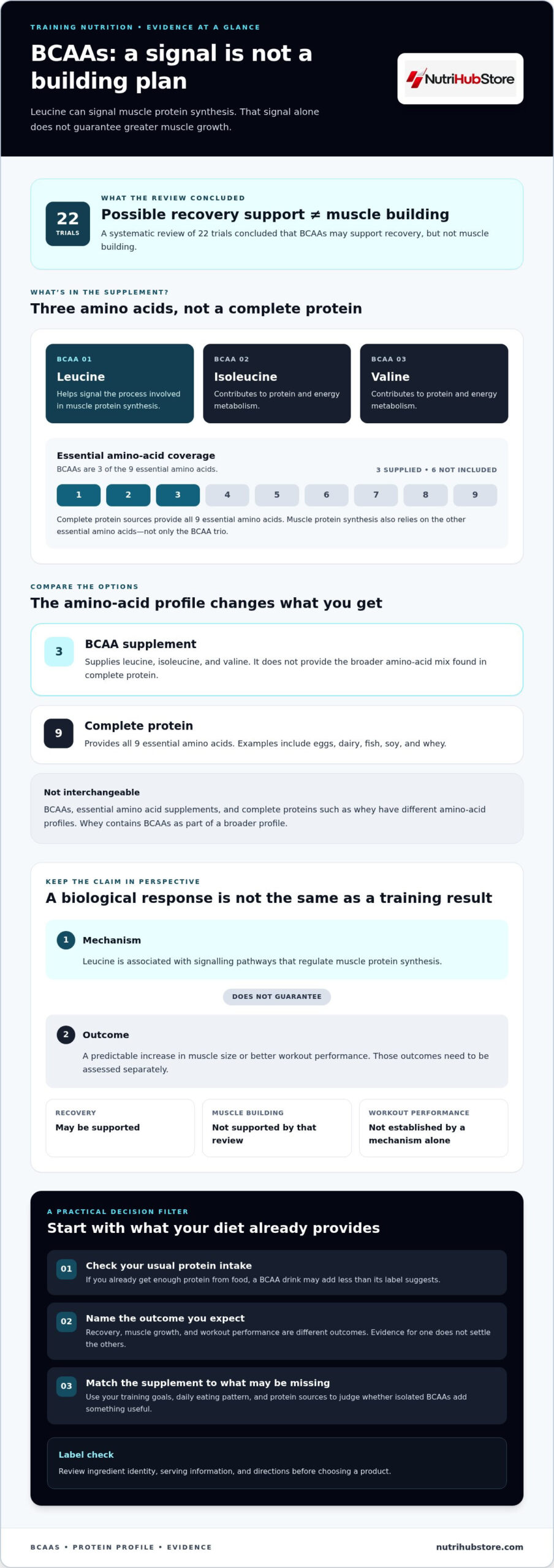
Leucine, isoleucine, and valine are three essential amino acids, but muscle protein synthesis also relies on the other essential amino acids. That’s why BCAAs, essential amino acid supplements, and complete proteins such as whey aren’t interchangeable. The practical question is whether BCAAs add something useful to your training routine, or whether food or complete protein better fits your needs. Focus on your diet and training, not a promise printed on a tub.
Key Takeaways
- Leucine can signal muscle protein synthesis, but that signal alone doesn’t guarantee greater muscle growth.
- Weigh the benefits of BCAA for workout performance against your usual protein intake before adding a supplement.
- BCAAs provide a narrower amino-acid profile than complete-protein foods and options such as whey.
- Use your training goals, daily eating pattern, and protein sources to identify what your routine may be missing.
- Read supplement labels for ingredient identity, serving information, and directions before choosing a product.
What Are BCAAs, and Why Do Workouts Bring Them Up?
BCAAs feature prominently in supplement marketing, but their usefulness depends on your overall diet. They’re not a separate class of protein or a complete nutrition plan. Branched-chain amino acids are leucine, isoleucine, and valine, three members of the essential amino-acid group. Your body can’t make essential amino acids, so you need to get them from food or supplements.
That distinction matters when weighing the benefits of BCAA for workout performance. A supplement can supply specific amino acids, but it can’t replace the broader mix in complete protein. The practical question isn’t simply whether BCAAs have a role in the body. It’s whether taking these three separately adds something useful to your usual diet.
What makes leucine, isoleucine, and valine different?
The term “branched-chain” describes their molecular structure: each amino acid has a side chain that branches off from its main carbon framework. That structural feature gives the group its name, but it doesn’t mean all three have the same job. A concise Branched-chain amino acid overview explains the structure and general roles.
Leucine gets much of the attention because it helps signal the process involved in muscle protein synthesis. But a signal isn’t the same as the raw materials needed to build muscle tissue. Isoleucine and valine also contribute to the body’s protein and energy metabolism, but neither simply duplicates leucine’s signalling role. Treating the three as interchangeable misses what makes each one distinct.
During training, muscle tissue uses amino acids as part of normal protein turnover, and the body can also break down BCAAs for energy. That doesn’t mean a BCAA drink automatically improves a session. The effect of supplementation depends on factors such as what you’ve eaten and whether your overall diet supplies enough protein.
How BCAAs differ from complete protein
A BCAA supplement supplies those three amino acids. Complete protein sources provide a wider selection, including all nine essential amino acids needed to support the body’s protein-building processes. Eggs, dairy, fish, and soy are examples of foods that can provide complete protein. Whey is another option.
For instance, whey protein contains BCAAs as part of a broader amino-acid profile. Choosing it instead of isolated BCAAs may make more sense if you want protein overall, not just three individual amino acids. Kevin Levrone Gold Whey is a complete-protein option available through Nutrihub Store. The right choice still depends on your eating pattern and training goal.
Use sports nutrition guidance as a starting point when comparing supplement categories, then consider what your regular meals already provide. This keeps the decision grounded in your overall diet rather than in a single ingredient on a label.
How Could BCAAs Affect Muscle Protein Synthesis and Exercise?
A biological mechanism can make a supplement sound more convincing than its training results justify. With BCAAs, researchers examine both changes in muscle protein synthesis and whether people actually perform or recover better. Those are separate questions. Evidence for one doesn’t settle the other.
Leucine and the muscle-building signal
Leucine is associated with signalling pathways that regulate muscle protein synthesis. The useful distinction is between a measurable response inside muscle and a change that matters to training progress. Research reviews, including Wolfe’s review in the Journal of the International Society of Sports Nutrition, discuss this mechanism. But the mechanism isn’t proof that taking BCAAs alone produces a predictable increase in muscle size.
A change in a muscle-building pathway is evidence of a biological response, not a guarantee of a visible training result. The outcome still depends on the full training and nutrition context. Judge claims about muscle growth by results over time, not by the proposed mechanism alone.
BCAAs as a possible fuel source during exercise
During exercise, the body can break down amino acids and use them in energy metabolism. Wolfe’s review discusses BCAA oxidation as a possible fuel pathway. But the existence of that pathway doesn’t show that taking BCAAs before or during a session reliably improves performance. The relevant test is whether human training studies consistently find meaningful improvements in outcomes such as work completed, pace, or perceived effort.
Claims about fatigue sometimes refer to a proposed effect on brain signalling during prolonged exercise. That hypothesis isn’t the same as a dependable energy boost, and it shouldn’t be presented as an established performance benefit. Training type, duration, food intake, and study methods can all affect results. A finding in one exercise setting may not apply to a different session or athlete.
Keep the claim narrow. A 2025 systematic review of 22 trials concluded that BCAAs may support recovery, but not muscle building. That conclusion doesn’t establish an endurance benefit or show that every user will feel less tired. It also doesn’t mean the supplement has no possible use. It means the specific outcome matters when interpreting the evidence.
When judging the potential benefits of BCAA for workout use, ask what the study measured and whether that outcome matches your goal. A change in a metabolic process, a report of soreness, and an improvement in training performance aren’t interchangeable results. Keep that distinction in mind as you compare sports nutrition products with your routine.
Do BCAAs Improve Workouts If You Already Eat Enough Protein?
“Improve my workout” can mean a heavier lift, more repetitions, less perceived effort, or feeling ready sooner for the next session. Those are different outcomes. Before judging BCAAs, decide which change you expect and how you’ll measure it. A vague feeling after one workout can’t establish a reliable effect.
When a BCAA supplement may offer limited extra value
If your nutrition is already consistent, it can be difficult to assess a new supplement because training performance naturally varies. Sleep, stress, session difficulty, and exercise selection can all affect how a workout feels. It’s easy to credit a supplement for a strong session, or blame it for a tough one, without enough evidence.
Supplement value depends on whether it changes a specific outcome you can track, not simply on whether you take it. Choose a measure that matches your goal. For strength training, record the weight and repetitions for a familiar lift. For conditioning, note the planned work and how hard it felt. Keep your programme and other habits as steady as possible while you observe the pattern.
A personal log can’t replace controlled research or prove that a supplement caused a change. It can help you spot a repeatable difference, or the absence of one. If your sessions improve while your sleep, training plan, and meal routine also change, you won’t know which factor mattered. Keep expectations modest, and don’t treat one good or bad workout as a verdict.
What the evidence says about soreness and recovery
Soreness is separate from workout performance. Feeling less sore the next day doesn’t automatically mean you lifted more, gained strength, or recovered in a way that improves your next session. Soreness itself isn’t a dependable scorecard for training quality. Ask whether you can complete your planned sessions and progress over time, rather than whether every muscle feels tender afterward.
Research on BCAAs and post-exercise soreness has reported possible benefits, but the findings don’t establish a consistent response for every person or workout. Study results can differ with the exercise protocol, participant group, and way researchers assess soreness. Treat a reported change as a limited finding, not a promise of faster progress. Your training load, rest, and daily routine still matter when you interpret how you feel.
If you already feel well-fuelled and your training is progressing, don’t add a product just to chase an undefined improvement. If you’re curious about the benefits of BCAA for workout performance, set a measurable goal first and judge claims against it. You can also compare sports nutrition products by the specific need each is meant to address.
How to Decide Whether BCAAs Fit Your Training and Nutrition
A supplement choice gets clearer once you name the problem it’s meant to solve. A BCAA product won’t fix inconsistent training, and it may not address a shortfall in total protein. Start with your goal and regular routine, not the timing advice on a tub.
A practical check before considering BCAAs
Use this sequence to work out what, if anything, your nutrition plan needs:
- Name the goal. Are you looking for workout energy, support for recovery, or a convenient way to increase protein? These are different aims. Don’t treat one supplement claim as proof that it covers all three.
- Review a typical training day. Note what you eat around training and across the rest of the day. Include meals, snacks, and protein sources. One unusually busy day may not reflect your normal pattern.
- Find the gap. If you often skip protein-containing meals, the issue may be overall protein intake rather than a lack of BCAAs specifically. If meals already provide a steady supply, isolated amino acids may offer little extra.
- Match the option to the evidence. Consider whether the research relates to your actual goal. A finding about soreness, for example, doesn’t establish improved workout energy or long-term muscle growth.
This check can also reveal practical barriers. Perhaps you struggle to eat before training, or your schedule makes a regular meal difficult afterward. Identify the pattern first, then choose a solution that addresses it. Don’t add a product just because its suggested timing sounds precise.
Food, whey protein, and BCAAs compared
Whole-food protein fits into meals and contributes amino acids as part of a broader diet. Whey protein offers a convenient complete-protein option, providing all essential amino acids. BCAAs are narrower: they supply only leucine, isoleucine, and valine. Each option serves a different role, so your preference, routine, and dietary gap all matter.
If your main aim is to increase your protein intake, whey may be a more direct fit than BCAAs. If you already meet that need through food, a separate protein supplement may not add value either. Whey won’t suit every dietary preference, and whole foods may appeal more to some people. Compare the protein source with your own eating habits instead of assuming a powder is automatically the best answer.
Don’t let timing crowd out the basics. A precisely timed serving can’t compensate for a training plan you don’t follow or meals that routinely fall short of your needs. Focus first on consistent sessions and an overall eating pattern you can maintain. Then decide whether a supplement serves a clear purpose.
What to Do Next: Choose Supplements Based on Evidence
A supplement shouldn’t earn a place in your routine just because it promises a faster workout. Start with a specific need, then check whether the evidence supports that product for that outcome. If you can’t name the problem it solves, pause before adding it.
A sensible supplement decision starts with a specific goal
Decide whether you want to increase daily protein, support recovery, or address a particular training concern. Each goal calls for a different question. If your meals regularly lack protein, a source of complete protein may fit better than a product supplying only selected amino acids. If your diet already meets your needs, an extra supplement may contribute little.
Next, take an honest look at your meals and training. A powder won’t make inconsistent sessions consistent, and careful supplement timing can’t replace a sound eating pattern. Weigh the proposed benefits of BCAA for workout use against your specific goal and the evidence for that outcome, not broad promises about energy, recovery, or muscle gain.
If you have a health condition, are pregnant, or have questions about how a supplement might interact with medication, seek advice from a qualified healthcare professional before using it. General sports-nutrition information can help you compare categories, but it can’t account for your personal health circumstances.
Read the label for information you can act on
Before choosing any supplement, check what it contains and how the label describes its use. Look for the ingredient identity, the amount or serving information provided, and the directions for use. Read the full ingredient list instead of relying on front-label claims. This helps you compare what products provide without assuming that a prominent performance claim guarantees a result.
Then ask whether the product matches the gap you identified. If your aim is to add complete protein, compare protein options by their ingredient and nutrition information. If your aim is different, look for evidence relevant to that outcome. Don’t treat a serving suggestion as proof that a particular dose or timing will improve your training. There’s no universal BCAA dose or schedule established here.
Keep the decision simple: identify the need, check your usual diet, review the evidence for the intended outcome, and read the label carefully. If your meals already cover the need, you may not need another product. If you’ve found a clear gap, compare options that address it directly.
For a measured next step, explore sports nutrition products and choose based on your actual nutrition needs, not a promise of guaranteed results.
Make Your Next Nutrition Choice Count
Your next step doesn’t have to be another supplement. Keep a simple note of your meals, training sessions, and the outcome you care about, then use that record to spot a genuine nutrition gap. This gives the benefits of BCAA for workout performance a practical test: does a targeted amino-acid product address your need, or would another nutrition choice fit better?
Nutrihub Store serves customers across the United Arab Emirates and offers sports nutrition products for a range of training goals, including Ronnie Coleman Creatine XS and Kevin Levrone Gold Whey. Compare options with your own routine in mind, and choose for a clear purpose rather than a promise of guaranteed results.
Build your routine one informed choice at a time. Consistency comes from decisions you can sustain, not from chasing every new claim.
Frequently Asked Questions
Are BCAAs worth taking if I already get enough protein?
For many people, there’s little reason to add them routinely if their protein needs are already met. Before buying a supplement, keep a brief food and training log for several typical days, including rest days. Look for a pattern rather than judging one unusually busy day. The benefits of BCAA for workout performance matter most when they address a specific need, not when they simply duplicate your established routine.
Can BCAAs help build muscle on their own?
Don’t assume BCAAs alone produce a reliable increase in muscle size. If muscle gain is your aim, track your training progress over time, such as whether your programme lets you gradually handle more work with sound technique. That gives you a more useful measure than judging results by how you feel after one serving. If progress stalls, review your training and recovery habits before adding another supplement.
Do BCAAs reduce muscle soreness after a workout?
Some research has tested BCAAs for soreness, but you shouldn’t expect a consistent effect. If you want to assess your own response, record how sore you feel and whether it affects your next planned session. Keep your training routine steady while observing the pattern. That won’t prove the supplement caused a change, but it can help you avoid mistaking one unusually easy or difficult workout for a dependable result.
Can I get BCAAs from food instead of supplements?
Yes. A varied eating pattern can provide BCAAs through ordinary protein-containing meals, so a separate supplement isn’t the only way to get them. Note which meals reliably include a protein source and where your routine tends to fall short, such as during a busy workday. This can help you plan meals around your schedule instead of assuming you need a particular food or supplement.
Is it safe to take BCAAs every day?
Daily use can’t be declared safe for everyone. Check the product’s ingredient information and follow its directions rather than increasing use based on training intensity or advice from a friend. If you have a medical condition, are pregnant, or take medication, ask a qualified healthcare professional before using BCAAs. If you experience an unexpected reaction after taking a supplement, stop and seek appropriate medical advice.
Do BCAAs give you more energy during a workout?
Don’t count on BCAAs as a reliable energy boost. If your sessions feel flat, first note when the feeling occurs, how long the session lasts, and whether it happens repeatedly or only after a demanding day. That pattern can help you identify whether your routine needs attention. A supplement’s possible role in energy metabolism doesn’t establish that it will improve your workout performance.
Are BCAAs the same as essential amino acids?
No. The terms describe different product categories, so check the ingredient panel rather than relying on the front label. A BCAA product lists three specific amino acids; an essential-amino-acid product lists a wider set. Compare that information with the outcome you want and your existing nutrition routine. This simple label check helps prevent choosing a product that doesn’t match the category you intended to buy.