


“Unflavored” doesn’t guarantee a powder will disappear into a recipe. Even without added flavoring, whey can affect sweetness, thickness, and texture. The best unflavored whey protein isolate for clean cooking and smoothies is the one that suits the foods you actually make.
If you’ve hesitated over a label or ended up with a lumpy smoothie, your caution makes sense. “Clean” is a preference, not a precise product standard, and ingredient lists differ. Check what’s included, then consider how the powder mixes before choosing it for a particular recipe.
This guide explains how to compare label details and assess whether an isolate suits smoothies, batters, or other cooked dishes. You’ll also learn how mixing methods and heat can affect results, and what to check before buying. Nutrihub Store lists whey and protein among its categories, but a specific unflavored isolate isn’t confirmed. Verify current product details rather than assuming it’s available. Start with the label, then match the powder to your kitchen routine.
Key Takeaways
- “Unflavored” means no added flavoring, not necessarily a completely neutral taste. Check the ingredient list before adding a powder to delicate recipes.
- Compare isolate, concentrate, and plant-based powders by their labels, including declared protein per serving, allergens, and serving directions.
- Match the powder to its use. Cold blending and cooking can produce different textures, so test a small amount in your recipe first.
- Use this checklist to choose unflavored whey protein isolate for clean cooking and smoothies: set ingredient priorities, inspect the label, match the intended use, then test.
- NutrihubStore lists whey and Kevin Levrone Gold Whey, but check current inventory and product details before assuming a specific unflavored isolate is available.
What “Unflavored Whey Protein Isolate” Means for Everyday Recipes
A powder labelled “unflavored” can still leave its mark on a smoothie or batter. The label describes added flavoring, not a promise of zero taste or identical results in every recipe. For practical use, the ingredient list and nutrition panel matter more than the wording on the front of the pack.
Whey protein isolate is a dairy-derived protein ingredient made by processing whey to separate protein from other components. Whey isolate is more extensively processed to separate protein from other whey components, while concentrate retains a different mix. Neither name alone tells you a product’s exact composition. For background on whey and its forms, see What is whey protein.
“Clean” doesn’t have one universal meaning in this context. It’s a personal way to describe ingredient preferences, not a regulated quality grade. One shopper may prioritise a short ingredient list; another may want to avoid particular sweeteners or gums. Decide which ingredients matter to you before comparing products, rather than treating “clean” as proof of a specific standard.
How isolate differs from whey concentrate
Isolate and concentrate come from whey, but manufacturers process and formulate them differently. The resulting ingredients and nutrition details can vary from product to product, including among powders in the same category. Don’t assume every isolate has the same composition or that every concentrate behaves alike in recipes. Compare each product’s ingredient list and nutrition panel instead of relying on the category name.
What “unflavored” does and does not tell you
Unflavored generally indicates that the product has no added flavoring. It doesn’t guarantee tastelessness, and it doesn’t tell you how smoothly the powder will mix into a specific food. Even a simple recipe can make subtle dairy notes more noticeable. Likewise, a powder that works in a cold drink may not give you the texture you want in a cooked mixture.
Read the full ingredient list. Check specifically for sweeteners, added flavors, gums, and other ingredients that could affect your recipe or conflict with your preferences. Then consider the manufacturer’s serving directions and test a small amount in the food you plan to make. That’s a more reliable way to assess whether unflavored whey protein isolate for clean cooking and smoothies fits your kitchen than choosing by the word “clean” alone.
How Whey Isolate Behaves in Smoothies and Cooked Food
A smooth shake and a tender pancake put powder through different conditions. Cold blending combines whey isolate with liquid and other ingredients. Cooking exposes it to heat, which can change the protein’s structure and affect a recipe’s texture. It doesn’t make the protein disappear, but it can change how the finished food feels.
Adding powder gradually to liquid gives it a chance to disperse, which can reduce dry pockets and clumps. That simple step can help, but no method guarantees the same result with every powder or recipe. Start with a small portion before using the powder in a full batch.
Adding unflavored isolate to smoothies
If clumping is an issue, blend the powder with some of the liquid first, then add thicker ingredients. Fruit can bring sweetness and pulp. Yogurt and oats can make a smoothie thicker, sometimes enough to need more liquid. Add liquid a little at a time and blend again until the texture suits you. The amount needed depends on the powder and the other ingredients.
Using whey isolate in cooked recipes
Pancakes, baked goods, and foods stirred on the hob are possible applications to test, not guaranteed uses for every product. Mix the powder into the wet ingredients, or first whisk it into a small portion of cool liquid, then combine it with the recipe. Follow the product’s directions, and avoid tipping powder straight into a hot mixture where it may disperse unevenly.
Heat can alter whey proteins’ structure, while the recipe’s moisture and other ingredients also influence the finished texture. A batter may turn out denser or firmer than expected. Don’t replace flour or another ingredient one-for-one. They serve different functions, and that swap can throw off the recipe’s balance. Test a small batch and adjust the formula based on the result.
The most reliable way to assess unflavored whey protein isolate for clean cooking and smoothies is to test it in the exact drink or dish you plan to make. Check manufacturer directions alongside the ingredient and nutrition panels. If you’re comparing available whey options, review the whey products in the shop and confirm each product’s details before choosing it for a recipe.
How to Compare Unflavored Isolate with Other Protein Powder Options
A category name can narrow your search, but it can’t tell you how a powder will taste or behave in your recipe. Compare the actual label first, then test the product in the smoothie or dish you plan to make.
| Powder type | What to compare on the label | Recipe considerations |
|---|---|---|
| Whey isolate | Ingredient list, declared protein per serving, milk allergen information, and serving directions. | Check for an explicitly unflavored option. Dairy-derived taste may still come through, and recipe texture depends on the product and ingredients. |
| Whey concentrate | Review the same details. Formulations and declared nutrition can vary between products. | Don’t assume it will taste or mix like an isolate. Test it in the recipe you intend to use. |
| Plant-based protein | Check the listed protein sources, any other ingredients, declared protein per serving, allergens, and directions. | Taste and texture vary by product and source. Try a small amount before using it in a full recipe. |
The table is a comparison framework, not a ranking. Use each product’s own label. Serving sizes can differ, so compare declared protein per serving alongside the stated serving directions rather than assuming the category tells the whole story.
Which powder suits a neutral-tasting smoothie?
Start with a label that explicitly says “unflavored,” then scan the full ingredients for sweeteners or added flavoring. The dairy taste may still be noticeable, especially in a smoothie with mild-tasting ingredients, so blend a small test portion before making a larger drink. If you’re considering a flavored whey instead, NutrihubStore’s Kevin Levrone whey protein guide may help you review that separate option, but it doesn’t confirm an unflavored isolate.
Which powder suits cooking and baking?
For a cooked recipe, ingredient simplicity is only one part of the decision. Consider how the powder mixes into the actual food. A powder stirred into a cool mixture faces different conditions from one baked into pancakes or other goods. Follow the manufacturer’s directions, and test any recipe changes in a small batch. Don’t assume one powder will work the same way in every formula.
To assess unflavored whey protein isolate for clean cooking and smoothies, weigh label details against the job you need it to do. NutrihubStore lists whey and protein, but a specific unflavored isolate isn’t confirmed. Browse current protein options and verify each product’s label and directions before choosing it for a recipe.
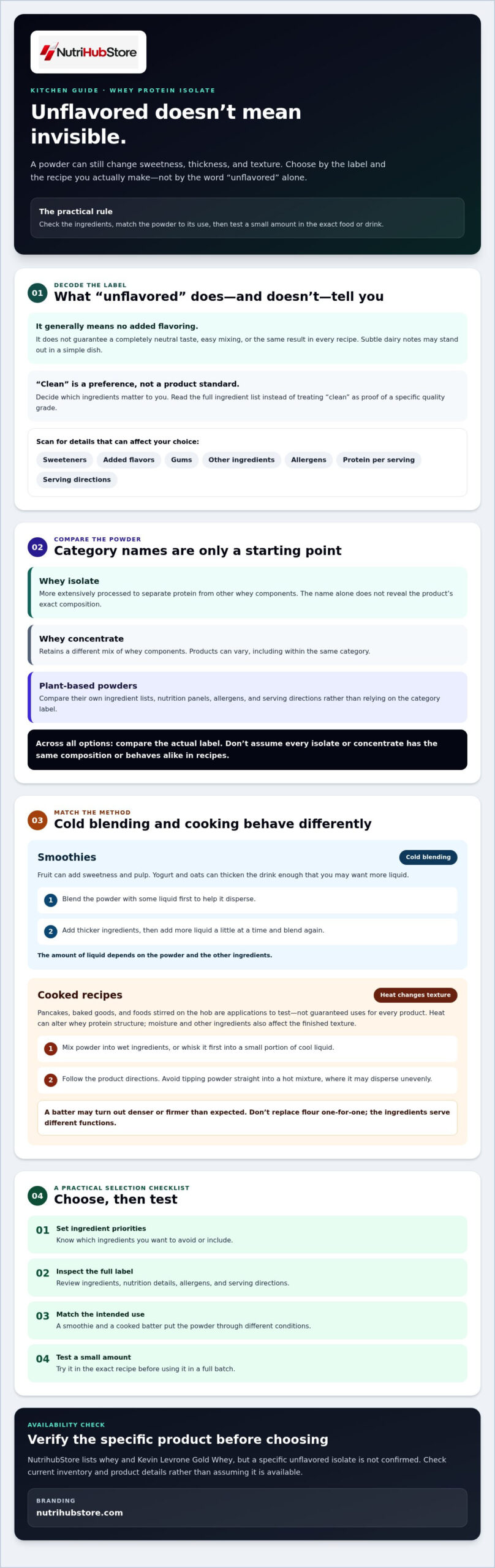
Checklist for Choosing Unflavored Whey Protein Isolate for Clean Cooking and Smoothies
A short ingredient list won’t tell you whether a powder will suit your smoothie or turn your pancake batter dense. Use this checklist to judge the label and the kitchen results separately.
- Define your ingredient priorities. Decide which ingredients you want to include or avoid, such as added sweeteners or gums. “Clean” is a personal preference, so set your own criteria.
- Inspect the full label. Confirm that the front says “unflavored,” then check the ingredients, nutrition panel, allergen statement, and manufacturer’s serving directions. Don’t rely on the product name alone.
- Match the powder to your routine. Think about whether you’ll blend it cold, stir it into food, or bake with it. Choose based on the recipes you make most, not a broad promise that one powder works in everything.
- Test before changing a regular recipe. Try a small portion and note the taste, texture, and mixing. Adjust the recipe only after you see how the powder behaves.
Read the label before judging the product
Compare nutrition panels on the same serving basis where the product information allows it. Serving sizes can differ, so look at both the declared protein per serving and the stated serving size. There’s no single protein threshold that makes a powder right for every kitchen routine.
Whey is dairy-derived. Review the allergen statement carefully, especially if you need to avoid milk due to an allergy, and follow the manufacturer’s storage and preparation directions. For any product, check the package details and available manufacturer information rather than relying on a retailer description alone. For broader guidance on buying protein powder in the UAE, look for a guide that explains how to check product labels and seller details.
Match the product to your recipe routine
A powder that blends into a cold smoothie may not behave the same way in food stirred on the hob or baked in the oven. Test it in the recipe you actually plan to use, since heat, liquid, and other ingredients can affect texture. Note whether it mixes evenly and whether its taste changes the dish. Make small adjustments first. Don’t overhaul a familiar recipe based on an untested assumption.
Use the same approach to assess unflavored whey protein isolate for clean cooking and smoothies: check the label, match the intended use, then test a small amount. NutrihubStore lists whey and protein, but a specific unflavored isolate isn’t confirmed. Verify current product details before choosing.
Finding a Suitable Protein Option at NutrihubStore
A product’s name isn’t enough to confirm that it’s unflavored or suitable for cooking. NutrihubStore lists whey and Kevin Levrone Gold Whey, but the available product information doesn’t verify either as an unflavored whey protein isolate. Check the live listing and label before treating any product as a match.
What to verify in the current shop listing
Before naming a specific option or describing how it may work in a recipe, confirm its exact product name and current availability. Then check the label and manufacturer information for:
- Flavor designation: Does the product explicitly say “unflavored”?
- Full ingredient list: Are there sweeteners, flavoring, gums, or other ingredients you want to avoid?
- Nutrition and allergen details: What does the nutrition panel declare per serving, and what allergen information appears?
- Preparation guidance: What serving, mixing, storage, or recipe directions does the manufacturer provide?
Use the live product information as your source. A category name or short product description can leave out details that matter for your ingredient preferences or intended recipe. If the current listings don’t show a clearly identified unflavored isolate, say so plainly rather than presenting a different whey product as an equivalent.
Choose with realistic expectations
Even a verified unflavored powder may not taste or mix the same way in every smoothie and cooked dish. A cold blended drink, a stirred food, and a baked recipe each put the powder into different conditions. Manufacturer directions can guide preparation, but they don’t confirm that a product will produce your preferred texture in every formula.
Once you’ve checked the product name, flavor, ingredients, nutrition panel, allergen information, and directions, you can browse the NutrihubStore shop for current options. The right unflavored whey protein isolate for clean cooking and smoothies is one whose verified label fits your ingredient priorities and whose performance you’ve tested in the foods you actually make.
Compare current product labels against your usual recipes, then test a small portion before making any powder your regular choice.
Choose by the Label, Then Test It
The right powder isn’t simply the one marked “unflavored.” Check its ingredients, nutrition panel, allergen information, and manufacturer directions, then judge how it tastes and mixes in the recipe you actually make. Small-batch testing helps you avoid changing a favourite smoothie or baking formula based on guesswork.
That’s the practical way to choose unflavored whey protein isolate for clean cooking and smoothies: define your ingredient priorities, compare product details, and see how the powder performs in your kitchen. “Clean” is personal, and no category label can promise identical results across different recipes.
NutrihubStore lists sports nutrition products, including Kevin Levrone Gold Whey. Check current inventory and product labels before assuming an unflavored isolate is available or describing any product as suitable for cooking.
Choose with care, try a small portion first, and let the label and your own recipe test guide your next step.
Frequently Asked Questions
Is unflavored whey protein isolate completely tasteless?
No, unflavored whey protein isolate isn’t necessarily tasteless. “Unflavored” generally means the product isn’t sold with added flavoring, but whey itself can have a noticeable dairy taste. Formulas also differ, so don’t assume one powder will taste neutral in every dish. Check the full ingredient list and try a small amount in a smoothie or recipe before making it part of your regular routine.
Can you cook or bake with whey protein isolate?
Yes, some recipes can include whey isolate, but results depend on the product, heat, moisture, and other ingredients. Heating changes protein structure. It doesn’t mean the protein simply disappears. Follow the manufacturer’s directions and test a small batch before adapting a favourite recipe. Avoid replacing flour or another ingredient one-for-one unless that specific recipe has been tested, since the swap can change the food’s texture and structure.
How do you add unflavored whey isolate to a smoothie without clumps?
Blend the powder with some of the liquid first, then add thicker ingredients and adjust the consistency gradually. A blender or shaker may help disperse the powder, but neither guarantees a smooth result with every formula. If clumps persist, try a smaller amount or change the order in which you add ingredients. Powders and recipes vary, so use a small test rather than assuming every isolate mixes alike.
Is whey isolate better than whey concentrate for cooking?
Neither type is automatically better for every recipe. Isolate and concentrate are different product categories, but their ingredients, nutrition panels, taste, and mixing behaviour can vary by manufacturer and formulation. Compare the actual labels and consider whether you’ll use the powder in a smoothie, stirred food, or baked recipe. For a specific dish, a small test batch gives more useful information than choosing by category name alone.
What should I look for in an unflavored whey protein isolate label?
Confirm that the product is explicitly described as unflavored, then read the full ingredient list rather than relying on front-label wording. Compare declared serving information on a consistent basis, review allergen details, and follow the manufacturer’s preparation directions. For unflavored whey protein isolate for clean cooking and smoothies, also define what “clean” means to you, such as avoiding particular ingredients, before comparing products.
Does NutrihubStore sell unflavored whey protein isolate?
NutrihubStore’s product information confirms whey options, including Kevin Levrone Gold Whey, but doesn’t confirm a specific unflavored whey protein isolate. Check the current product listing and full label before deciding. Don’t assume a named whey product is unflavored or an isolate unless its live product information explicitly confirms both. Product details and inventory can change, so verify them when you shop.
Can people with lactose intolerance use whey protein isolate?
Whether a person with lactose intolerance can use a whey product depends on individual tolerance and the specific product. Its name alone can’t establish suitability. Check the ingredient and allergen information, and ask a qualified healthcare professional for personal medical guidance. NutrihubStore doesn’t provide medical consultations, and no whey product should be assumed suitable for everyone. If you’re unsure, get advice before adding it to your routine.